
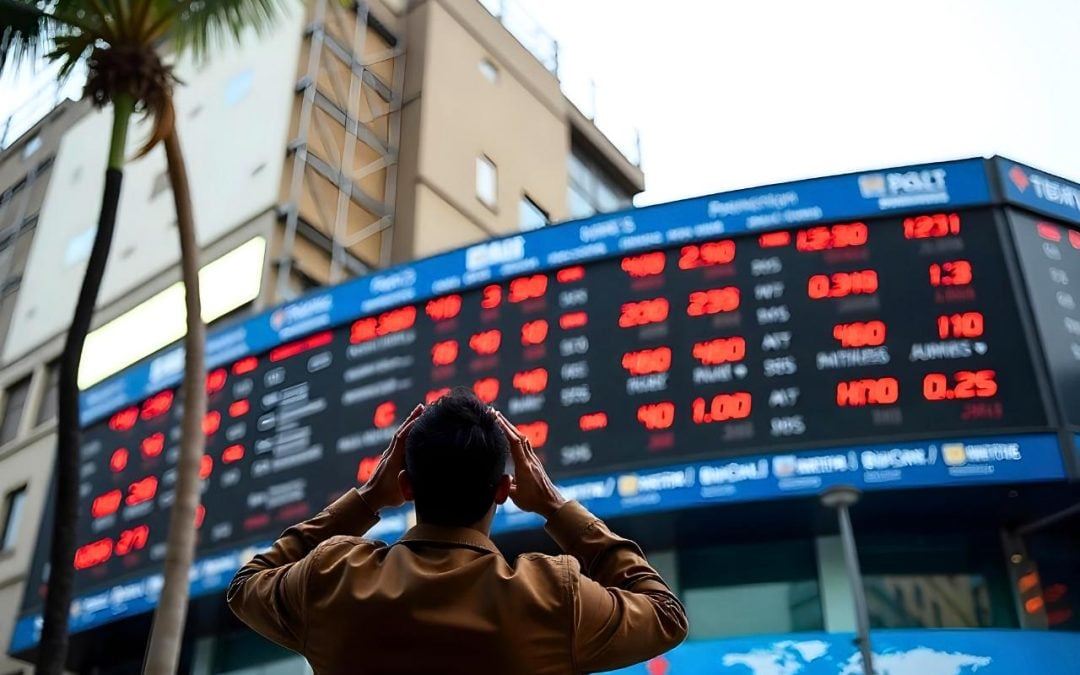
Synopsis: A $315 billion sector is bleeding. Foreign funds are fleeing at a record pace, AI is rewriting the rulebook, and India’s IT giants are asking a question they never expected to face.
For decades, Indian IT was the country’s most reliable wealth creator – the sector that turned software engineers into millionaires and built world-class companies out of Bengaluru, Hyderabad, and Pune. It was the answer to every question about India’s global ambitions. Then 2025 arrived, and everything changed. Now, in 2026, the sector finds itself at the most uncertain crossroads in its history – battered by foreign selling, shaken by artificial intelligence, and squeezed from all sides. The Nifty IT index is the worst-performing sector of 2026, down roughly 25% from January 2026 level.

The Perfect Storm Hitting Indian IT
There is no single villain in this story. The Indian IT crash has been a slow-motion collision of at least four forces arriving at the same time, each one damaging enough on its own, but together capable of reshaping the entire sector.
The first force is artificial intelligence. The most powerful and arguably most structural reason driving foreign selling is the fear that generative AI will fundamentally undermine Indian IT’s core business model. For decades, Indian IT firms built dominant global positions based on labour arbitrage – deploying large armies of skilled workers. That model is now under threat. AI is expected to cause roughly 2–3% annual deflation in traditional IT services revenues over the next couple of years. When Anthropic, OpenAI, and Palantir publish announcements about automating tasks that Indian IT firms used to bill by the headcount, global investors take notice – and then they sell.

The second force is the American client. The US, which accounts for more than half of revenues at most large Indian IT firms, has seen softer deal pipelines, while uncertainty surrounding immigration and tariffs persists, and geopolitical conflicts further delay long-term technology spending decisions. Clients are not cancelling relationships – they are simply pausing, reviewing, and delaying big commitments. That caution has shown up directly in earnings. India’s top five IT firms are expected to post muted revenue growth of about 3-4% in the near term, a far cry from the double-digit growth years that made this sector a market darling.
The third force is the visa policy. The broader Indian IT industry continues to face challenges from proposed visa fees of up to ₹95 lakh (approximately $100,000) per H-1B application. For companies that depend on deploying Indian engineers at client sites in the United States, this is not a minor regulatory footnote – it is a direct hit to margins and delivery flexibility.

The fourth force is the rupee and the US dollar. Higher US bond yields, now above 4% in dollar terms, have made developed market assets more attractive compared to emerging markets. The rupee’s slide has further eroded returns for foreign investors, making it doubly painful to stay invested in India.
The FII Exit: How Bad Is It?
The numbers are staggering. Between January 2024 and December 2025, cumulative FII outflows exceeded $46 billion from Indian equities, pushing FPI ownership in NSE-listed companies to 16.9% – the lowest in over 15 years. And 2026 has been even sharper. FIIs sold nearly ₹1.98 lakh crore between January 1 and April 30 of 2026 – a pace that already rivals the full-year outflow of ₹2.4 lakh crore seen in all of 2025.
Within that broader exit, IT has been a specific target. In February 2026 alone, FPIs pulled out ₹16,949 crore from IT stocks – a seven-month high – even as they turned net buyers of ₹22,615 crore overall in Indian equities that month. That divergence is telling. Foreign investors are not just broadly selling India – they are specifically reassessing Indian IT as a structural story.

The Floor That Has Held
Here is the surprising part: the market has corrected, but it has not collapsed. As of March 2026, DII ownership in Indian equities has climbed to a record 18.9% of total market capitalisation, while FII ownership has fallen to 14.7% – a 14-year low. This is the first time in modern Indian capital market history that domestic institutional investors own more of India Inc than foreign ones do.
In March 2026, DIIs nearly quadrupled their purchases to offset the FII exit, absorbing the selling pressure almost entirely. SIP contributions barely moved – the worst month for markets was also the month with the highest SIP contribution of the entire period. That is the structural shift that is keeping things from turning into a full-blown crisis. India’s domestic investor base – built on years of SIP habit-formation – has become a shock absorber that simply did not exist a decade ago.
Is the Worst Over?
The honest answer is: probably, but not certainly. The Nifty IT P/E ratio has dropped to levels below its one-year and two-year historical averages, and many analysts now view this as a “deep value” zone where downside is limited compared to historical norms.
The longer-term bull case is also intact. AI will not erode the global IT revenue pool overnight. We are currently in a “Show Me the Money” phase – the market has aggressively priced in the threat of disruption but has yet to value the potential of Indian firms as global AI orchestrators. Companies like TCS, Infosys, and Wipro are not standing still. They are retraining hundreds of thousands of engineers, building AI practices, and repositioning from labour-arbitrage vendors to AI-delivery partners.
Analysts expect a gradual improvement rather than an immediate reversal. If the US Federal Reserve turns accommodative and the dollar softens, emerging markets, including India, could see renewed allocations. India’s structural story – demographics, digitisation, and capital expenditure – remains unmatched.
The sector that built India’s Silicon Valley is not going away. But it is going through a reckoning – and the investors who come out ahead will be those who understand that what looks like a crash is also, quietly, a reset.
Disclaimer: The views and investment tips expressed by investment experts/broking houses/rating agencies on tradebrains.in are their own, and not that of the website or its management. Investing in equities poses a risk of financial losses. Investors must therefore exercise due caution while investing or trading in stocks. Trade Brains Technologies Private Limited or the author are not liable for any losses caused as a result of the decision based on this article. Please consult your investment advisor before investing.