
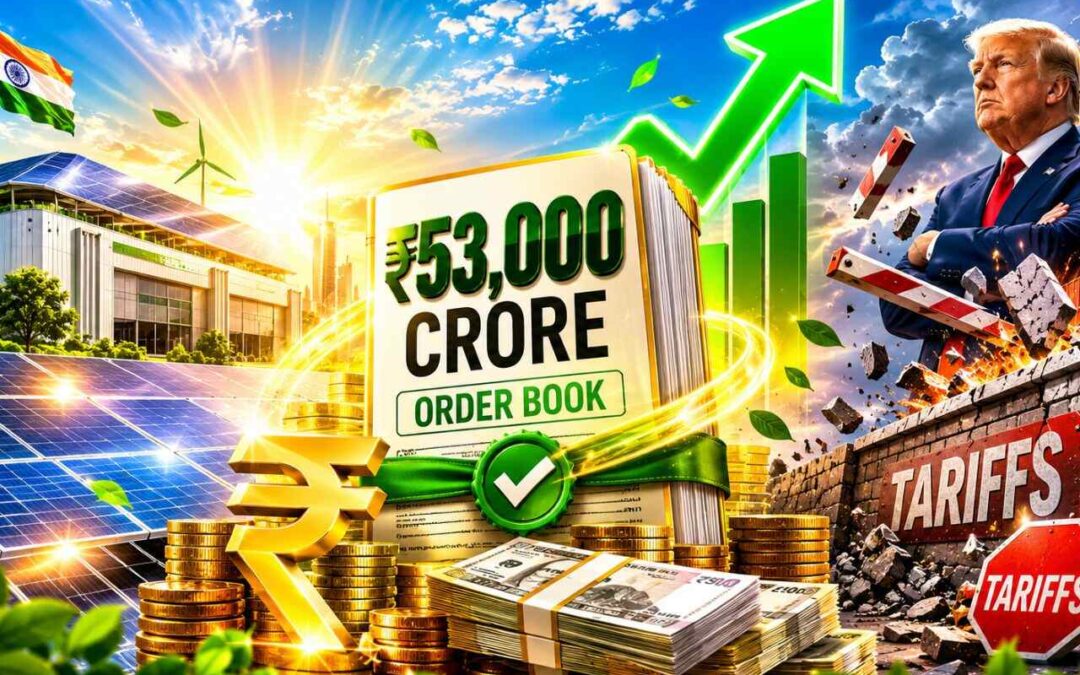
Synopsis: U.S. tariffs effectively stacked a 234% trade penalty against Indian solar imports, threatening Waaree Energies’ international growth. Yet, as the market braced for a collapse, this BlackRock-backed company executed a series of high-stakes logistical manoeuvres, involving localising manufacturing, shifting cell sourcing to compliant corridors, and securing a $1.6 billion polysilicon partnership in Oman, successfully insulating its Rs. 53,000 Crore order book from political volatility.
When Donald Trump returned to the White House, he put the renewable energy sector directly in his crosshairs. By freezing multi-billion-dollar clean energy grants and stacking trade penalties into a massive 234% tariff wall, his administration engineered what should have been a terminal blow to international solar manufacturers, creating a near-impossible market for international renewable players trying to survive in the United States.

On paper, what was designed as a systematic crackdown on clean-tech imports ultimately revealed a massive loophole. By re-engineering its global logistics, this BlackRock-backed powerhouse completely outmanoeuvred the administration, proving that real corporate intelligence can comfortably outlast shifting political agendas and transform what should have been a terminal trade barrier into an unassailable corporate moat.
The Trump Mantra “Drill, Baby, Drill”
When Donald Trump took the oath of office, global climate policy didn’t just slow down—it was thrown into reverse. On day one, carrying the momentum of his trademark campaign chant, “drill, baby, drill,” the administration signed an executive order pulling the US out of the Paris Climate Agreement for the second time.

The political spotlight shifted entirely back to fossil fuels. Federal agencies smoothed the path for oil, gas, and coal, while the president publicly dismissed massive renewable installations as land-devouring and inefficient. But the real shockwave hit the financial backbone of America’s clean energy boom: the Inflation Reduction Act (IRA).
For a long time, the solar industry’s biggest enemy was market anxiety. Renewable tax credits were notoriously unpredictable, extended by Congress for only a year or two at a time. The IRA changed the game by replacing that chaos with a guaranteed, ten-year horizon. It offered a 30% Investment Tax Credit, providing the exact long-term predictability developers needed to fund multi-billion-dollar mega-projects.

Also, developers could pocket an extra 10% bonus credit if they sourced their solar components from factories built inside America. It instantly created a massive, hungry market for domestic solar modules.
Then came the legislative hammer. By passing the targeted restructuring mandates, informally dubbed the “One Big Beautiful Bill Act,” the administration pulled the rug out from under the sector. The law abruptly required that wind and solar projects be fully operational by December 31, 2027, to claim their remaining tax credits, effectively killing the economics of long-term utility pipelines. Downstream, consumer and commercial EV tax credits were wiped out entirely.
Behind the scenes, executive orders froze billions in unspent green energy grants and loan guarantees. While the capital legally existed on paper, the Treasury Department quietly tightened regulatory definitions, trapping active projects in indefinite financial limbo. The message from Washington was clear: the green party was over.

The Global Tariff Storm and the Stacking of AD/CVD
As domestic green incentives dried up, the trade borders turned hostile. The administration initially rolled out a universal 10% baseline tariff on global imports. But when geopolitical tensions flared over India’s continued sourcing of discounted crude oil from Russia, Washington weaponised its trade policy.
By late 2025, steep reciprocal and punitive duties slammed a crushing 50% aggregate tariff on the majority of Indian exports. Though an intense bilateral agreement eventually negotiated that baseline floor down to 18% in exchange for a massive $500 billion purchase pledge of American goods, a much more surgical strike was waiting for solar.
While macro trade deals were being hammered out, a coalition of domestic US solar manufacturers quietly petitioned the Department of Commerce for protection against foreign competition. The resulting regulatory rulings paralysed Indian solar exports.
In early 2026, Washington dropped a preliminary 125.87% Countervailing Duty (CVD) on Indian solar imports, claiming that India’s domestic manufacturing incentives, like the Production Linked Incentive (PLI) scheme, acted as unfair government subsidies that allowed local players to crash market prices.
Less than two months later, the Department of Commerce dropped its second weapon: a preliminary 123.04% Anti-Dumping (AD) duty, declaring that Indian solar cells were being “dumped” into the US below fair value.
Crucially, these two penalties didn’t replace one another. They stacked directly on top of each other, pushing the total trade penalty to a staggering, impossible 234%. In a little over twelve months, the United States transformed from India’s most lucrative export destination into a heavily fortified trade fortress. It forced international suppliers into a brutal corner: either retreat and flood the Indian domestic market, or find a brilliant way around the wall.
Waaree’s Great Escape: Engineering a Counter-Strategy
Amidst this industry-wide wreckage, Indian solar giant Waaree Energies remained remarkably unfazed. Armed with a fortress-level order book of Rs. 53,000 Crore and a wider forward pipeline stretching past 100 GW, the company’s executive leadership team began quietly executing a masterclass in supply chain architecture. While competitors were getting caught in the regulatory dragnet, Waaree bypassed Trump’s multi-layered tariff walls using three highly sophisticated manoeuvres.
1. The Country-of-Origin Pivot
The crushing 234% tariff penalty had a very specific technical vulnerability: it was targeted at solar panels utilising Indian-made cells. To navigate this, Waaree utilised an established US Customs precedent dating back to 2012, which dictates that a solar panel’s legal country of origin is determined by where the cell is manufactured, not where the final module is assembled.
Waaree promptly stopped using Indian-fabricated cells for its US export lines. Instead, they routed their cell sourcing through select Southeast Asian corridors and alternative global pipelines—such as Ethiopian cell routes—where import tariffs remained low. These compliant cells are shipped directly to their assembly lines, allowing the finished modules to sail cleanly through US Customs entirely untouched by the punitive India-centric duties.
2. Radical Localisation
Realising that the US border would always remain volatile, Waaree decided to move inside the fortress. They transitioned from being an international exporter to a local, domestic US manufacturer.
Today, Waaree operates a 1.6 GW module manufacturing plant in Houston, Texas, and is actively scaling its localised US footprint up to 4.2 GW over the coming months. By establishing local manufacturing, they not only insulate themselves from shifting import tariffs but also put themselves back in a position to claim the lucrative domestic manufacturing bonuses left over from the IRA.
To lock this moat in permanently, they are already executing plans to build an independent, fully localised solar cell plant on US soil, ensuring their components are 100% compliant with America’s strict non-FEOC (Foreign Entity of Concern) sourcing laws.
3. The Oman Polysilicon Masterstroke
Even if a company manages to bypass tariffs, the ultimate logistical nightmare for solar exporters remains the US Uyghur Forced Labour Prevention Act (UFLPA). The US Customs routinely impounds shipments if the raw polysilicon used to make the wafers can be traced back to China’s Xinjiang region.
To build an airtight, completely auditable, non-Chinese supply chain, Waaree looked to the Middle East. Through its US arm, the company injected a $30 million strategic equity investment into United Solar Polysilicon in Oman’s Sohar Freezone.
This isn’t a pilot project on paper; the $1.6 Billion complex has officially transitioned into commercial production. Boasting a massive capacity of 100,000 tons per annum, the plant produces enough ultra-pure polysilicon to potentially fuel 40 GW of solar manufacturing every year.
Backed by a long-term offtake agreement, this move guarantees Waaree a structural supply of certified clean, non-Chinese raw material, completely decoupling its premium US export pipeline from geopolitical border risks.
Securing the Home Front: Waaree 2.0
Waaree Energies, through its “Waaree 2.0” initiative, is committing ~ $3.5 billion over the next two years to transform from a traditional solar manufacturer into a fully integrated energy transition powerhouse. Driven by a projected $4 trillion global market opportunity by 2035, the company’s aggressive roadmap relies on a two-pronged strategy, the deep vertical integration and sweeping horizontal expansion.
Waaree is dedicating $1.3 billion to vertical integration, which includes scaling up to massive 28 GW module and 15 GW cell facilities, backed by a 10 GW ingots and wafers plant, 2,500 TPD of solar glass capacity, and a strategic investment in a 100,000 TPA polysilicon facility.
At the same time, the company is diversifying into high-value clean-tech ecosystems. This horizontal expansion includes a $1.1 billion investment in a 20 GWh Battery Energy Storage System (BESS) plant and a $75 million outlay for a 1 GW green hydrogen electrolyser facility. They are rounding out the ecosystem with a 4 GW inverter plant, a 20,000 MVA transformer facility, and a dedicated transmission and distribution (T&D) arm.
Looking ahead, Waaree Energies has set an ambitious path to scale its topline to a peak revenue of Rs. 1 Lakh Crore by FY30, a 4x leap from the Rs. 26,537 Crore generated in FY26. This exponential growth trajectory is anchored not just in volume but in a deliberate transition from a module-maker to an integrated energy powerhouse.
Orderbook Overlook
The sheer scale of this backlog gives Waaree highly predictable long-term revenue streams. Its firm order book of Rs. 53,000 Crore marks a clear climb from Rs. 47,000 Crore in the previous fiscal year. Roughly 65% to 70% of these contracts are long-range overseas commitments scheduled for delivery over a three-to-four-year horizon, with over 90% of those exports heading straight to the premium US market.
To buffer against sudden global macro shocks, Waaree’s management has carefully protected its flank. First, they’ve written regulatory “pass-through clauses” into their major overseas agreements, legally shifting unexpected tariff burdens onto the American buyers. Second, they have nurtured a massive domestic retail channel. Entirely excluded from the institutional order book figures, Waaree’s retail segment surged 84% in FY26 to bring in Rs. 5,515 Crore in revenue, acting as a powerful cash-flow cushion right at home.
The BlackRock Bet
BlackRock is one of the largest foreign institutional shareholders in the company. It initially acquired its position during Waaree Energies’ Rs. 4,300 Crore IPO, by investing Rs. 31.75 crore through the anchor book via the BlackRock Institutional Trust Company.
Believing in the company’s prospects, BlackRock Inc. holds a direct 1.77% stake representing 50.78 Lakh equity shares, while carrying additional cross-border exposure via its iShares ETF ecosystems. With Waaree’s equity performance tracking its rapid operational growth, where FY26 revenues reached Rs. 26,537 Crore (+84% YoY) and net profits doubled to Rs. 3,884 Crore, BlackRock’s collective stake has grown to a valuation of over Rs. 2,100 Crores.
Conclusion
The dynamic between Washington’s trade policies and Waaree Energies demonstrates that global market shifts can bypass political roadblocks through deliberate operational planning. The administration’s parallel tariffs and funding freezes were designed to protect domestic fossil fuels by restricting foreign clean-tech competition. For many international manufacturers, these barriers effectively closed off access to the American market.
Yet, Waaree navigated the chaos by pairing institutional support with an adaptable supply chain. The company protected its Rs. 53,000 crore order book by bringing module assembly onto US soil, shifting cell production to compliant trade routes, and securing non-Chinese raw materials from Oman. Ultimately, this move proves that a well-architected global supply chain can successfully detach a company’s growth from the unpredictability of shifting political agendas
Disclaimer: The views and investment tips expressed by investment experts/broking houses/rating agencies on tradebrains.in are their own, and not that of the website or its management. Investing in equities poses a risk of financial losses. Investors must therefore exercise due caution while investing or trading in stocks. Trade Brains Technologies Private Limited or the author are not liable for any losses caused as a result of the decision based on this article. Please consult your investment advisor before investing.