
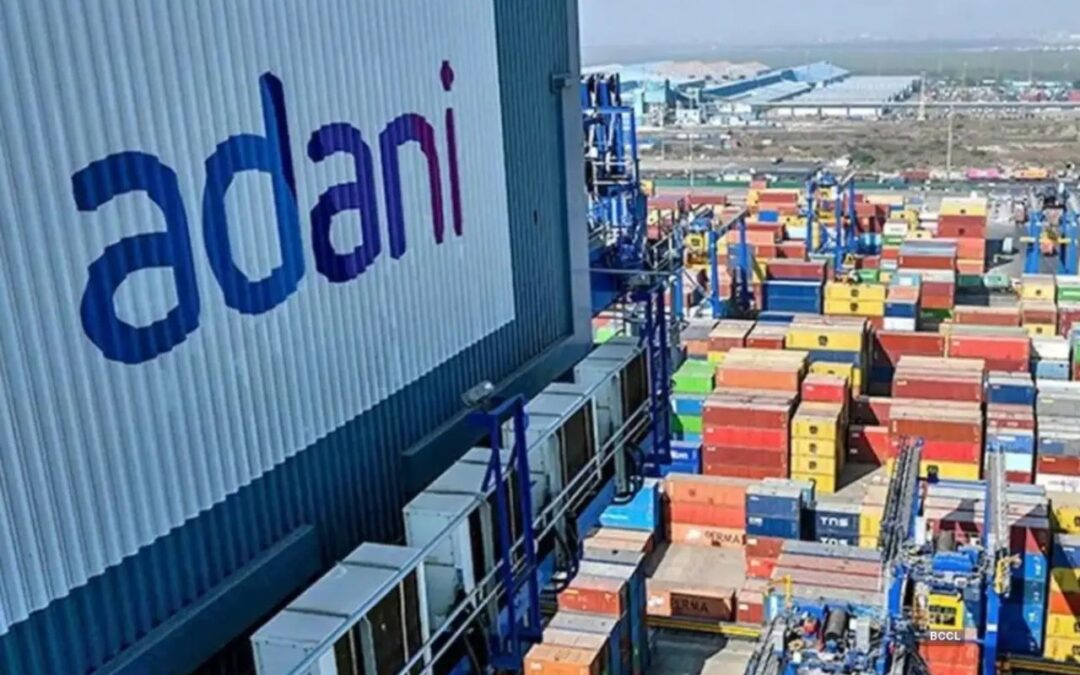
Synopsis: India’s largest private port operator has agreed to sell a 49 percent stake in its flagship transshipment terminal to the investing arm of the world’s largest shipping line, in a deal valuing the port at USD 2.85 billion and unlocking roughly USD 1.4 billion for the parent company. The structure keeps the port consolidated on the seller’s books while shifting a meaningful share of future capital expenditure onto the new partner, though the cash arrives in two tranches tied to deal closing and a 2028 construction milestone.
A leading Indian port and logistics operator came into focus after disclosing a definitive agreement to sell a minority stake in one of its newest and fastest-growing terminals to a global shipping conglomerate’s terminal investment arm. The company filed the disclosure with the exchanges on June 30, 2026, alongside a media release and investor presentation detailing the transaction.

With a market capitalization of approximately Rs. 4,17,131.79 crore, the shares of Adani Ports and Special Economic Zone Limited were trading at Rs. 1,810 per share, up 1.91 percent from its previous closing price of Rs. 1,776.10 apiece. It is trading at a P/E of approximately 32.67.
Adani Ports has signed a Share Purchase and Subscription Agreement with Mundi Limited, a subsidiary of Terminal Investment Limited (TiL), the container terminal investing arm of Mediterranean Shipping Company, under which TiL will acquire a 49 percent interest in Adani Vizhinjam Port Private Limited (AVPPL).

The transaction values AVPPL at USD 2.85 billion, with TiL’s proportionate share working out to USD 1.397 billion, split into two tranches: roughly USD 539 million for the 49 percent equity stake itself, and a further USD 858 million tied to TiL’s 49 percent participation in funding the port’s expansion through construction debt and equity ahead of a December 2028 completion target. Adani Ports retains 51 percent ownership, keeps majority board control, and will continue to consolidate AVPPL as a subsidiary, meaning the deal does not remove Vizhinjam’s revenue from the company’s reported topline.
That last point matters more than it might appear. Because AVPPL stays consolidated, Adani Ports will keep booking 100 percent of Vizhinjam’s revenue and EBITDA in its financial statements, but going forward 49 percent of the port’s net profit will be carved out as a non-controlling interest before it reaches shareholders. Investors reading future quarterly results should expect Vizhinjam’s contribution to consolidated revenue to look unchanged while its contribution to profit attributable to Adani Ports shareholders shrinks by nearly half. The filing discloses AVPPL’s income for FY26 at Rs. 843.19 crore against a net worth of Rs. 2,813.98 crore, but does not break out the port’s standalone profit or loss, so the near-term earnings impact of that NCI carve-out cannot be precisely sized from this disclosure alone.

Strategic Context and Financial Impact
The more immediate financial story is the cash. USD 1.397 billion translates to roughly Rs. 11,700 crore at current exchange rates, a sum that arrives without Adani Ports issuing new equity or taking on incremental parent-level debt. The structure effectively gets TiL to co-fund Vizhinjam’s capacity expansion from 1.6 million to 5.7 million TEUs, a project carrying a stated capex of USD 1.75 billion, rather than leaving Adani Ports to fund that build-out alone. For a port that only began commercial operations in December 2024 and is still ramping toward full utilisation, sharing expansion capital with a partner that also happens to be the world’s largest container shipping line reduces both the funding burden and the commercial risk of the next phase.
This is Adani Ports’ third strategic partnership with TiL, following the 2013 joint venture at Mundra’s Container Terminal 3 and the 2023 tie-up at Ennore. Those two precedents offer a useful, if mixed, reference point. Mundra’s TiL joint venture handled 3.2 million TEUs in FY26, marginally down from 3.3 million in FY25, while Ennore’s smaller joint venture grew from 682,000 to 701,000 TEUs over the same period. Neither shows the explosive growth Vizhinjam has posted in its first eighteen months, but both have operated as stable, ongoing partnerships rather than one-off capital events, which is the more relevant precedent for judging execution risk on this deal than the headline volume narrative in the company’s own presentation.
For retail investors, the practical takeaways are threefold. First, this transaction strengthens the balance sheet without diluting existing shareholders, since the capital comes in at the subsidiary level rather than through a parent company rights issue or share sale. Second, the cash is not unconditional: Tranche 1 depends on customary regulatory approvals closing the deal, while Tranche 2, the larger of the two at USD 858 million, depends on Vizhinjam’s expansion actually being completed by December 2028, a four-and-a-half-year construction timeline that carries the usual risks of cost overruns or delays common to large port infrastructure projects.

Third, the stock already trades at a rich valuation near 32 times trailing earnings, which means the market has priced in continued execution on growth assets like Vizhinjam; this deal supports that execution case but does not, by itself, change near-term consolidated earnings per share.
Business Overview
Adani Ports’ near-term growth case rests on converting capacity additions like Vizhinjam’s phase two expansion into cargo volume ahead of its stated 2030 target of one billion tonnes of throughput, with partnerships like this one intended to accelerate ramp-up through MSC’s global routing rather than purely organic demand. Execution on the December 2028 expansion timeline, and how quickly Vizhinjam’s profitability scales once expanded capacity comes online, will determine whether the deal’s financial logic plays out as intended.
Incorporated in 1998 and headquartered in Ahmedabad, Adani Ports and Special Economic Zone Limited is India’s largest private port operator, running 15 domestic ports alongside four international port assets and an integrated logistics network spanning rail, warehousing, and road transport. For the year ended March 2026, consolidated revenue rose to Rs. 38,736 crore from Rs. 30,475 crore a year earlier, while net profit grew to Rs. 12,782 crore from Rs. 11,061 crore, even as total borrowings increased to Rs. 63,566 crore from Rs. 51,621 crore to fund the company’s expansion pipeline. Promoter holding stood at 68.02 percent as of March 2026.
Disclaimer: The views and investment tips expressed by investment experts/broking houses/rating agencies on tradebrains.in are their own, and not that of the website or its management. Investing in equities poses a risk of financial losses. Investors must therefore exercise due caution while investing or trading in stocks. Trade Brains Technologies Private Limited or the author are not liable for any losses caused as a result of the decision based on this article. Please consult your investment advisor before investing.