
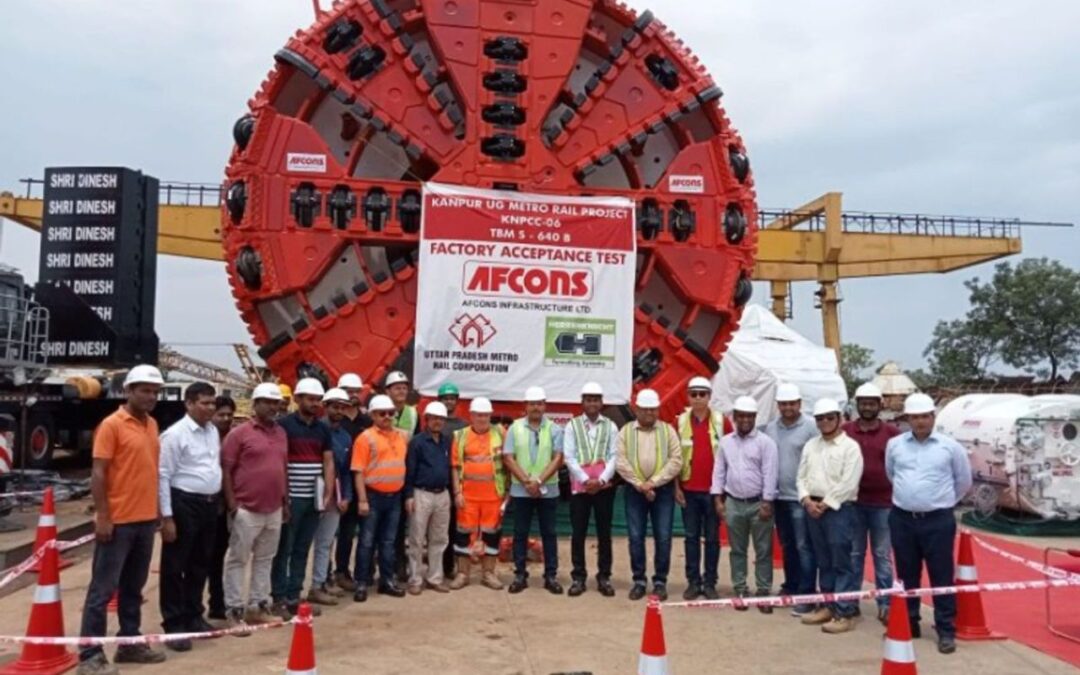
Synopsis: An infrastructure contractor has secured a favourable arbitration award of Rs. 148.67 crore over a long-running dispute tied to a Kashmir rail tunnel project, alongside an order to release a bank guarantee held against the contract. The award lands just weeks after the company posted a net loss for the March quarter, and its eventual cash impact depends on whether the counter-party, typically a government railway body in disputes of this kind, chooses to challenge it in court.
A leading Indian infrastructure engineering and construction company came into focus after disclosing a favourable arbitration award relating to a tunnel project executed in Jammu and Kashmir. The company filed the disclosure with the exchanges on June 30, 2026, confirming the award amount and a related direction on collateral held against the contract.

With a market capitalisation of approximately Rs. 11,485.91 crore, the shares of Afcons Infrastructure Limited were trading at Rs. 312.30 per share, down 1.12 percent from its previous closing price of Rs. 315.55 apiece. It is trading at a P/E of approximately 46.33.
An Arbitral Tribunal has granted Afcons an award of Rs. 148.67 crore relating to claims arising from the construction of Tunnel T74-R, a 3,290-metre balance work package between Km 127/660 and Km 130/950 on the Dharaam-Qazigund section of the Udhampur-Srinagar-Baramulla Rail Link (USBRL) project. Alongside the award, the tribunal has directed the release of a bank guarantee Afcons had standing against the contract. The company has stated the award will have a positive impact on its financial position, but flagged a material condition in the same filing: payment is subject to the counter-party not challenging the award within the period prescribed under law.

That conditionality is the detail retail investors should weigh most carefully. Government and public-sector project authorities, the typical counter-parties in USBRL-linked tunnel disputes, challenge arbitral awards in court with some regularity, and such challenges under India’s Arbitration and Conciliation Act can stretch the actual cash realisation timeline by months or, in contested cases, years beyond the award date itself. Recognising this as a settled claim in the company’s books is one thing; collecting Rs. 148.67 crore in cash is a separate process that has not yet concluded. The bank guarantee release is the more immediately tangible benefit, since it frees up credit lines and collateral capacity that had been locked against the contract regardless of how the cash payment timeline plays out.
Financial Impact
The timing of this award is worth sitting with. Afcons closed its March 2026 quarter with a consolidated net loss of roughly Rs. 89 crore, a sharp reversal from the Rs. 97 crore profit posted the previous quarter, as operating margins collapsed to around 2 percent from 14 percent in the prior three months. Full-year FY26 net profit nearly halved to Rs. 251 crore from Rs. 487 crore in FY25, and trailing twelve-month profit growth stands at negative 41 percent.

Against that backdrop, a Rs. 148.67 crore arbitration award, once and if collected, would be large enough to meaningfully offset a full quarter’s losses, but investors should be careful not to read a favourable arbitration outcome as evidence that the operating issues behind the March quarter’s margin collapse have been resolved. The two are unrelated: one is a balance-sheet recovery of a long-disputed claim from a past project, the other reflects current execution and cost performance across the company’s live order book.
There is a working capital dimension too. Afcons has reported negative operating cash flow for two consecutive years, at minus Rs. 132 crore in FY25 and minus Rs. 127 crore in FY26, with free cash flow negative in both years as well, while working capital days have stretched to 63 from single digits just two years ago.
Arbitration claims of this kind are a structural feature of long-gestation EPC contracts in India, where contractors routinely carry large amounts of disputed and unbilled revenue tied up in claims for time extensions, idle machinery, and cost escalation, and that overhang shows up directly in stretched working capital metrics. A cash recovery from this award, when it eventually lands, would help ease that pressure, but the company’s broader cash conversion challenge does not resolve with a single award; it depends on how quickly the rest of its claims pipeline and billing cycle normalise.

This award also arrives on the heels of a strong order intake month for Afcons, including a Rs. 5,301 crore breakwater contract for the Vadhvan Port project secured earlier in June. Strong order wins and a favourable arbitration outcome both support the long-term narrative, but neither changes the near-term margin and cash flow questions the March quarter results raised, and the stock’s roughly 28 percent decline over the past year suggests the market has already been pricing in those execution concerns ahead of this announcement.
For retail investors trying to size the impact, the more useful exercise is separating the accounting treatment from the cash treatment. Once an award becomes final and uncontested, companies typically recognise it in the period it crystallises, which could lift a future quarter’s reported profit by a one-time amount roughly equivalent to the award value, net of any provisioning already made against the disputed receivable.
Whether that translates into an equivalent cash inflow in the same period is a separate question entirely, governed by how quickly the counter-party settles once the challenge window lapses. Investors should also note that Rs. 148.67 crore, while meaningful against a single quarter’s loss, is modest relative to Afcons’ full-year revenue base of nearly Rs. 12,000 crore, and should be sized as a balance sheet repair item rather than a structural earnings driver.
Business Overview
Afcons’ near-term outlook depends on stabilising execution margins on its current order book while collecting on a growing pipeline of arbitration claims from past projects, with the latter providing periodic but unpredictable boosts to reported profitability rather than a steady earnings stream investors can model with confidence.
Incorporated in 1959 and headquartered in Mumbai, Afcons Infrastructure is the flagship infrastructure engineering and construction arm of the Shapoorji Pallonji Group, with a project portfolio spanning marine works, tunnels, metros, bridges, and oil and gas infrastructure across India and overseas markets. Promoters hold 50.17 percent of the company, of which 60.1 percent has been pledged, a figure investors tracking balance sheet risk should monitor alongside the company’s already flagged low interest coverage ratio and elevated cost of borrowing.
Disclaimer: The views and investment tips expressed by investment experts/broking houses/rating agencies on tradebrains.in are their own, and not that of the website or its management. Investing in equities poses a risk of financial losses. Investors must therefore exercise due caution while investing or trading in stocks. Trade Brains Technologies Private Limited or the author are not liable for any losses caused as a result of the decision based on this article. Please consult your investment advisor before investing.