
Synopsis:- While the broader Nifty IT index has slid to multi-year lows through the first half of 2026, this stock has emerged as the index’s sole positive performer, up nearly 49 percent year-to-date, a divergence rooted less in sentiment than in a fundamentally different business model built on software licensing rather than headcount-linked services.
Every so often, a single stock’s performance forces a rethink of what an entire sector label actually means. That is roughly the situation playing out within India’s technology sector this year, where one constituent of a widely-tracked index has moved in almost the opposite direction of everything around it.

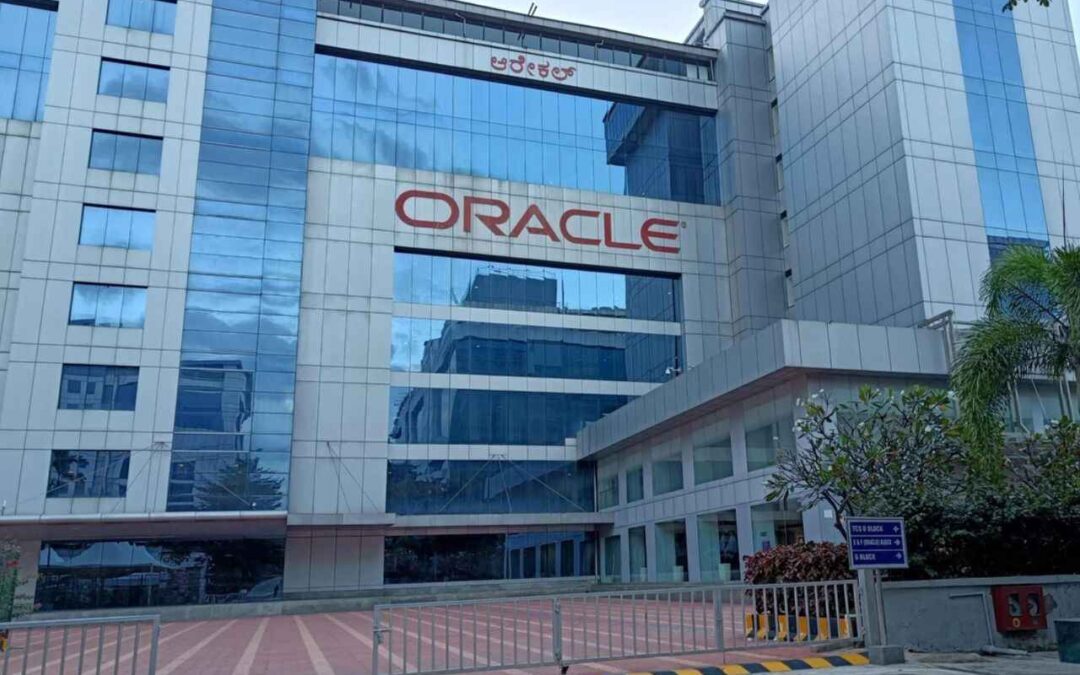
Oracle Financial Services closed on Monday at Rs. 11,746, up 0.82 percent on the day, with a market capitalization of Rs. 1,02,135.62 crore and a P/E ratio of 38.44 times. The stock is hovering around its 52 week high of Rs.11,958.
A Sector in Broad Retreat, and One Exception
The Nifty IT index has spent much of 2026 testing multi-month lows, with nine of its ten constituents posting year-to-date losses ranging from 9 to 35 percent. This stock stands alone with a positive return, continuously touching fresh 52-week highs while peers such as Infosys, TCS, Wipro, and Tech Mahindra have struggled under a combination of pressures and trading around 5 years low.

Chief among these is anxiety over generative AI automating code generation and software testing, which threatens the headcount-linked billing models underpinning traditional IT services revenue.
Layered on top of that is a broader pullback in discretionary technology spending among Western enterprise clients, longer deal closure cycles, and a meaningful contraction in foreign portfolio investment across the sector as institutional capital reallocates away from names seen as structurally exposed to AI-driven disruption.

Why the Business Model, Not the Sector Label, Explains the Gap
The most useful distinction here is that this company is not really an IT services provider in the conventional sense, even though it sits within the same benchmark index. Its revenue comes overwhelmingly from software product licensing, centred on its FLEXCUBE core banking suite, rather than from deploying engineers on client projects billed by time and material.
That distinction matters directly to the AI disruption narrative weighing on services peers. Traditional IT firms scale revenue roughly linearly with headcount, more billable engineers generally means more revenue, which is precisely the model AI-driven code automation threatens to compress.
A product licensing business works differently: once a core banking software engine is built, selling an additional licence to a new bank carries close to zero incremental cost, producing operating leverage that a labour-intensive services model simply cannot replicate.

It also matters to the discretionary spending question weighing on the sector. Global banks can defer a digital marketing refresh or a front-end application upgrade far more easily than they can defer replacing obsolete core ledger infrastructure, which regulators, real-time payment rail mandates, and fintech competition are increasingly forcing them to modernise regardless of the broader macro environment.
What the March Quarter Actually Showed
The company’s Q4 FY26 results gave the market concrete evidence to support the structural story rather than leaving it as theory. Consolidated revenue rose 20.33 percent year-on-year to Rs. 2,065.2 crore, while consolidated net profit climbed a sharper 30.72 percent to Rs. 841.7 crore, comfortably ahead of the Street’s estimated band of Rs. 620 to 680 crore. The Products segment specifically grew 21.02 percent to Rs. 1,871 crore, confirming that licensing revenue, not the smaller services arm, is doing the heavy lifting.
The more telling number sits in the margin line. Operating profit margin expanded to 51 percent in Q4FY26, up roughly 600 basis points year-on-year, a level that would be almost unheard of among traditional IT services firms typically operating in the 20 to 25 percent range.
That gap is the clearest quantitative evidence of the operating leverage argument: revenue growth is translating into profit growth at a rate services-driven peers structurally cannot match, and it is why the market has been willing to reward this stock with a premium multiple even as it has punished the rest of the index.
The Shareholder Return Profile & What Investors Should Look For
Alongside the results, the board approved an interim dividend of Rs. 270 per share, taking annualised shareholder distributions to roughly Rs. 400 per share, backed by a cash reserve of Rs. 14,882 crore, a figure close to double the company’s entire annual operating revenue.
That combination of growth and cash-backed dividend yield is relatively unusual for a stock trading at a 36.73 times earnings multiple, and it is one reason institutional income-focused funds have found the name attractive even as broader tech sentiment has soured elsewhere in the index.
The company’s medium-term growth case rests on two pillars that are reasonably distinct from the pressures facing services peers. The first is direct synergy with its parent’s Oracle Cloud Infrastructure expansion, which positions its cloud-ready FLEXCUBE platform as a natural choice for banks migrating core ledgers onto that infrastructure, reducing customer acquisition costs relative to independent competitors.
The second is the broader, multi-year global shift toward modular, API-first core banking architecture, a transformation that is difficult for financial institutions to defer indefinitely given competitive pressure from neobanks and tightening regulatory demands around instant settlement.
Disclaimer: The views and investment tips expressed by investment experts/broking houses/rating agencies on tradebrains.in are their own, and not that of the website or its management. Investing in equities poses a risk of financial losses. Investors must therefore exercise due caution while investing or trading in stocks. Trade Brains Technologies Private Limited or the author are not liable for any losses caused as a result of the decision based on this article. Please consult your investment advisor before investing.