
Synopsis: SpiceJet shares surged 10 percent to hit the upper circuit after the airline inducted three Airbus A320 aircraft on damp lease, even as fresh data shows its domestic market share has halved and losses have widened sharply since a Rs. 3,000 crore capital raise in 2024.
India’s domestic aviation sector continues to operate under tight capacity constraints driven by global engine and maintenance supply-chain bottlenecks, a dynamic that has kept airfares elevated and supported sector-wide profitability. Brokerage Elara Securities expects the industry to remain profitable through FY27, though it flags that carriers with larger fleets and stronger operational scale are better positioned to capitalise on these favourable pricing conditions than smaller players.

Shares of SpiceJet Ltd hit the 10 percent upper circuit at Rs. 12.32 on the BSE, up from a previous close of Rs. 11.20, with a market capitalisation of Rs. 1,880.15 crore. The stock remains far below its 52-week high of Rs. 40.84, having fallen more than 63 percent since the start of 2026 alone.
What’s the News?
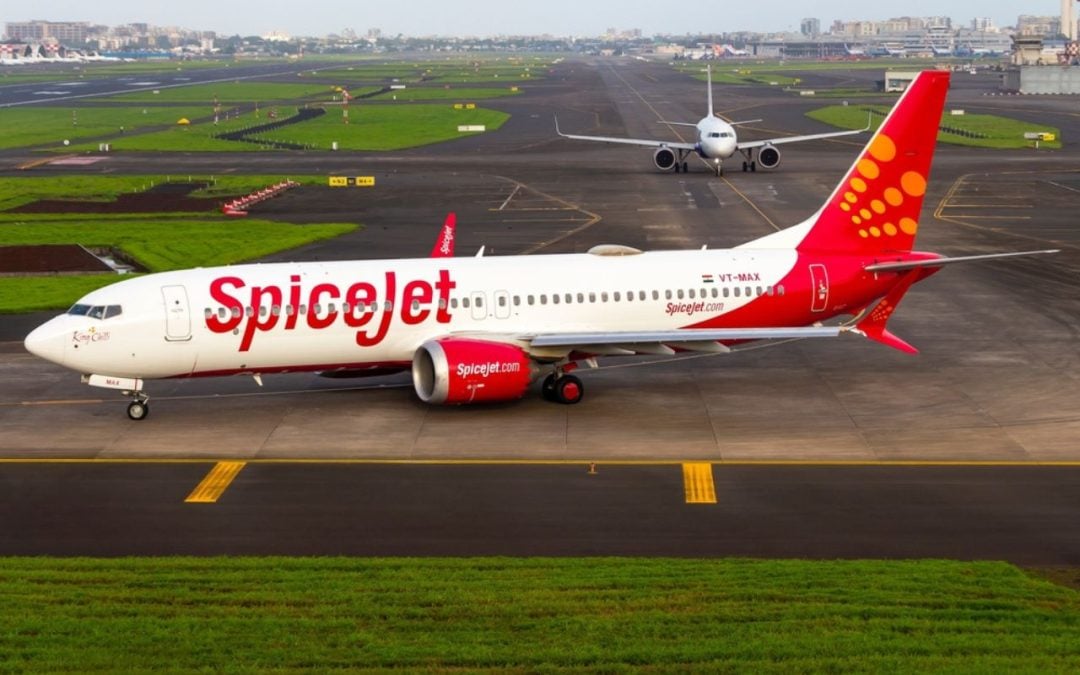
SpiceJet announced it has inducted three Airbus A320 aircraft into its fleet under damp lease arrangements, with all three aircraft having arrived in India and commercial operations set to begin later this week. Under a damp lease, the lessor supplies the aircraft, pilots and maintenance, while the airline provides cabin crew and operates the flights.

The airline said the additional capacity will support its network expansion plans and improve connectivity across key domestic routes, with Chief Business Officer Debojo Maharshi noting that the move is part of planned capacity expansion ahead of the busy travel season, aimed at adding flights on existing routes and supporting new service launches. SpiceJet said it is in advanced discussions with other lessors to induct further aircraft in the coming months.
However, the fleet expansion comes after a prolonged financial restructuring. In 2024, SpiceJet raised Rs. 3,600 crore through a Qualified Institutional Placement (QIP) and a preferential issue to strengthen its balance sheet. By December 2025, the airline had utilised Rs. 3,578 crore, but most of the funds were directed toward resolving legacy financial obligations rather than expanding operations.

Only Rs. 35 crore was spent on fleet induction, while nearly Rs. 900 crore went toward clearing dues owed to lessors, financiers and vendors. Another Rs. 601 crore was used to settle statutory liabilities, highlighting that the capital raise was primarily focused on stabilising the business before restarting fleet growth.
Financial and Business Analysis
Today’s three-aircraft induction, while operationally modest in scale, could carry outsized signalling value for investors given how little of SpiceJet’s prior capital raise has actually gone toward fleet expansion. If sustained, continued induction activity alongside the airline’s stated advanced discussions with other lessors would mark a meaningful shift from the balance-sheet-repair phase toward genuine capacity rebuilding.
However, the airline’s recent financial trajectory raises real questions about whether this expansion can be sustained. For the nine months ended December 2025, revenue from operations declined 14 percent year-on-year to Rs. 3,321 crore, while net loss widened nearly fourfold to Rs. 1,117 crore from Rs. 280 crore a year earlier. Quarterly data shows the pattern continuing, with a net loss of Rs. 269.27 crore in the December 2025 quarter alone, against revenue of Rs. 1,384.31 crore.

The QIP context adds further weight to today’s stock move: SpiceJet raised Rs. 3,000 crore in September 2024 at Rs. 61.60 per share, and even after today’s 10 percent rally to Rs. 12.32, those investors remain sitting on losses of over 80 percent, translating to an estimated Rs. 6,237 crore of shareholder wealth erosion since the raise. A separate preferential issue originally targeting Rs. 2,241.5 crore saw weak participation, ultimately yielding just Rs. 678.19 crore, with Rs. 381.81 crore of warrants forfeited unconverted.
Brokerage Elara Securities expects SpiceJet’s Q1 FY27 revenue to decline a further 11.5 percent year-on-year, with the airline likely to remain loss-making in the near term, though it has pencilled in a modest Rs. 100 crore adjusted profit for the full FY27 year, a target that would depend heavily on the airline successfully converting today’s fleet additions into sustained capacity and market share gains.
Industry and Strategic Analysis
SpiceJet’s domestic market share has more than halved over the course of this year, falling from 3.9 percent in January 2026 to 1.9 percent in June, according to Directorate General of Civil Aviation data, even as the broader domestic aviation market has remained resilient. This decline has coincided with a sharp deterioration in operational reliability, with the airline’s cancellation rate climbing to 6.23 percent in June against an industry average of just 0.63 percent.
Against this backdrop, the three-aircraft induction represents a critical test of whether SpiceJet can begin reversing its capacity and reliability decline. The airline holds approvals for 54 aircraft on its Air Operator Permit but has not disclosed how many are currently operational, leaving investors without full visibility into the scale of its actual flying fleet.
Management has attributed the slow pace of recovery to global supply-chain constraints affecting aircraft engines and maintenance capacity, challenges it describes as industry-wide rather than company-specific, and has pointed to geopolitical disruptions in West Asia as an additional headwind affecting fuel costs and airspace access across the sector. The airline said it continues to evaluate additional financing options, including the government’s Emergency Credit Line Guarantee Scheme, to accelerate the return of grounded aircraft to service.
For investors, the central risk remains execution: SpiceJet has successfully used prior capital to resolve legacy disputes with lessors and creditors, but converting that stabilised balance sheet into a genuine market share and profitability recovery has so far proven elusive, making today’s fleet addition a data point to watch rather than confirmation that the turnaround has taken hold.
Company Overview
SpiceJet Limited is an Indian low-cost carrier operating domestic and international passenger and cargo services. The airline has been engaged in a multi-year turnaround effort following significant financial distress, including a Rs. 3,000 crore Qualified Institutional Placement in September 2024 aimed at stabilising its balance sheet, settling liabilities with aircraft lessors and creditors, and restoring grounded aircraft to active service.
Disclaimer: The views and investment tips expressed by investment experts/broking houses/rating agencies on tradebrains.in are their own, and not that of the website or its management. Investing in equities poses a risk of financial losses. Investors must therefore exercise due caution while investing or trading in stocks. Trade Brains Technologies Private Limited or the author are not liable for any losses caused as a result of the decision based on this article. Please consult your investment advisor before investing.