Synopsis: Campa and Coca-Cola are making bold moves in India, while Varun Beverages is defending Pepsi’s market share through pricing, distribution and coolers. Yet its biggest acquisitions, new categories and manufacturing plans are increasingly centred on Africa. Is VBL quietly building a future abroad while Reliance Consumer Products reshapes India’s beverage market?
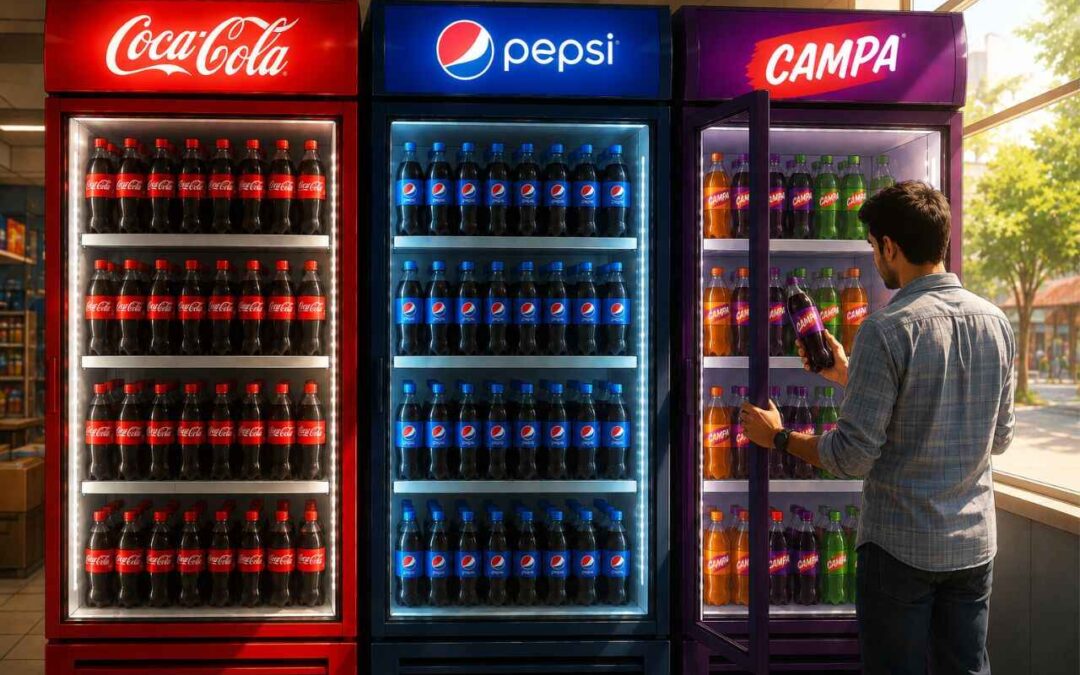
India’s beverage market is becoming more competitive. Reliance Consumer Products has turned Campa into the third-largest player through value pricing, higher distributor margins and the reach of Reliance Retail. The additional data shows that Campa generated gross sales of more than Rs. 4,700 crore in FY26, while Reliance’s beverages business recorded revenue of Rs. 2,900 crore in Q1 FY27. Campa is also estimated to have captured around 7-8 percent of India’s carbonated beverage market within a few years of its relaunch.

Coca-Cola remains the market leader, with an estimated 40-42 percent share, compared with Pepsi’s 28-30 percent. It is preparing for a possible 2027 listing of Hindustan Coca-Cola Holdings. The proposed issue has reportedly been discussed at around $1 billion, with an internal valuation of nearly $10 billion. However, the transaction is expected to largely involve a stake sale rather than fresh capital.
This leaves Varun Beverages, PepsiCo’s main Indian bottling partner, facing pressure from both sides. Campa is spending to build market share, while Coca-Cola could soon bring its Indian bottling operations to Dalal Street. VBL is responding in India, but many of its larger strategic moves are now taking place in Africa.

Why Has Competition Suddenly Become More Serious?
Campa’s strategy is straightforward. It is offering consumers an affordable alternative and giving distributors attractive margins, while using Reliance’s retail network to improve availability. The brand has crossed double-digit market share in some key regional markets and has expanded beyond cola into lemon, orange and energy drinks. Reliance is also adding manufacturing capacity and exploring low-alcohol ready-to-drink beverages.
For VBL, Campa can force the industry to spend more on discounts, coolers, retail incentives and affordable packs. Management acknowledged this during the Q3 CY2025 call, saying competition had “woken” the company up and pushed it to visit the market more frequently.

However, VBL does not view the new player only as a threat. Management believes that more companies placing coolers and opening outlets can expand India’s still-low beverage consumption. In its latest earnings call, the company said Campa, Coca-Cola, VBL and retailers together could be adding roughly one million pieces of chilling equipment annually. The question is therefore not whether the market will grow, but which company will execute better at the retail level.
How Is VBL Defending India?
VBL’s response in India is mainly operational. It is using selective price points, larger packs, wider distribution and more chilling equipment rather than announcing a major acquisition.
Management described Rs. 10 as a strong entry price that could increase consumption in rural and semi-rural areas. However, it said VBL would use it only when required. By early CY2026, the company had launched Rs. 10 products in West Bengal and the Northeast and said the rollout would remain selective. In Q1 CY2026, management said these packs contributed less than 2 percent of volumes and were used partly to keep distributors with the company.

The bigger volume push came through the Rs. 20 pack, which was upsized from 250 ml to 400 ml. This gave consumers more product at the same price point, but also reduced India’s realisation per case by 1.5 percent in Q1 CY2026. Management said consumption increased in both litres and units, while higher volumes and plant efficiency absorbed the impact.
Distribution remains the other major defence. VBL expanded its network during CY2025, but weak rural demand meant retailers did not buy as much as expected. The company continued adding distributors, logistics and outlets for CY2026 and expects stronger sales from the same network if the season improves. It is also deploying more visi-coolers and expanding routes, although management no longer gives detailed figures to avoid helping competitors.
Has VBL Already Finished Its Big India Investment?
VBL invested around Rs. 1,700 crore in four Indian greenfield plants at Prayagraj, Buxar, Damtal and Mendipathar during CY2025, along with roughly Rs. 300 crore on brownfield expansion at Sri City and Gorakhpur.
Those plants are operational, and management says India has enough capacity. It said VBL had added around 40-45 percent capacity over two years and had roughly 50 percent more capacity available than the volume produced in CY2025. India capex is therefore expected to remain below Rs. 500-600 crore in CY2026.
This does not mean VBL is abandoning India. It expects double-digit domestic growth if weather remains reasonable. Q1 CY2026 India volumes grew 14.4 percent, while India EBITDA margin improved by 112 basis points despite lower realisation. But the strategy has shifted from building major plants to using the capacity, outlets and coolers already created.
Is Africa Becoming VBL’s Bigger Strategic Bet?
While India is now largely an execution story, Africa is where VBL is making acquisitions, entering new categories and preparing capacity. International volumes grew 21.4 percent in Q1 CY2026, compared with 14.4 percent in India, and management said growth was spread across its international territories.
The largest move is the acquisition of Twizza, which is one of South Africa’s leading soft drink manufacturers. VBL completed the acquisition through BevCo at an enterprise value of ZAR 2,053 million. Twizza had annual revenue of around Rs. 800 crore and owns three manufacturing facilities with backward integration. Management believes it will improve VBL’s manufacturing and distribution in Africa’s largest soft-drink market.
VBL has also agreed to acquire Crickley Dairy for around ZAR 238 million. Management said Twizza and Crickley together had revenue of close to Rs. 1,000 crore. Twizza also gives BevCo spare production capacity, allowing the South African business to grow without immediately building another large beverage plant.
Together, Twizza and Crickley show that VBL is putting more capital into Africa through acquisitions, manufacturing capacity and new product categories. India remains important, but the company’s bigger expansion moves are currently taking place outside the country.
Is Africa Also VBL’s Testing Ground For New Categories?
VBL also said certain African subsidiaries of the company would test-market Carlsberg beer under an exclusive distribution agreement. Management explained that it would initially import and distribute the product, move slowly and expand after seeing demand. It described most selected markets as white spaces for Carlsberg and said beer consumption in several African countries could be as large as, or larger than, soft-drink consumption.
However, VBL is no longer only testing the category through imports. Management later said it would begin setting up its first greenfield brewery in CY2026 and hoped to complete it by the end of CY2027. For now, the Carlsberg plan is specifically for Africa.
Beer is only one part of the expansion. VBL began manufacturing Cheetos in Morocco, commissioned a snacks plant in Zimbabwe and started distribution in Zambia and Zimbabwe. Snack revenue reached around Rs. 340 crore in CY2025, while Q1 CY2026 revenue rose to Rs. 112 crore from Rs. 52 crore. It has also created a Kenya subsidiary for dairy and beverages, while Crickley adds a dairy platform in South Africa.
These moves show that Africa is becoming more than another market for Pepsi beverages. It is where VBL is building businesses in snacks, dairy and beer, while strengthening its soft-drink network through Twizza, new lines and backward integration.
Has VBL Shifted Its Attention Away From India?
VBL has not stopped investing in India. It is still adding routes, outlets, coolers, packs and products, and management continues to call India a major long-term growth market. The latest quarter also shows that the domestic business can deliver strong growth.
However, the nature of the two strategies is different. In India, VBL is mainly defending and using what it has already built. In Africa, it is buying companies, entering categories, creating subsidiaries and preparing a brewery. Reliance, meanwhile, is making aggressive moves inside India, and Coca-Cola is preparing a possible IPO for its Indian bottling business.
Africa can reduce VBL’s dependence on India, add revenue streams and give it room to test categories before taking larger risks. But if its biggest strategic bets remain overseas, Campa may get more time to build share and enter new categories in India. VBL’s India business is not being ignored, but for now, its boldest growth plans appear to be coming from Africa.
Disclaimer: The views and investment tips expressed by investment experts/broking houses/rating agencies on tradebrains.in are their own, and not that of the website or its management. Investing in equities poses a risk of financial losses. Investors must therefore exercise due caution while investing or trading in stocks. Trade Brains Technologies Private Limited or the author are not liable for any losses caused as a result of the decision based on this article. Please consult your investment advisor before investing.