
Synopsis: Ather Energy Limited is entering its most ambitious phase with the launch of EL, a new electric scooter platform targeting India’s ₹1–₹1.25 lakh mass segment, which management estimates represents 45–50% of the electric two-wheeler market. Backed by Rizta’s success, improving margins, Factory 3.0, and a 700-store network, EL could redefine Ather’s market positioning.
India’s electric two-wheeler market is evolving rapidly, and success is increasingly shifting from premium innovation to mass-market scale. For Ather Energy Limited, the next phase appears to revolve around EL, its new platform built to enter a segment where the company currently has no presence.

Coming after Rizta’s strong execution, expanding dealer confidence, improving unit economics, and rising manufacturing capacity, EL is emerging as more than a product launch; it could become Ather’s biggest strategic opportunity in electric mobility. With a market cap of Rs 35,194 crore, the shares of Ather Energy Ltd are trading at Rs 920. The shares have given a return of more than 200% in the last year.
A Breakthrough FY26
The revenue from operations for the company stood at Rs 1,175 crore in Q4 FY26 compared to the Q4 FY25 revenue of Rs 676 crore, up by about 74 per cent YoY. Similarly, the net loss stood at Rs 100 crore in Q4 FY26, compared to the Rs 234 crore loss in Q4 FY25.

FY26 was more than just an eventful year of growth for Ather Energy Limited; it was a game-changing year for the company in terms of its size, positioning, and ambition. As mentioned by the management, FY26 was the year of the company’s “breakthrough”.
This is evident from the fact that overall volume during FY26 increased by 66%, whereas the fourth quarter saw volumes rising to 83,000 units, which the management noted is almost 80% of Ather’s annual volume from a few years back. Most of the increase in volumes has been driven by Ather’s latest offering in the market, which is its family scooter named “Rizta”.

With the introduction of this new product, almost three-fourths of Ather’s total sales have been generated from this one model alone. Not only this, but it was also due to the success of Rizta that the market share of Ather improved by 1,100 basis points to reach 18.6% in Q4 FY26 from 8%.
Rizta Changes the Scale
The discussion on EL will come only after understanding the basis for such a level of confidence from management. Rizta has been the example of a new product entering into the business portfolio, unlocking demand, distribution, and market share altogether.
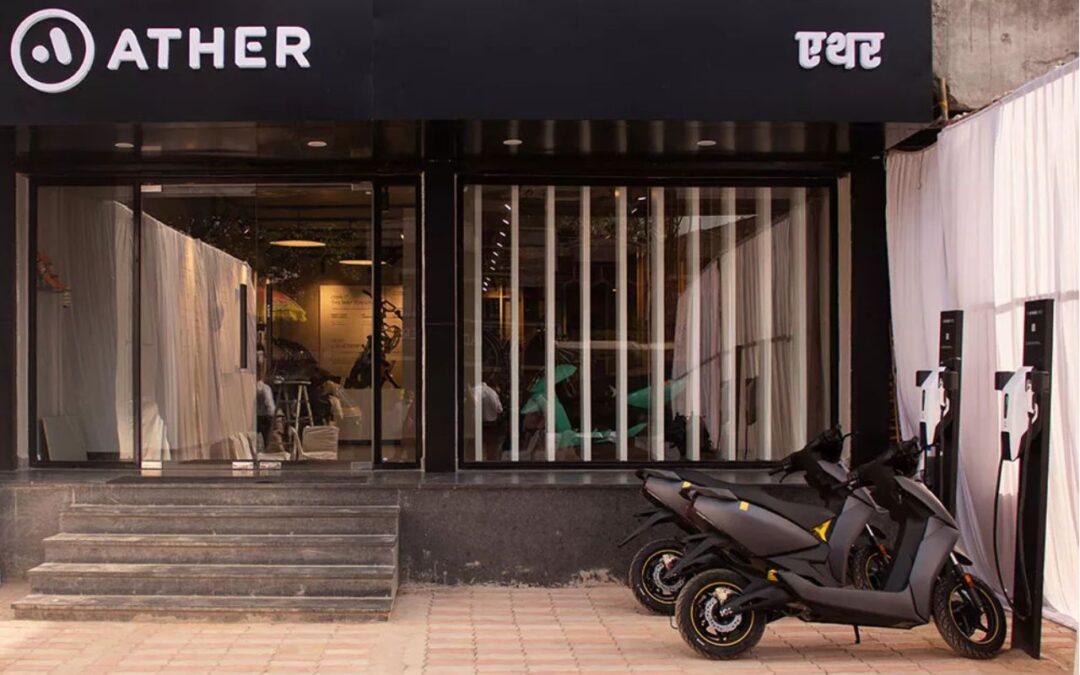
In FY26, Ather increased its retail store portfolio two times, from 351 to 700 stores, thereby opening 80 to 90 stores per quarter. The even more impressive figure has been that of dealers accounting for 75% of the total number of openings in the stores.

Geographically, the impact of the same has been visible, especially in the case of Middle India, consisting of Maharashtra, Gujarat, Odisha, Madhya Pradesh, and Chhattisgarh. The market share of Ather jumped from 4% to 17.3%, with Gujarat and Odisha alone contributing to a hike in market share from 4% to 19.7%. In Maharashtra, Madhya Pradesh, and Chhattisgarh, Ather’s market share has risen from 8% to over 16%.
The Market Ather Is Missing
Despite this promising track record, management acknowledged that at present Ather was catering to only a tiny portion of India’s electric two-wheeler market. At the moment, Ather has its sights set on the ₹1.25 lakh to ₹1.5 lakh mass premium segment as well as the ₹1.5 lakh+ premium segment.
On the basis of management’s market analysis, it came to the conclusion that the two segments together accounted for only 25% to 30% of the electric two-wheeler market in India. The greatest potential for market penetration lay in the ₹1 lakh to ₹1.25 lakh “mass” segment, which management believed made up 45% to 50% of total industry volumes. There was no denying the fact that there was nothing from Ather in this segment.
What Exactly Is EL?
It was emphasised several times by the management team that EL is not only a launch of another scooter but rather a completely different architecture. According to the management, “EL is fundamentally a platform and not just one product.”
It is significant to understand that, in essence, it gives an opportunity to have more variants at various price levels. As mentioned by the management, initially the focus will be made on the mass and mass premium segments; however, later on, it may become possible to have products in all price segments. In contrast to the current portfolio that Ather possesses, which is primarily in premium segments, EL should help the company broaden its pyramid substantially.
Built for Scale and Margins
Even more intriguing about the EL vehicle is how management intends to use it not just for volume growth but as a means for margin enhancement as well. Indeed, it has been developed with an emphasis on cost savings in mind. As per management, the new model avoids aluminium-based frames and utilises smaller amounts of copper.
Furthermore, it utilises a simpler transmission system. Technologies like the Ather Charge Drive Controller that brings on-board charging capability along with simplified chargers are incorporated into the platform as well. In addition to this, the AEBS, Advanced Electronic Braking System, technology has been used in order to provide ABS-level braking but at a far cheaper cost than standard ABS technology.
As per management, the EL would allow us to reduce reliance on costly materials like aluminium while improving our unit economics. At a time when lithium prices have increased by 2 to 2.5 times and overall commodity inflation stands at 40-50 per cent, this becomes strategically significant.
Profitability Is Improving
Ather begins its EL launch with far greater financial strength than most people would have guessed. In the fiscal year 2026, adjusted gross margins have gone up from 19% to 24% with subsidies and 12% to 21% without subsidies.
The cost of goods sold has dropped by 9% for the year. Monetising software is also an important factor. While there was a steady increase in quarterly volume from 43,000 units to 81,000 units, the Pro Pack attach rate of Ather grew to 93% in Q4 of FY26, a record high in the company’s history. This enabled a significant boost in profitability. The EBITDA loss margin improved by 1,500 to 1,600 basis points in the fiscal year 2026, and just the quarter itself witnessed an improvement of 2,000 basis points, with EBITDA loss dropping from 23% to -2%.
Factory 3.0 Powers EL
In order to support the scaling aspirations of EL, Ather is constructing its third factory in Chhatrapati Sambhaji Nagar. According to management, this will be the company’s biggest manufacturing site.
This facility will have a total capacity of 10 lakh units, out of which Phase 1 itself will contribute 5 lakh units worth of capacity. Monthly-wise, Phase 1 will bring on board an additional capacity of 42,000 units per month, which exceeds Ather’s current installed capacity of 35,000 units per month.
The management did admit that the current plant had already reached 90% to 95% capacity usage, making supply issues a pressing concern. The third factory is expected to start trial production during the festive season and reach full-capacity operation in Phase 1 before the end of FY27.
Can EL Unlock 50% of the Market?
With management statements, the answer seems highly likely now. Ather has shown with its experience of launching Rizta that a new product can change the rules of the game, especially when it comes to market share, distribution, and bottom-line metrics.
The company now has 700 stores, over 6,000 fast charging points, 643 patents applied to date, and, according to management, the brand has been established as the most frequently searched electric vehicle brand in India in the fourth quarter. This new product is launched with healthy margin performance, sound dealer economics, and supply limitations that prove high demand, plus a new factory of 10 lakh units under construction.
What matters more is that Ather’s new product aims at the price point of ₹1 lakh to ₹1.25 lakh, which, according to the management, constitutes 45% to 50% of the Indian market for electric two-wheelers in which Ather currently does not have any market share.
Disclaimer: The views and investment tips expressed by investment experts/broking houses/rating agencies on tradebrains.in are their own, and not that of the website or its management. Investing in equities poses a risk of financial losses. Investors must therefore exercise due caution while investing or trading in stocks. Trade Brains Technologies Private Limited or the author are not liable for any losses caused as a result of the decision based on this article. Please consult your investment advisor before investing.