
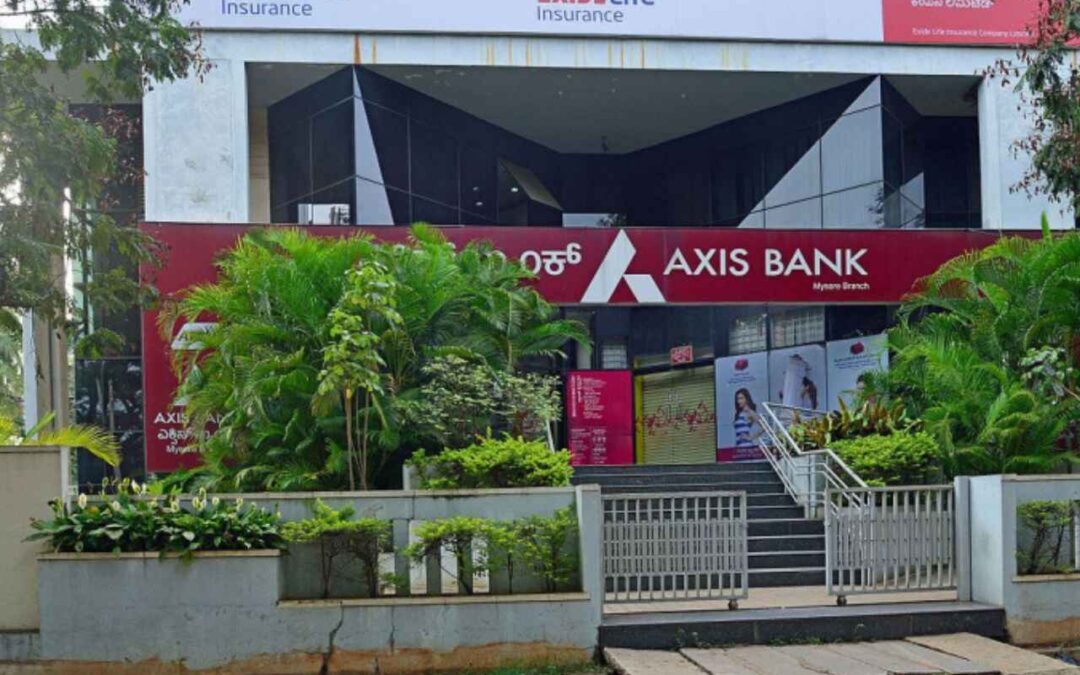
Synopsis:- Axis Bank’s Q1 FY27 numbers show AI moving from pilot projects to core banking operations, with fraud prevention, onboarding and customer servicing all now running on an enterprise-wide AI platform called AXIOM.
India’s private banks have spent the past two years talking about digital transformation, but most of that conversation has stayed at the level of chatbots and mobile app ratings. Axis Bank’s Q1 FY27 investor presentation suggests something more structural is underway at India’s third-largest private lender, where artificial intelligence is being wired into the operating model itself rather than bolted on as a customer-facing gimmick.

With a market capitalization of Rs. 3,90,177.44 crore, the shares of Axis Bank were trading at Rs. 1,254.30 per share on the NSE, down close to 5.59 percent from its previous closing price of Rs. 1,328.50 apiece. The stock is trading at a P/E of roughly 14.82.
What’s the News?
Axis Bank has built what it calls AXIOM, an enterprise AI operating model spanning five focus areas: zero-ops document processing, conversational interfaces for customers, an enterprise knowledge bot, a relationship manager copilot, and fraud and credit assurance. The bank says these are reusable capability platforms, not one-off pilots confined to a single business line.

The scale is the striking part. In Q1 FY27 alone, Axis processed roughly 34 million documents with AI assistance and enabled 1.05 million AI-assisted customer onboardings. Its Gen AI chatbot for frontline staff, called ADI, was used by 87,000 employees in FY26, up from 45,000 a year earlier, with query volumes growing 3.5 times to over 32.5 lakh.
Axis also disclosed that its relationship manager copilot analysed 8 million minutes of voice-to-text transcription and roughly 2.1 million minutes of RM calls, generating over 2 million pieces of insight. Company-wide, 93,000 employees used Copilot tools, generating close to 4 million prompts a month.

Financial Impact Analysis
The bank reported a 320 percent year-on-year improvement in fraud value prevention, a number that stands out even in a results deck packed with growth percentages. Fraud losses are a direct hit to profitability for any lender, and a jump of this magnitude, if sustained, has a real bearing on credit costs and provisioning going forward.
Beyond fraud, the productivity case is showing up in operating metrics. Cost to assets fell to 2.20 percent in Q1 FY27, down 21 basis points year-on-year and 8 basis points quarter-on-quarter, even as the bank absorbed higher technology spending. Axis attributed part of the expense growth to Rs. 186 crore of incremental investment in IT infrastructure and digital journeys, which it says is being offset by volume-linked efficiency gains elsewhere in the cost base.
Automation is also compressing onboarding timelines. The bank’s neo for Corporates platform has cut co-origination turnaround time by three times and reduced account opening time by half through integrated APIs, according to the presentation. That kind of efficiency gain matters more as loan volumes scale, since manual processing costs would otherwise grow in step with business growth rather than staying flat.

Industry and Strategic Analysis
Digital adoption metrics reinforce the AI story rather than sitting apart from it. Axis holds close to 38 percent market share in UPI as a payer PSP by volume and 22.1 percent share in merchant acquiring terminals, ranking among the largest players in that segment. Axis Mobile has around 16 million monthly active users and a 4.8 rating on both major app stores, while roughly 12 million of those users are not otherwise Axis Bank customers.
WhatsApp banking has crossed 40 million customers since its 2021 launch, and 98 percent of the bank’s financial transactions by individual customers are now conducted through digital channels. These are not vanity metrics in isolation, they represent the data pipes that make AI-led fraud detection and personalisation possible in the first place, since a model is only as useful as the transaction volume feeding it.
The competitive read here is that scale in digital rails and scale in AI reinforce each other. A bank processing a large share of the country’s UPI volume has more transaction data to train fraud models on than a smaller peer, which could compound Axis’s lead over time if execution holds.
Financial Performance
The technology investment is not coming at the expense of core banking growth. Advances grew 19 percent year-on-year to Rs. 12,61,557 crore, deposits rose 18 percent to Rs. 13,72,936 crore, and net profit climbed 23 percent year-on-year to Rs. 7,114 crore in Q1 FY27, aided by positive operating jaws and stable asset quality.
Segment growth was broad-based rather than concentrated in one business line. SME loans grew 25 percent year-on-year, corporate loans rose 38 percent, and the combined SBB, SME and mid-corporate book expanded to Rs. 3,06,086 crore, now accounting for 24 percent of total loans against 15 percent five years ago. Gross NPA improved to 1.28 percent from 1.57 percent a year earlier, and net NPA fell to 0.39 percent, indicating that credit quality has not been sacrificed for growth. Return on equity on a consolidated basis rose to 14.52 percent, up 95 basis points year-on-year, with subsidiaries contributing 36 basis points of that improvement.
Wealth Management
The technology push sits alongside a broader diversification of the Axis franchise. The bank’s wealth management arm, Burgundy, now manages Rs. 7.54 lakh crore in assets, up 20 percent year-on-year, while Burgundy Private’s family count grew 25 percent to over 17,400. Axis Finance, the group’s NBFC, crossed Rs. 50,000 crore in assets under finance during the quarter, growing 21 percent year-on-year, and received a Rs. 2,250 crore capital infusion from Axis Bank and Kedaara Capital to support its next phase of retail, MSME and wholesale lending growth.
Taken together, these moves point toward a bank that is trying to become a full-stack digital financial platform rather than a traditional deposit-and-lending institution that happens to have a mobile app.
Whether that translates into a durable valuation premium will depend on whether the fraud-prevention and cost gains from AXIOM continue to compound as transaction volumes scale, or whether they plateau once the low-hanging automation opportunities are exhausted.
What Should Investors Look Out For
Investors tracking Axis Bank should watch whether the cost-to-assets improvement holds as technology spending continues to rise, and whether the fraud prevention gains reported this quarter prove repeatable rather than a one-off base effect.
Net interest margin compression, down to 3.46 percent from 3.62 percent in the previous quarter, is also worth monitoring closely, since AI-led efficiency gains matter less to shareholders if core spread income keeps eroding.
The scale-up of Axis Finance and the wealth management franchise adds another growth lever, but also adds execution complexity that the market will likely track through subsidiary-level return on investment rather than headline AUM numbers alone.
Disclaimer: The views and investment tips expressed by investment experts/broking houses/rating agencies on tradebrains.in are their own, and not that of the website or its management. Investing in equities poses a risk of financial losses. Investors must therefore exercise due caution while investing or trading in stocks. Trade Brains Technologies Private Limited or the author are not liable for any losses caused as a result of the decision based on this article. Please consult your investment advisor before investing.