Have you ever wondered how thousands of trades get placed in the market within seconds?
This happens because of algorithmic trading. It has quietly become one of the most important forces shaping financial markets. From large investment banks to individual traders sitting at home, algorithms are being used across the board to execute trades faster, smarter, and more consistently than ever before.
In this blog, we will learn what algorithmic trading is. How does algorithmic trading work, and why has it become such a significant part of online forex trading and the broader financial world?
What is Algorithmic Trading?
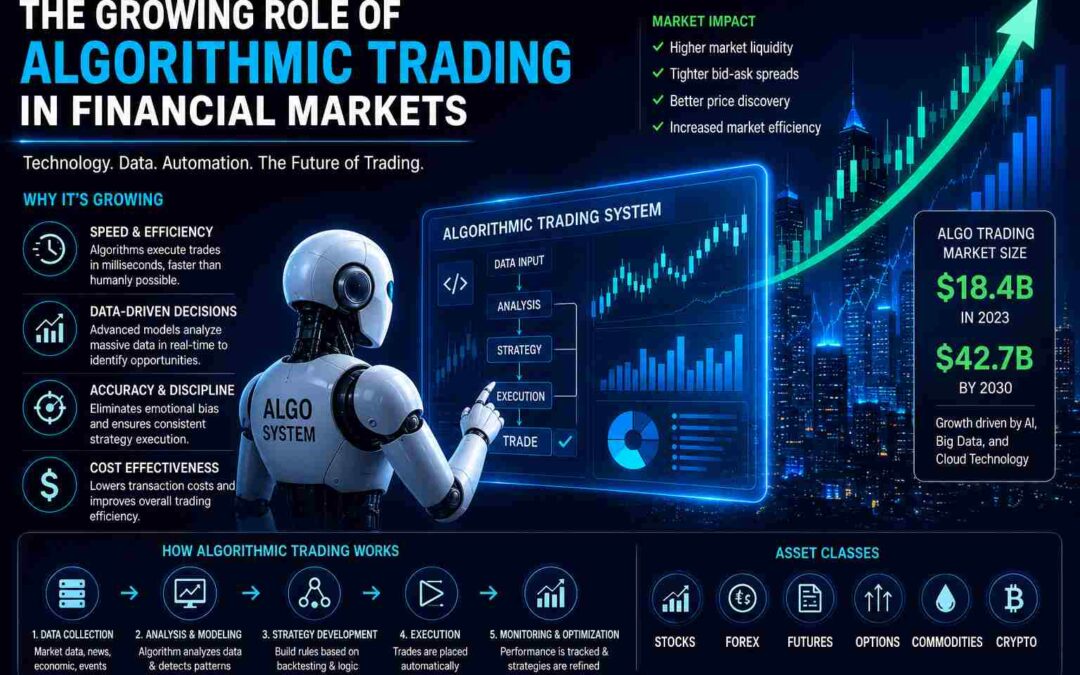
Algorithmic trading is the use of computer programmes to execute trades automatically based on a set of pre-defined rules. These rules can be based on price, timing, volume, or a combination of technical indicators. When the market meets the conditions set in the algorithm, the trade is placed instantly without any manual input.
It is also known as algo trading or automated trading. And while it was once only available to large financial institutions, it is now accessible to individual traders through modern trading platforms.
How Does Algorithmic Trading Work?
The idea behind algorithmic trading is simple. Here, you define a set of conditions, and the programme continuously monitors the market. When those conditions are met, the trade is executed automatically.
For example, a simple algorithm might be set up to buy a currency pair when its 50-day moving average crosses above its 200-day moving average, and sell when the opposite happens. The programme watches the chart around the clock and acts the moment those conditions are triggered.
Here is what happens behind the scenes:
- Market data feed: The algorithm receives live price data from the market.
- Signal generator: It analyses the data and identifies when trading conditions are met.
- Risk management system: It checks position size and exposure before placing the trade.
- Execution engine: It places the order instantly once all conditions are confirmed.
This entire process can happen in milliseconds, far faster than any human trader could react.
Common Algorithmic Trading Strategies
There are several strategies that traders use when building algorithms. Here are the most widely used ones:
Trend Following: This is the most common algorithmic strategy. The algorithm identifies a market trend using indicators like moving averages and enters trades in the direction of that trend. It holds the position until the trend shows signs of reversing.
Arbitrage: This strategy looks for price differences for the same asset across markets. When a discrepancy is found, the algorithm buys at the lower price and simultaneously sells at the higher price. These opportunities are small and disappear quickly, which is why speed is essential.
Mean Reversion: This strategy is based on the idea that prices tend to return to their average over time. When a price moves too far above or below its historical average, the algorithm takes a position, expecting it to revert.
High-Frequency Trading: It is an advanced form of algorithmic trading. It executes thousands of orders within fractions of a second, taking advantage of very small price movements. It is mostly used by large institutional players.
The Role of Algorithmic Trading in Online Forex Trading
The forex market is one of the most active markets in the world. It runs 24 hours a day, five days a week, across multiple time zones. This makes it one of the most natural environments for algorithmic trading to thrive.
In online forex trading, algorithms can monitor multiple currency pairs simultaneously. They react to price movements, news events, and technical signals instantly.
For individual traders, using algorithms in forex also means being able to trade during hours when they are not at their screens. The algorithm keeps working while you sleep, follows your rules, and never lets emotions influence a decision.
Benefits of Algorithmic Trading
Algorithmic trading has several advantages. Here is what makes it a preferred choice for many traders today:
- Speed and Precision: Algorithms execute trades in milliseconds. This speed removes the delay that comes with manual trading and ensures orders are placed at the exact price conditions you set.
- Emotion-Free Trading: One of the biggest challenges in trading is managing emotions. Fear and greed lead to poor decisions. Algorithms do not have emotions. They follow the rules every single time, which helps maintain consistency in your trading approach.
- Ability to Backtest: Before using an algorithm in a live market, you can test it against historical data. This process, known as backtesting, helps you understand how the strategy would have performed in the past and where it needs improvement.
- Multitasking: An algorithm can monitor multiple markets, instruments, and timeframes simultaneously. This gives traders access to more opportunities than they could manually track.
Risks of Algorithmic Trading
Algorithmic trading has its advantages, but it also has its risks that every trader must understand:
- Technical failures: A system crash, connectivity issue, or coding error can lead to unintended trades or may miss an opportunity.
- Over-reliance on historical data: A strategy that worked in the past may not perform in changing market conditions.
- Market impact: In fast-moving markets, algorithms can sometimes increase volatility rather than reduce it.
- No response to unexpected events: Algorithms follow pre-set rules. They cannot interpret a sudden geopolitical event or an unexpected central bank announcement the way a human trader can.
Conclusion
Algorithmic trading has changed the way financial markets operate. Once used primarily by large institutions, automated trading tools are now increasingly accessible to individual traders participating in online forex markets.
The trading is no longer just for large institutions. It is now part of how everyday traders approach the financial markets. Understanding how it works gives you a clearer picture of what is moving the market and how you can use that knowledge to trade more effectively.
