

Key takeaways
- Most chatbot ROI claims you see online are vendor marketing; build your own model instead.
- The honest formula has four inputs: deflected volume, cost per interaction saved, revenue effects, and total cost of ownership.
- Industry research confirms large aggregate savings — but also that many organizations capture far less value than they expected.
- Run the math on conservative assumptions; if it only works on optimistic ones, it does not work.
Search “chatbot ROI” and you will be buried in confident percentages. “340% first-year return.” “Save 30% on support costs.” The numbers are seductive and almost always borrowed from someone else’s business. The useful question is not what a chatbot returned for a stranger — it is what it will return for you, on numbers you can defend.
This article gives you a transparent way to model that, plus a reality check from independent research on where the value actually shows up.
What the research really says
The aggregate case for chatbots is well documented. Juniper Research has repeatedly estimated multi-billion-dollar annual cost savings from chatbot deployment across retail, banking, and healthcare, driven largely by the agent time each automated interaction saves. At the level of a whole industry, the savings are real and large.
But there is a crucial counterpoint, and ignoring it is how buyers get burned. McKinsey’s State of AI research has consistently found that while a large majority of organizations now use AI, only a small fraction report meaningful bottom-line impact from it. In other words: the technology works, but capturing value is an organizational achievement, not an automatic one. A chatbot does not deliver ROI. A well-scoped, well-integrated, well-maintained chatbot does.
That gap between potential and captured value is exactly why you should model your own case rather than inherit someone else’s headline.
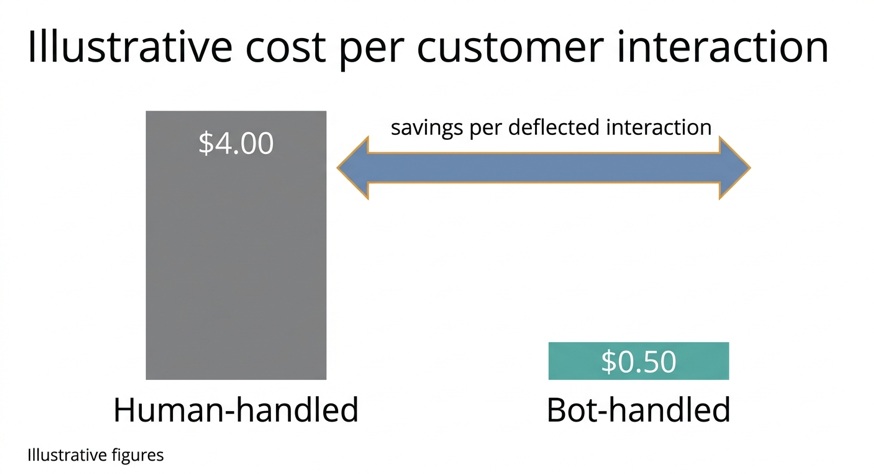
Figure 1 — Where the savings come from: the gap between a human-handled and a bot-handled interaction, multiplied by deflected volume. Figures illustrative; use your own loaded costs.
The four inputs of an honest ROI model
Strip away the marketing and chatbot ROI comes down to four things.
1. Deflected volume
How many interactions will the bot genuinely handle end to end? Not “touch” — handle. Start from your current ticket or chat volume, estimate the share that is repetitive and automatable (order status, FAQs, basic account changes), and apply a realistic containment rate. For most small and mid-sized deployments, assuming 40–55% containment on the automatable slice is defensible; assuming 90% across all tickets is fantasy.
2. Cost per interaction saved
What does a human-handled interaction actually cost you? Take the loaded hourly cost of a support agent, divide by how many interactions they handle per hour, and you have a per-interaction cost. Multiply by deflected volume to get gross labor savings. The often-quoted gap between a human-handled and a bot-handled interaction is large, but use your numbers — a founder answering chats has a very different cost than an outsourced contact center.
3. Revenue effects
This is the input most models forget, and for many businesses it dwarfs the cost savings. A bot that answers instantly at midnight can recover an abandoned cart. A bot that qualifies a lead before a salesperson calls shortens the sales cycle. These effects are harder to measure, so estimate them conservatively — but do not zero them out, because for revenue-facing bots they are the main event.
4. Total cost of ownership
Subtract everything the bot costs: subscription, message or resolution fees at your real volume, integration and setup effort, and ongoing maintenance time. The maintenance line is the one teams forget. A bot is not a slow cooker you set and walk away from; someone has to feed it new answers as your business changes.
A worked example
| Input | Illustrative assumption | Annual figure |
| Automatable interactions / month | 1,000 | 12,000 |
| Containment rate | 50% | 6,000 deflected |
| Cost per interaction saved | $4.00 | $24,000 saved |
| Estimated recovered revenue | conservative | $9,000 |
| Platform + fees | — | −$3,600 |
| Setup + maintenance time (valued) | — | −$6,000 |
| Net first-year benefit | $23,400 |
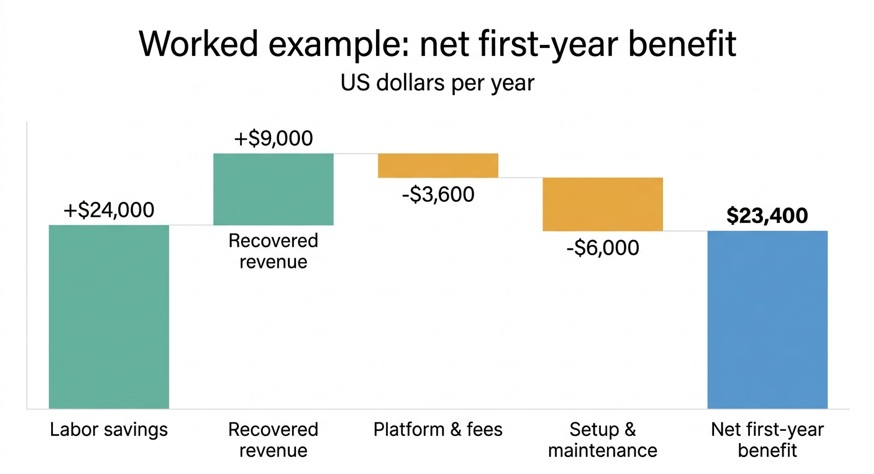
Figure 2 — The worked example as a waterfall: savings and revenue up, costs down, net benefit at the end. Built from the illustrative table above.
On these assumptions the deployment pays for itself comfortably. But notice how sensitive the result is: halve the containment rate or double the maintenance burden and the picture changes fast. That sensitivity is the whole point — a model you can adjust beats a borrowed percentage every time.
Stress-test before you sign
A good ROI model is one you try to break. Three tests separate a real case from a hopeful one.
The conservative-only test. Re-run the model with pessimistic inputs: lower containment, lower revenue effect, higher maintenance. If it still clears zero, you have a robust case. If it only works on optimistic numbers, treat that as a warning.
The payback-period test. Divide your total first-year cost by your monthly net benefit. If payback lands inside roughly three to six months, the case is strong. A payback longer than a year deserves a hard second look.
The do-nothing test. Compare against the real alternative, which is usually not “perfect human service” but “customers waiting, abandoning, or churning.” The cost of the status quo is part of the return.
From model to decision
Once your model holds up, the platform choice has to match the assumptions inside it. A platform with weak analytics makes your containment assumption unverifiable. A platform that prices aggressively on volume can quietly erode the savings line as you grow. The model and the platform are not separate decisions.
If you would rather not build the spreadsheet from scratch, a structured starting point helps. A purpose-built chatbot ROI calculator walks through the same four inputs and lets you test conservative versus optimistic scenarios in a few minutes — a faster way to pressure-test the case before you talk to any vendor.
Frequently asked questions
Is the “340% ROI” figure real?
It appears widely online, usually traced back to industry research, but treat any single headline percentage as someone else’s result, not a forecast of yours. Build your own model on your own numbers.
What is a good payback period for a chatbot?
Roughly three to six months is a strong result for a well-scoped deployment. Anything past twelve months warrants scrutiny of your assumptions.
Should I include revenue effects or just cost savings?
Include both, but estimate revenue conservatively. For sales- and conversion-facing bots, recovered revenue often exceeds labor savings; for pure support bots it is smaller.
What is the most commonly forgotten cost?
Ongoing maintenance time. A chatbot needs regular updates to its knowledge and flows. Budget for that human time or your real ROI will trail your model.
The takeaway
Chatbot ROI is real, but it is earned, not assumed. Model four inputs — deflected volume, cost per interaction saved, revenue effects, and total cost of ownership — then stress-test the result with conservative numbers and a clear-eyed view of the do-nothing alternative. A case that survives that scrutiny is one you can act on with confidence. A borrowed percentage is not.
