
Synopsis: India’s private space sector is entering a new phase of growth following Skyroot Aerospace’s successful orbital launch. Solar Industries, through its strategic investment in Skyroot and expertise in rocket propellants and energetics, could emerge as one of the few listed beneficiaries of India’s expanding commercial space ecosystem.
The Indian space industry is experiencing one of its most significant shifts since the formation of ISRO. With the opening of India’s space industry to private companies in 2020, it has provided room for startups to join forces with launch vehicles, satellites, downstream applications, and space infrastructure.

This is a huge opportunity. Currently, the country holds a share of approximately $8 billion in the space economy of the world; however, the government plans to raise this amount to $44 billion by 2033 through commercialisation of space technology.
As a result, there has been a development of a very active startup ecosystem in the country. One of the companies that has benefited the most from the new policies is Skyroot Aerospace from Hyderabad.

Skyroot Aerospace Scripts History
Founded in 2018 by Pawan Kumar Chandana and Naga Bharath Daka, who were former scientists of ISRO, Skyroot Aerospace has quickly gained prominence as the leading private space technology firm in India.
In May 2026, Skyroot became the first space-tech unicorn of India after garnering almost $60 million of new investment from Singapore’s sovereign wealth fund GIC and Sherpalo Ventures, which valued the company at about $1.1 billion. With this fundraising, the company’s total funding has crossed the mark of $160 million.

Skyroot’s biggest achievement was in July 2026, when Vikram-1 successfully achieved orbital insertion and became the first orbital payload launch by a private Indian firm, thereby making India only the third country in the world behind the US and China to have private sector launch capacity to reach orbit. This successful endeavour made Skyroot one of the best private launch companies in the world.
Vikram-1 Validates India’s Commercial Space Potential
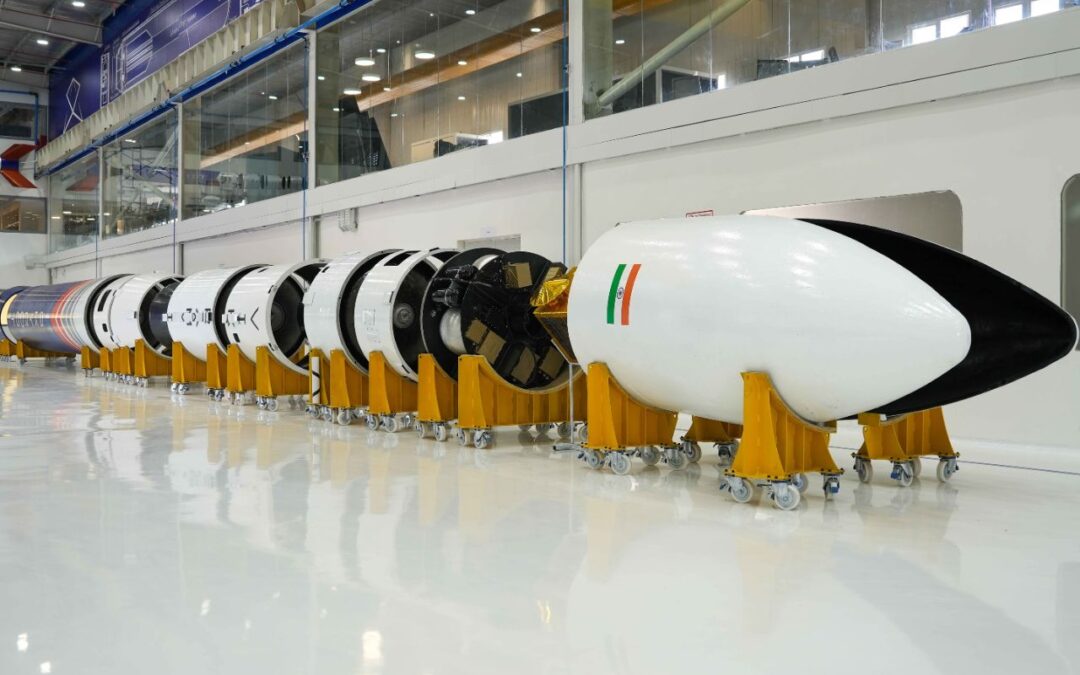
The Vikram-1 mission was important not only due to its success in reaching orbit but also because it proved the viability of India’s commercial space launch infrastructure. The 22-metre-long launch vehicle, with a capacity to lift 350 kg payloads to low Earth orbit, successfully placed six payloads into orbit, including satellites and technology demonstrations from customers in India and abroad.
The launcher has three solid fuel stages and an orbital manoeuvring stage with liquid fuel, using many proprietary technologies, including 3D-printed engines. The success of the mission makes India a possible low-cost option for launching satellites for the booming market of small satellites worldwide. However, the most interesting aspect of the mission is what listed firms can capitalise on.

Solar Industries Has Quietly Built a Strategic Position
One firm that seems to be uniquely situated is Solar Industries India Ltd. From the FY25 annual report of Solar Industries, it can be seen that Solar Industries has investments in Skyroot Aerospace through equity shares and Series A1 compulsorily convertible preference shares valued at around Rs 105.75 crore.
Thus, Solar Industries emerges as one of the very few publicly held Indian firms with any financial stakes in India’s top private space firm. Surprisingly enough, Solar’s relationship with Skyroot is no new thing. Since 2019, Solar Industries has announced its intention to invest in Skyroot to the tune of Rs 17.5 crore. This early move on the part of Solar Industries seems more and more clever with each passing day.
The Relationship Goes Beyond Financial Investment
One of the most critical features of this event is that Solar Industries is not a mere investor here. Post-launch reports confirmed that Solar provided rocket propellants for the launch vehicle and contributed to static testing activities from its base at Nagpur. This essentially means that Solar is a direct participant in India’s budding private launch sector, not just an investor in Skyroot.
Thus, the success of this launch proves not only the efficacy of Skyroot’s technology but the entire network of suppliers and partners that support the venture as well. For Solar Industries, participation in the project opens up new possibilities in areas like propulsion technologies, testing facilities, and energetics.
Strong Technology Synergies Could Drive Future Opportunities
There exist numerous technological synergies that support the strategic tie-up between Solar Industries and Skyroot Aerospace. For instance, Solar Industries has gained extensive experience over many years in energetics, solid propellants, explosives, missile systems, and defence technology.
These are areas which have considerable overlap with the manufacture of launch vehicles. Today’s rockets need to be made using advanced propellant compositions, test facilities, and knowledge of how to handle energetic materials, all of which Solar Industries has already developed.
Its gradual diversification from industrial explosives to defence and aerospace technologies adds another layer of capability that it can potentially bring to the Indian private space sector.
Repeat Launches Could Become the Real Growth Driver
Though the success of Vikram-1 is a milestone, the real success can be achieved by way of repeated launches and commercialisation. On a global scale, the providers of launching services get substantial benefits from frequent launches and recurring customer relationships. Skyroot has already expressed its intentions of making its launches more frequent and designing new rockets in addition to Vikram-1 in response to the rising need for launches of small satellites.
As the launches of satellites will grow across the globe for purposes of communications, Earth observations, and defence, there is likely to be a rise in the need for cheap launching services. If Solar Industries manages to develop its business, it would have the potential to benefit from it in multiple ways.
Scarcity Value Makes Solar Industries Unique
An equally significant element of the investment thesis revolves around the scarcity value of Solar Industries. Out of the numerous Indian-listed firms, there are only a select few that have a validated and direct link with Skyroot Aerospace. Although there are numerous defence firms which operate in India’s aerospace industry, including those participating in ISRO projects and defence contracts, what sets Solar apart from others is the fact that it has invested directly in the equity of Skyroot, providing rocket propellant and testing launch activities. This makes Solar Industries a unique proxy for India’s growing private space story.
Risks Remain Despite the Long-Term Opportunity
However, along with its significant long-term prospects, investors need to consider that India’s private space industry is still at an early stage of development. The commercial viability of space companies like Skyroot would depend upon several variables, which include the frequency of launch, customer base, competitive pricing, and regulatory support.
Furthermore, the current role played by space activities in Solar Industries’ business is relatively minor, whereas explosives and defence continue to be the key contributors to Solar’s bottom line. Therefore, India’s private space industry needs to be considered as a strategic optionality for now and not an immediate source of earnings. However, strategic optionality tends to create value in high growth industries over time, particularly when it comes to industries with significant entry barriers.
Disclaimer: The views and investment tips expressed by investment experts/broking houses/rating agencies on tradebrains.in are their own, and not that of the website or its management. Investing in equities poses a risk of financial losses. Investors must therefore exercise due caution while investing or trading in stocks. Trade Brains Technologies Private Limited or the author are not liable for any losses caused as a result of the decision based on this article. Please consult your investment advisor before investing.