
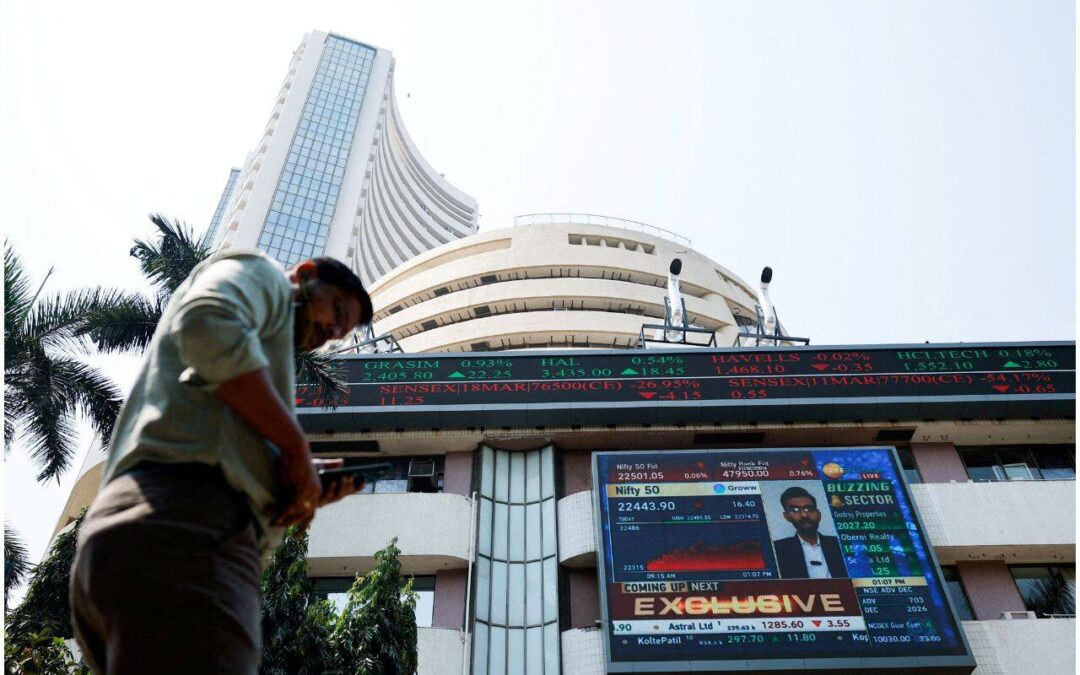
Synopsis: The Nifty has stayed range-bound for two years with no returns, as currency weakness, FII selling, IT sector pressure, high valuations, and global geopolitical risks weighed on sentiment.
The Indian stock market has remained largely range-bound over the past two years. Despite touching an all-time high of 26,373.20 in January 2026, the index is now roughly at the same level as it was two years ago, delivering almost no returns for investors during this period.

This lack of movement has been driven by a mix of global and domestic pressures, including currency weakness, sustained foreign investor selling, sector-specific challenges, and valuation concerns. As a result, even though corporate earnings have grown, the overall market performance has remained subdued and volatile.
Why has the market given no return over the last 2 years?
Rupee depreciation pressure
One of the key reasons for muted market returns is the sharp fall in the rupee. Over the last two years, the currency has weakened from around Rs 81.82 per US dollar to nearly Rs 95.15, touching a high of Rs 97.27. This nearly 16 percent depreciation has impacted foreign investor sentiment and increased concerns around imported inflation and margin pressure for companies dependent on global inputs.

FII selling pressure
Foreign Institutional Investors (FIIs) have remained consistent net sellers in Indian equities over this period. A large portion of global capital has moved towards the US markets, driven by stronger returns and lower risk perception. Continuous outflows from FIIs have acted as a strong headwind, limiting market upside despite steady domestic inflows.
Weakness in IT due to AI shift
The IT sector, a major weight in Indian indices, has faced pressure due to the global artificial intelligence (AI) shift. While global technology companies have moved fast in building AI platforms and agents, Indian IT firms are still in a transition phase integrating AI. This has raised concerns about future revenue growth and led to valuation corrections in the sector.

Valuation concerns
At multiple points in the last two years, Indian equities were trading at stretched valuations compared to earnings growth. Even though corporate profits have grown steadily, prices had already discounted much of the optimism. This led to limited fresh upside and frequent profit booking, keeping the overall index range-bound.
Geopolitical uncertainty
Global geopolitical tensions have also weighed on sentiment. Events such as the US–Iran conflict and renewed tariff-related discussions from the US have increased uncertainty in global trade. Such external shocks have reduced risk appetite among investors, leading to cautious positioning in emerging markets like India.
Is the worst over for the index?
One of the biggest positives for the market is the easing of global geopolitical tension. The war between the US and Iran has moved into a truce phase, which has reduced global uncertainty. At the same time, crude oil prices have corrected sharply by nearly 40 percent from around $120 per barrel to about $73. This has helped bring inflation expectations lower, which is supportive for both corporate margins and interest rate stability.

A new growth driver is emerging from India’s infrastructure and technology ecosystem. The infrastructure sector is increasingly focusing on building large-scale AI-ready data centers. This shift is helping India position itself in the global AI value chain. Alongside this, IT companies are integrating AI through global partnerships with firms such as Microsoft, Google Cloud, AWS, and NVIDIA, which is improving efficiency and long-term growth visibility.
Apart from global and sector-specific drivers, the broader market setup has also started to improve. Domestic Institutional Investors (DIIs) have remained steady buyers in equities, which has helped balance foreign outflows and provided stability to the market.
The rupee has also shown some recovery, moving from its recent weak levels near Rs 98 per dollar to around Rs 95 per dollar, indicating reduced immediate pressure on currency markets. In addition, concerns around key global trade routes like the Strait of Hormuz remain contained for now, keeping energy supply risks lower and supporting overall market stability.
Conclusion: Outlook for the Indian market
The near-term outlook for the Indian equity market remains cautious as global uncertainty continues to weigh on sentiment. Citi has reduced its Nifty 50 target from 27,000 to 26,000, reflecting concerns around West Asia tensions, earnings downgrade risks, and sustained FII outflows. With foreign investors still underweight on India and allocation in emerging market funds at a five-year low, global flows remain a key headwind for the index.
However, positioning itself also suggests room for improvement. FII underownership near multi-decade highs indicates that even small triggers like easing geopolitical risks or a slowdown in outflows could lead to a sharp rebound. Earnings growth is still positive at a moderate pace, and valuations are now closer to long-term averages, reducing extreme overvaluation concerns compared to previous years.
Overall, the market appears to be in a consolidation phase rather than a structural downturn. Near-term volatility may continue, but the medium-term setup is more balanced. If global risks stabilize and foreign flows turn less negative, the index has potential to gradually move towards Citi’s revised target zone near 26,000, with selective sector-led upside.
Disclaimer: The views and investment tips expressed by investment experts/broking houses/rating agencies on tradebrains.in are their own, and not that of the website or its management. Investing in equities poses a risk of financial losses. Investors must therefore exercise due caution while investing or trading in stocks. Trade Brains Technologies Private Limited or the author are not liable for any losses caused as a result of the decision based on this article. Please consult your investment advisor before investing.