
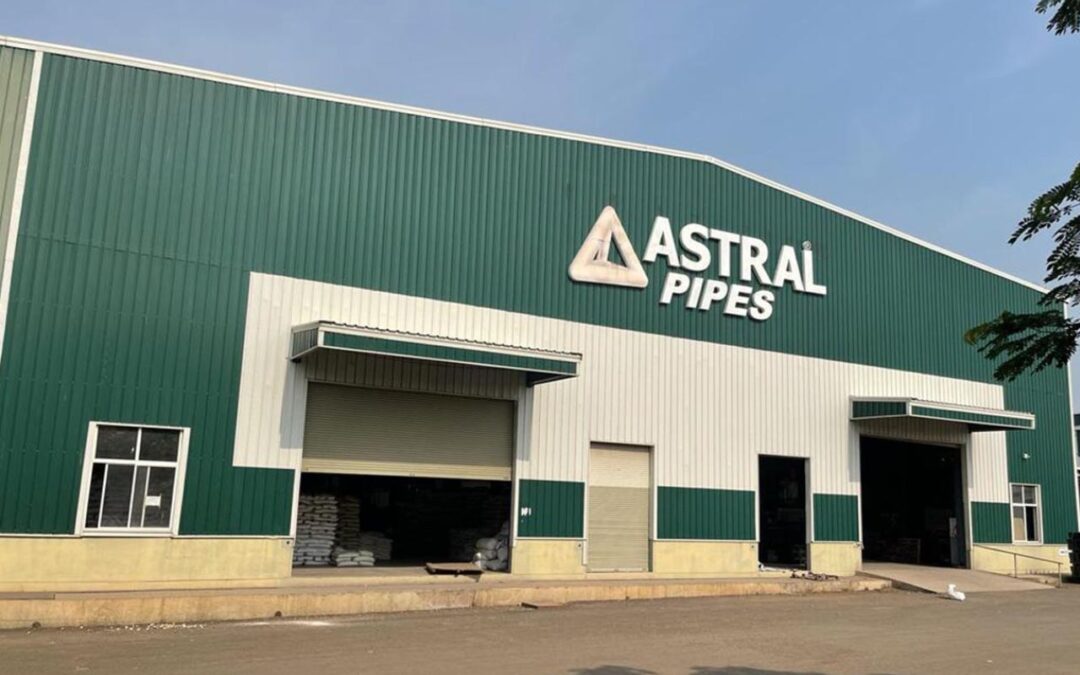
Synopsis: India’s PVC pipe demand tailwinds, Astral’s CPVC leadership, capacity ramp-up, backward integration and improving margins position the company for strong earnings recovery, though resin volatility and execution risks remain monitorables.
The plastic pipe industry is a core pillar of the construction, infrastructure, and agriculture ecosystem, driven by rising demand for durable, lightweight, and corrosion-resistant piping solutions. Plastic pipes such as PVC, CPVC, HDPE, and uPVC are widely used in water supply, drainage, irrigation, sewerage, and industrial applications because of their long life, low maintenance, and cost efficiency compared to traditional metal pipes. In India, the industry is witnessing strong structural growth supported by rapid urbanisation, housing demand, smart city projects, and government-led initiatives like Jal Jeevan Mission, AMRUT, and irrigation schemes

The brokerage view remains positive on Astral, with Geojit Financial Services initiating a BUY rating and a target price of Rs. 1,912. According to the brokerage, this target is based on 58x FY28E EPS, reflecting confidence in Astral’s leadership in the CPVC segment, visible earnings recovery after the capex cycle, and improving margins.
Investment rationale
Astral’s pipes and fittings business, which contributes nearly 70 percent of its revenue, continues to be the main growth engine, backed by pipe capacity of 4,10,000 MTPA and overall capacity of 5,49,126 MTPA. Improving resin prices have helped revive dealer restocking, resulting in strong plumbing volume growth of 16.8 percent YoY in Q3FY26, after 20.6 percent YoY in Q2FY26.

With the heavy capex cycle peaking in FY25 and easing ahead, earnings are expected to grow at a ~28.1 percent CAGR over FY26–FY28E. Its 80 percent stake in Nexelon Chem, with 40,000 MTPA CPVC resin capacity by Q4FY27, should reduce import dependence, while non-pipe businesses may grow at ~15.4 percent CAGR.
Business segment breakdown
Astral’s business is well diversified across key building material segments, with pipes and fittings forming the core of its revenue base. This segment includes premium products such as FlowGuard CPVC pipes, known for heat resistance, corrosion protection and durability, along with Fire Pro pipes for fire safety, OPVC pipes for agriculture and industrial drainage, and advanced valve systems.

Supporting this, the adhesives and sealants segment contributes around 24 percent of revenue, led by brands like Resinova and Seal IT, which strengthen cross-selling opportunities. The company also has a premium paints portfolio and a fast-growing bathware segment, supported by 500+ branded showrooms, helping Astral build a balanced and high-margin building materials
Industry outlook
India’s plastic pipe industry still has significant room for growth, as the country’s per capita plastic consumption is only about half the global average and nearly one-third of China’s level. The organised plastic pipes market is estimated at Rs. 40,000–54,000 crore and is expected to grow at a 10–12 percent CAGR over FY23–FY28. Growth is being supported by government schemes such as Housing for All, Jal Jeevan Mission, AMRUT and Swachh Bharat, along with rising housing demand in Tier-II and Tier-III cities.
In agriculture, with around 51 percent of farmland still rain-fed, irrigation-focused schemes continue to support demand. The broader PVC pipe market is valued at USD 5.4 – 7.4 billion, with volumes of 3.0 – 3.2 million tonnes, and is projected to grow at 14 percent CAGR through 2031 and production expected to be around 4.5 – 5.5 million tons while organised players already command nearly 70 percent market share.

Peer analysis Profitability and margins
The Indian plastic pipes industry, valued at around Rs. 50,000–54,000 crore in FY25, has been facing headwinds from PVC resin price volatility and subdued demand after FY23, resulting in muted 3–5 percent year-on-year revenue growth across players. Among organised companies, Supreme Industries leads with around 15 percent overall pipe market share, supported by its larger scale.
Finolex Industries benefits from full PVC resin backward integration, which gives it cost advantages, while Prince Pipes remains more volume-focused in commodity uPVC segments. Astral, however, holds a differentiated position as the pioneer in the CPVC category with around 25 percent share in the organised CPVC segment, and its diversified presence across adhesives and bathware gives it a broader and more resilient business model than pure-play pipe peers.
Astral’s profitability stands out for its consistency, with EBITDA margins staying in the 15–17 percent range during FY20–FY25, making it one of the most stable players in the sector despite resin price cycles and demand slowdowns. In comparison, Supreme’s margins remained in the 13.5–15.5 percent band, while Finolex saw sharp swings from 28.6 percent in FY21 to 6.7 percent in FY23 due to its resin exposure. Prince’s margins have weakened to 6–7 percent from the earlier 8–12 percent range. Although Astral had a 270 bps ROE gap versus Supreme in FY25, this was mainly due to underutilised new capacity, with ROE expected to recover sharply to ~17.5 percent by FY28E.
Key risks and valuation
The key risks for Astral mainly revolve around input costs and execution. PVC and CPVC resin account for nearly 60–70 percent of raw material costs, so any sharp price movement can directly impact margins and also lead to dealer destocking, as seen during FY21–FY25. Another risk is competition, with Supreme Industries expanding aggressively in the organised market, while unorganised players continue to compete on pricing in commodity PVC pipes.
Of the expected ~150 bps EBITDA margin expansion between FY25 and FY28E, around 60 bps depends on Nexelon, so any delay beyond Q4FY27 could push this benefit to FY29. In addition, the UK adhesives business generates around Rs. 300 crore revenue at only ~3 percent EBITDA margin, creating a ~50 bps drag on group margins, while bathware remains a pre-breakeven business requiring continued investment.
Disclaimer: The views and investment tips expressed by investment experts/broking houses/rating agencies on tradebrains.in are their own, and not that of the website or its management. Investing in equities poses a risk of financial losses. Investors must therefore exercise due caution while investing or trading in stocks. Trade Brains Technologies Private Limited or the author are not liable for any losses caused as a result of the decision based on this article. Please consult your investment advisor before investing.