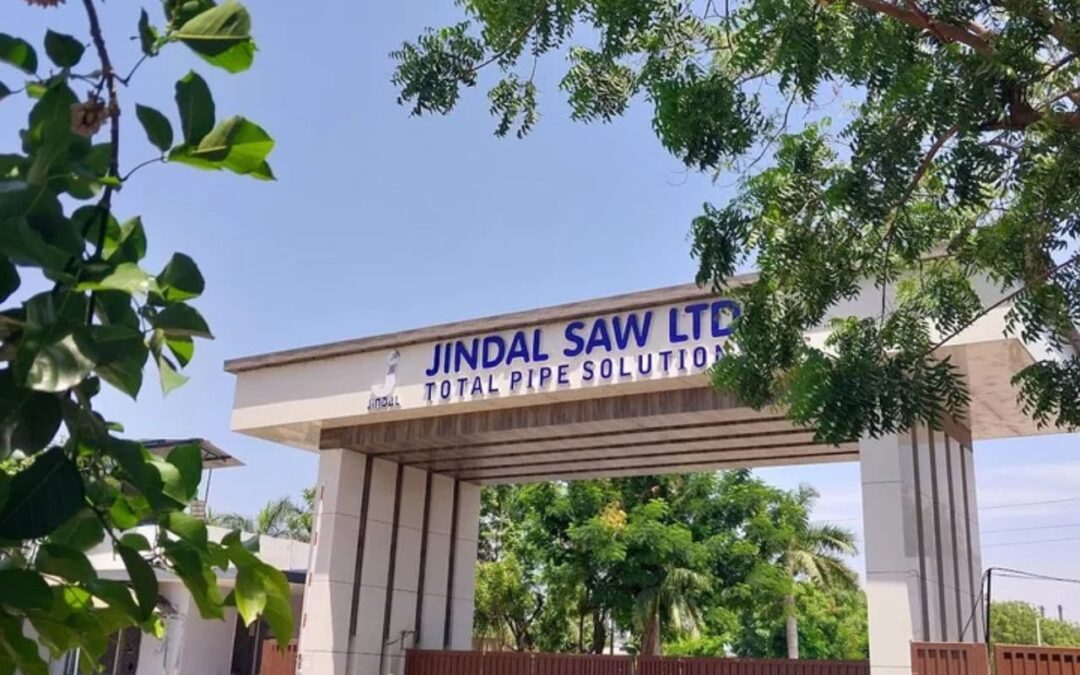
Synopsis: Heavy industrial pipe manufacturer Jindal Saw Limited has reported its consolidated financial results for Q1 FY27, highlighting a sharp divergence between top-line expansion and core profitability. Net profit after tax plunged due to intense logistical disruptions across the Middle East, maritime route closures, and localized manufacturing drags.
A surface-level glance at Jindal Saw Ltd.’s Q1 FY27 earnings reveals a stark operational paradox: consolidated top-line income expanded to Rs 44,760 million, yet consolidated profit after tax crashed by Rs 3,247 million. This performance drop reflects a clear operational bottleneck: geopolitical supply chain de-alignment.

Shares of Jindal Saw Limited were trading at Rs 254.25, down by 1.78 percent from the previous close of Rs 258.85. The stock opened at Rs 253, touching an intraday high of Rs 257.5 and a low of Rs 249.1. The company currently commands a market capitalisation of Rs. 16,323 crore.
Financial Performance
Jindal Saw reported a consolidated total income of Rs 4,476 crore during Q1 FY27, registering a 9.1 percent YoY growth compared to Rs 4,103 crore reported in the corresponding quarter last year. However, higher revenues failed to translate into profitability as operating disruptions significantly impacted earnings quality.

Operating performance weakened considerably during the quarter. EBITDA declined 38.9 percent YoY to Rs 420.4 crore from Rs 688.3 crore, while the EBITDA margin contracted sharply to 9.4 percent from 16.8 percent, indicating a loss of nearly 7.47 percent in operating profitability due to lower capacity utilisation, weaker export execution, and adverse operating leverage.
The pressure was even more pronounced at the bottom line. Profit Before Tax after Joint Ventures fell 61.8 percent YoY to Rs 142.9 crore (down from Rs 374.3 crore), while Profit After Tax dropped 78.1 percent YoY to Rs 90.8 crore (down from Rs 415.5 crore) in Q1 FY26. The sharp decline reflects not only lower operating profitability but also the absence of favourable tax adjustments that had benefited the previous year’s quarter.

Sequentially, the business also witnessed moderation. Revenue declined from Rs 4,657 crore in Q4 FY26 to Rs 4,476 crore, while EBITDA fell from Rs 504 crore to Rs 420 crore, indicating that export disruptions continued throughout the quarter. PAT also declined from Rs 123.6 crore reported during the March quarter to Rs 90.8 crore
Why Did Earnings Decline Despite Revenue Growth?
The decline in earnings was primarily due to the continuing geopolitical war in the Middle East which has had a significant impact on the company’s export business. Exports account for around 30 percent of Jindal Saw’s order book in value terms and 41 percent of the volume of pipe orders. The conflict that started in February 2026, primarily linked to the Middle East and North Africa (MENA) region, where most of these exports are destined, led to major shipping bottlenecks, the closure of key maritime routes, delivery delays, and a reduction in export dispatches during the quarter.
Management stated that the situation became severe enough for the company to invoke the force majeure clause on impacted export contracts. These disruptions also affected the operations of its Abu Dhabi subsidiary, where production and deliveries slowed because of supply chain constraints.

Operational Performance Remained Weak
Besides export issues, the company’s domestic operations struggled during the quarter. Despite a year-long order backlog, management reported slow execution in India’s ductile iron water pipe business. Although demand visibility is high, project execution has been slow, delaying revenue recognition from existing orders.
Iron & steel pipe production fell to 3.71 lakh MT in Q1 FY27 from 3.89 lakh MT in Q1 FY26, while pellet production fell to 2.90 lakh MT from 3.21 lakh MT. Pellet sales fell sharply to 2.82 lakh MT in Q1 FY27 from 3.87 lakh MT in Q4 FY26, indicating weaker operational momentum.
Geopolitical disruptions also affected the company’s international operations. Its Abu Dhabi business had supplied around 34,000 MT of corrosion-resistant ductile iron pipes in Q1 FY27 as compared with around 48,000 MT in the previous quarter, mainly due to disruptions caused by the Middle East conflict. Otherwise, the long-term demand outlook was healthy, but this hurt export execution.
Despite a challenging quarter, Jindal Saw continues to maintain one of the strongest order books in the domestic pipe industry. The company reported a standalone order book of US$1.171 billion (around Rs 10,070 crore), comprising US$1.164 billion (around Rs 10,010 crore) of iron & steel pipe orders and US$7 million (around Rs 60 crore) of pellet orders. The total order pipeline represents nearly 1.8 million tonnes, with execution scheduled over the next 9 to 12 months, providing strong medium-term revenue visibility.
Moreover, the company’s UAE arm has a separate order book of $188 million (around Rs 1,620 crore) or about 1.77 lakh MT, which is also independent of the parent company’s backlog. Once geopolitical conditions normalise, the overseas pipeline is expected to further strengthen execution and support future revenue growth.
Expansion Projects Remain Unaffected
While the conflict has affected operations, management said its Middle East strategic expansion projects are proceeding as planned. Financial closure is nearing for the 300,000 TPA seamless pipe manufacturing facility in Abu Dhabi, which is scheduled for commercial production in FY29. Additionally, its Saudi Arabian joint venture is building 300,000 TPA of HSAW and LSAW pipe manufacturing capacity and a ductile iron pipe facility.
Management noted that the company’s long-term growth strategy in the region is preserved as the ongoing conflict does not affect these projects, which are still under development.
Why Did the Stock Fall?
Jindal Saw continued to see strong revenue growth and had a healthy order pipeline for the long term. But investors were more worried about a sharp deterioration in profitability.
The combination of a 78 percent decline in net profit, 740 basis points of EBITDA margin contraction, slowing export execution, and uncertainty surrounding the duration of the Middle East conflict overshadowed the otherwise healthy order book.
Investors are now expected to closely monitor the normalisation of export logistics, the execution of the existing US$1.17 billion order book, the recovery in domestic ductile iron pipe demand, and progress on the company’s Middle East expansion projects, which remain critical drivers of earnings recovery in the coming quarters.
Jindal Saw Limited is one of India’s leading manufacturers of iron and steel pipes, ductile iron pipes, seamless pipes, SAW pipes and pellets. The company supplies oil & gas, industrial, water transmission and infrastructure applications to domestic and international markets. It has a diversified manufacturing base in India and a strong presence in export markets, especially the Middle East and Latin America, supported by a growing manufacturing base in the UAE and Saudi Arabia.
Disclaimer: The views and investment tips expressed by investment experts/broking houses/rating agencies on tradebrains.in are their own, and not that of the website or its management. Investing in equities poses a risk of financial losses. Investors must therefore exercise due caution while investing or trading in stocks. Trade Brains Technologies Private Limited or the author are not liable for any losses caused as a result of the decision based on this article. Please consult your investment advisor before investing.