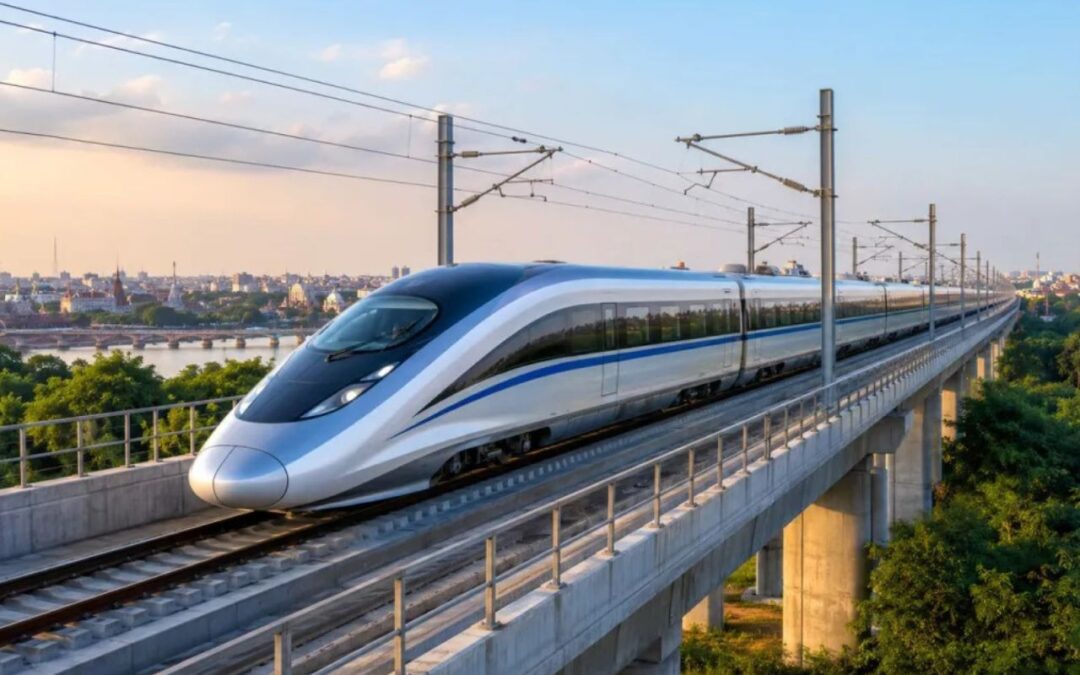
Synopsis: India’s bullet train ambition has arrived in South India. The Chennai–Bengaluru High Speed Rail corridor will cover 306 km in 73 minutes, cutting a 4–6 hour journey to just over one. For investors, the real story is what happens to land values along the eight proposed stations before a single pillar is cast.
The fastest train between Bengaluru and Chennai takes close to five hours. For two cities that together anchor South India’s technology and manufacturing economy, that has always been the journey you tolerate, not the one you choose. But all that is about to change. The time it would take for you to travel from Chennai to Bengaluru will decrease to just 73 minutes. The speed on dedicated rail lines would be at 320 kmph. NHSRCL has done its alignment survey and DPR has been prepared. Karnataka has granted administrative-level support (April 2026), and the project is about to begin from 2027-28 onwards.
What This Project Actually Is
The Chennai-Bengaluru HSR line is Phase 1 of the overall Chennai-Bengaluru corridor. It stretches through three states – Karnataka, Andhra Pradesh, and Tamil Nadu – on elevated lines except for urban areas where it goes underground. The implementing authority is NHSRCL, which implements the Ahmedabad-Mumbai bullet train project too.
Route and proposed stations
This corridor starts from Baiyappanahalli of Bengaluru and runs through Whitefield and Kodihalli close to Hoskote of Karnataka and passes through Chittoor of Andhra Pradesh and enters Tamil Nadu through Parandur and Poonamallee to terminate at Chennai Central.
- Baiyappanahalli, Bengaluru — terminal, underground
- Whitefield, Bengaluru — underground
- Kodihalli (near Hoskote), Karnataka
- Kolar / Hudukula, Karnataka
- Chittoor (Ramapuram), Andhra Pradesh
- Parandur, Kanchipuram district, Tamil Nadu
- Poonamallee, Tamil Nadu
- Chennai Central — terminal, underground
Why Underground Stations Matter
Three fully underground stations on one corridor is a first for HSR in South India. The reason is practical: surface land acquisition through Bengaluru’s IT belt and Chennai’s historic core would be prohibitively expensive and legally complex. Going underground avoids all of that. The tunnel breakdown:
- Whitefield to Baiyappanahalli, Bengaluru: 12 km
- Mogili Ghat section, near Chittoor (AP): 11.5 km
- Within Chennai city: 2.5 km
All three underground stations are built to the same full-scale specification – six lines, 415-metre platforms, 120 kmph crossover speed. These are high-capacity terminals, not token stops.
What This Means for Property
However, it is in the stage of civil planning that this project currently stands wherein historically infrastructure has begun impacting long-term expectations of the value of land before it even impacts any movement of people. Appreciation is generally seen in areas of underappreciated peripheral lands getting their first institutional connection.
Whitefield, Bengaluru: Whitefield is already a well-developed area, technologically integrated as an IT-enabled residential and commercial complex. Further, the establishment of the subway HSR station, together with the forthcoming Metro Blue Line (by late 2026), cements its status as a well-integrated multimodal urban complex. This is neither a discovery market nor a greenfield micro-market but a high-value-added micro-market of proven infrastructure and proven value-addition.
Kodihalli / Hoskote, Bengaluru Rural: Kodihalli and the broader Hoskote belt sit at a strategic junction influenced by multiple proposed HSR alignments, including the Chennai and Hyderabad corridors. The planned maintenance depot in this zone adds long-term functional importance. Compared to core Bengaluru locations, this remains a relatively affordable entry point, positioning it as an early-stage peripheral growth corridor tied to future infrastructure expansion.
Kolar / Hudukula, Karnataka: Kolar represents one of the most affordable and underdeveloped markets along the entire corridor. The confirmation of a station introduces first-time institutional connectivity to a region that has historically underperformed relative to its proximity to Bengaluru. The appreciation potential here is not immediate but structural, driven by long-cycle infrastructure absorption rather than short-term demand spikes.
Parandur, Tamil Nadu: The Parandur area has a proposed HSR station in its vicinity; hence, it can be considered to be the starting point of Tamil Nadu on this HSR line en route to Chennai Central. The area falls within the larger Kanchipuram–Sriperumbudur region, which has been growing at a consistent pace owing to its growth in industrialization, connectivity via highways, and the construction of the Bengaluru–Chennai Expressway. The coming HSR station, once up and running, is going to provide the area with the first-ever mass rapid transit facility, a structural shift that tends to revalue land over the long cycle.