
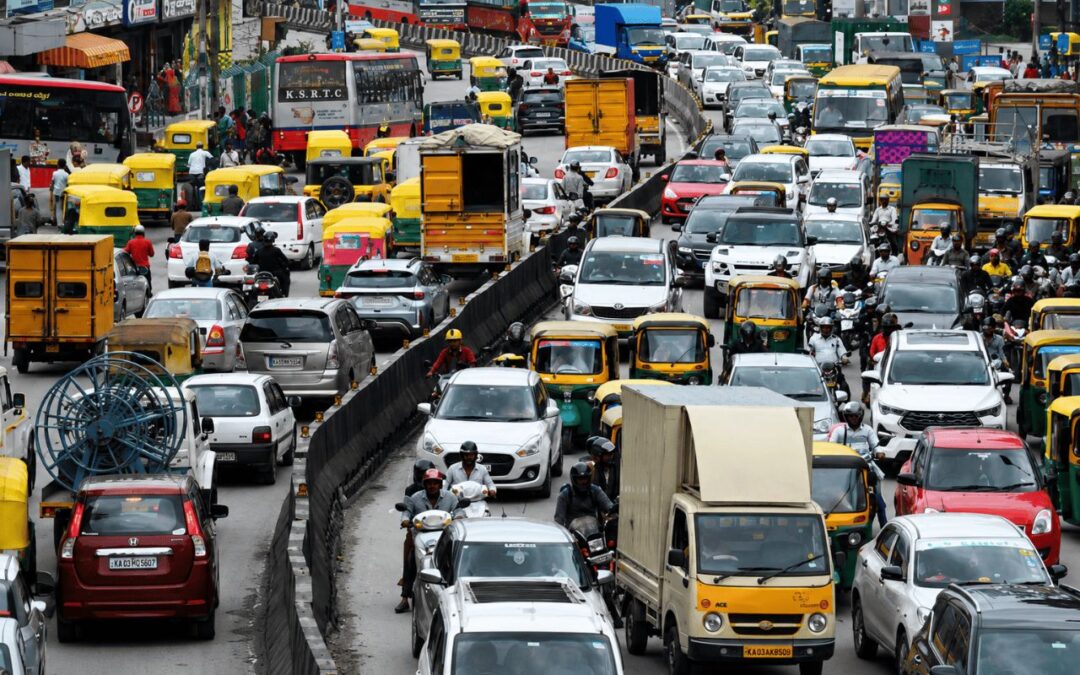
Synopsis: Bengaluru’s notorious traffic is well-known across India, and knowing the peak traffic times will actually help the commuters to plan their travel. This article gives a complete breakdown of the top 10 worst traffic zones in Bengaluru, why they get congested, and how long delays typically run.
Bengaluru’s on-road vehicle population is growing annually at nearly 10% making the road further congested with certain corridors becoming chronic pain points for daily commuters. Hence, knowing these traffic hotspots will help daily commuters to plan their travel. Here are the major and other traffic zones and corridors with their estimated peak traffic hours.
Area-wise peak hours and estimated delays
Major Traffic Zones
The Hebbal-Silk Board stretch of the ORR remains the most consistently cited problem corridor in the city. A large share of this traffic is due to poorly designed entry and exit points between the main carriageway and service roads, where merging traffic increases the present congestion.
- Silk Board Junction – widely flagged as the toughest junction in the city, with HSR Layout-bound commuters facing waits regardless of time of day
- Hebbal Junction – a major bottleneck for airport-bound and Yelahanka-side traffic; a new flyover loop brought a recorded drop in congestion on its first weekday, though evening traffic remains heavy as it builds up toward Mehkri Circle
- Marathahalli and Iblur Junction – ongoing Namma Metro pillar work has narrowed a four-lane stretch to two lanes, causing severe congestion during morning peak hours
- Bellandur, Ecospace Junction, and Kadubeesanahalli – tech-corridor stretches where IT-park commute volumes compound the ORR’s existing bottlenecks
- Nagawara and Hennur Junction – additional pressure points along the northern ORR stretch
Also read: 8 Most Well-Planned Areas in Bangalore for Quality Living and Better Connectivity
Other frequently congested junctions and stretches
- KR Puram – both the flyover and bridge area see heavy backups, particularly affecting Old Madras Road traffic
- Goraguntepalya Junction – a key northwest entry point, flagged among priority junctions for redesign
- Dairy Circle and Hudson Circle – long-standing central bottlenecks near the Hosur Road corridor
- Trinity Circle and MES Railway Gate – recurring problem spots among the city’s core congestion areas
- Veerannapalya and Gokaldas Junction – flagged in late 2025 as among the city’s most congested hotspots, worsened by ongoing metro construction
- Ramamurthy Nagar underpass and Kasturi Nagar down ramp – ORR sections prone to bad slowdowns during rain
- Yeshwanthpur and RMV 2nd Stage – slow-moving traffic through much of the day, especially during nearby infrastructure work
What’s being done
Karnataka’s government has outlined an infrastructure push covering several of these corridors, including a planned 40-km tunnel road project near some of the city’s busiest junctions, 450 km of white-topped roads budgeted at roughly ₹3,000 crore for FY2026-27, and metro expansion. Separately, BTP’s junction-improvement proposals for the Hebbal-Silk Board ORR stretch are expected to reduce congestion there by close to 20% once implemented.