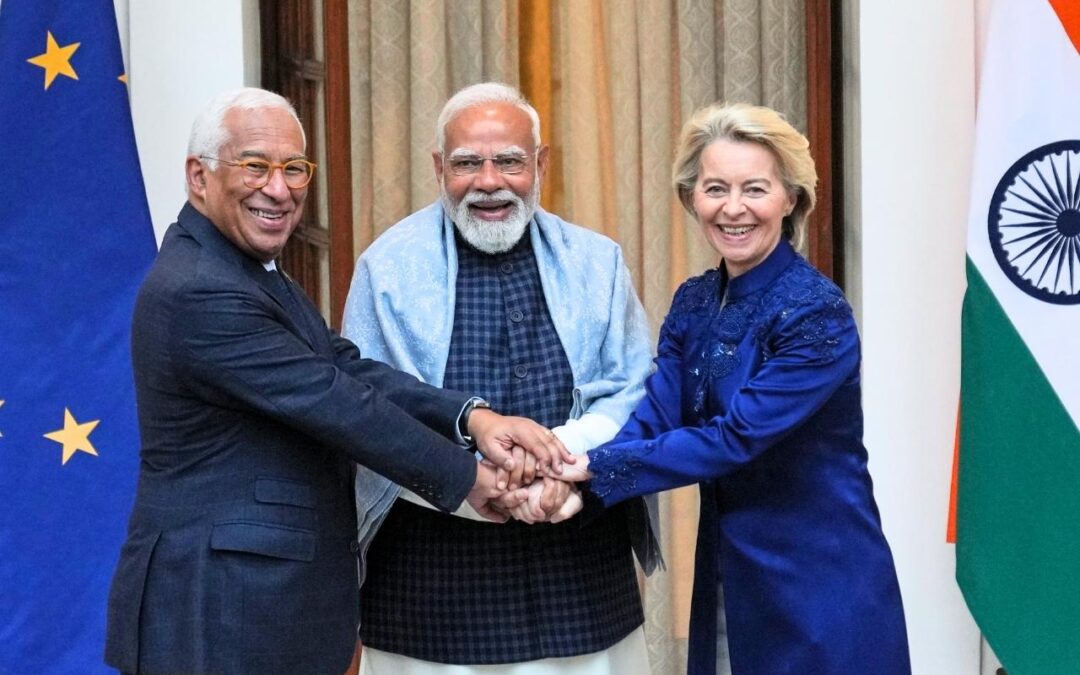
Synopsis: The India-EU FTA agreement is expected to increase exports and support various sectors across states of India which helps diversify India’s export markets by improving access to European markets.
India proposed a FTA (Free Trade Agreement) with the European Union (EU) marking a major step in expanding the country’s global trade. The deal was opened to 27 European markets and is expected to unlock export opportunities worth ₹6.4 lakh crore, with multiple states benefiting from it.
The agreement has the potential to strengthen India’s exports competitiveness, create job opportunities, and accelerate growth with lower tariffs and improved market access.
A Free Trade Agreement is a trade between two or more countries agreeing to reduce or eliminate tariffs, quotas, and trade barriers, making it easier and cheaper to trade goods and services.
This aims to boost exports, attract investments. India in the past signed FTAs with Japan, South Korea, EFTA, SAFTA etc. This helps India expand exports and reduce barriers and integrate more deeply into global supply chains.
The impact of implementing the India-EU FTA will vary across the Indian states. It majorly depends on the industries present, exports and sectoral strengths.
Key Indian States Likely to Benefit
1. Maharashtra
Maharashtra is expected to be one of the biggest beneficiaries as it has a strong manufacturing base, port connectivity, and export ready. Multiple high value sectors are likely to benefit from lower tariffs and improved EU market access.
- Reduced tariffs benefit: Textiles & apparel, electronics, engineering goods, pharmaceutical, and medical devices which improves their access to EU markets and cost competitiveness.
- Duty reductions benefit exports of gems & jewellery, leather goods, marine products, agri products, tea, and spice, which is an opportunity for the Indian exporters to expand into premium markets.
- Pune, Mumbai and garment clusters gain due to their manufacturing capacity and port connectivity.
2. Gujarat
Gujarat significantly benefits due to its exports, port infrastructure and dominance in trade driven sectors.
- Textiles, diamonds & jewellery, chemicals, engineering goods and marine products gain from tariffs and duty reductions.
- Port infrastructure, SEZs, and export-oriented clusters support higher EU bound trade from the state.
3. Tamil Nadu
Tamil Nadu is likely to see major gains from labour intensive manufacturing and MSMEs
- Apparel, leather, footwear, engineering goods, and electronics benefit from market access and reduced tariffs
- Labour intensive industries and MSMEs help scale exporters and support employment.
4. Karnataka
Karnataka is expected to benefit through its technology, electronics and pharmaceutical sectors.
- Electronics, engineering components, pharmaceuticals have export growth due to lower trade barriers.
- Bengaluru-Tumakuru industrial corridor strengthens integration with EU supply chains.
5. Uttar Pradesh
Uttar Pradesh is likely to gain from its strong coastal export hubs and marine.
- Leather, footwear, electronics, agri-products, and handicrafts gain access to EU markets
- Large labour base and traditional clusters support labour intensive exports
6. Andhra Pradesh
Andhra Pradesh has benefited hugely from its coastal export hubs, electronics and Pharmaceutical.
- Marine products like Shrimp, seafood, pharmaceuticals, and electronics benefit from reduced tariffs.
- Vishakhapatnam and Kakinada ports benefit with high export volumes to Europe.
7. Telangana
Telangana gains majorly from expanding its Pharmaceutical, electronics and manufacturing
- Textiles, pharmaceuticals, electronics, medical devices, and engineering goods benefit from EU access
- Hyderabad-Warangal industrial region supports manufacturing led exports
8. West Bengal
- Darjeeling tea, seafood, and handicrafts enter into premium European markets
- Exports oriented agri and artisan clusters benefit from reduced duties
9. Assam
- Tea, species, bamboo handicrafts, and niche pharma products benefit from reduced duty.
- Agri-based exporters and MSMEs gain better access to EU customers.
10. Kerala
- Spices such as pepper, cardamom, and marine products benefit from lower tariffs.
- Coastal export hubs and farmer networks gain from increased demand
11. Punjab
- Garments, knitwear, sports goods and light engineering products benefit from reduced tariffs.
- SME-driven manufacturing clusters support increased EU exports
12. Rajasthan
- Jewellery, handicrafts, sports goods, leather goods, textiles benefit from reduced duty.
- Traditional artisan and exports gain better access to EU markets.
Also Read: Budget 2026: Will 80C Deduction Limit Be Increased to ₹3.5 Lakh? Here’s What Experts Say
Major Sectors Poised for Growth
1. Textiles & Apparel
Under FTAs proposal, it is expected to introduce zero or reduced tariffs on several textile products which will improve competitiveness in the textile market and increase exports.
2. Leather & footwear
Reduced tariffs open access to the $100 billion EU leather and footwear market, supporting exporters from Agra, Kanpur, Kolhapur and southern manufacturing hubs.
3. Gems & Jewellery
Duty concession enabled better access into the $79 billion premium EU jewellery market, which benefits exporters from Gujarat, Maharashtra, and Rajasthan
4. Engineering & manufacturing goods
Trade access is expected for engineering goods, electronics, chemicals, plastics and rubber products making India’s manufacturing and exports stronger with Europe.
5. Pharmaceuticals & Medical devices
Improved market access and lower trade barriers supports export growth for the medical field with devices and pharmaceuticals, helping Indian firms export in larger volumes.
6. Marine & Agri-Products
Lower tariffs and improved access benefits exporters of seafood mainly shrimp, fish and spices, tea and handicrafts, which increases demand for Agri and marine products in European markets.
7. MSMEs & Labour-Intensive Clusters
Better and expanded access to the EU benefits MSMEs and labour-intensive exports, which helps the smaller firms integrate into global markets and creates job and employment.
Conclusion
The India-EU FTA is expected to diversify and strengthen India’s export destinations, reinforce high-growth and labour intensive sectors covering both modern and traditional exporters spanning across garments, leather, electronics, pharmaceuticals, agri- products etc.
Written by Boyapati Sai Jasmitha