
Synopsis: Petrol prices across India remain uneven in 2026 with state-level taxes continuing to drive a noticeable price gap. The base fuel cost is broadly aligned nationwide but it is the final retail price that varies by as much as ₹15–₹20 per litre. These numbers vary depending on location thus it makes regional taxation a determinant of what consumers ultimately pay.
India’s fuel pricing continues to operate under a decentralised tax regime where states retain the authority to impose VAT and additional levies. Even when there is stable global crude prices and uniform central excise duties the final retail price of petrol differs significantly across regions. This divergence is most evident between high-tax metropolitan markets and lower-tax regions. Let us check the prices of each state in this article and see how geographical placement directly influences fuel expenditure in the country.
What Influences Petrol Prices and Why They Change Daily
Amid rising tensions in the Gulf, Indian oil marketing companies (OMCs) have kept regular petrol and diesel prices stable in major cities, despite severe volatility in global crude oil markets which saw prices surge. Petrol prices in India are revised daily under a pricing system. The Oil marketing companies adjust prices based on changes in global crude oil rates and currency exchange fluctuations which means even small international shifts can reflect at local fuel stations.
At the same time the taxes imposed by both the central and state governments remain a major component of the final price. Since state VAT differs widely, it creates noticeable variation across cities even on the same day.
- The global crude oil prices have an influence on the cost
- Rupee vs US dollar exchange rate impacts import cost
- Central excise duty remains fixed in the short term
- State VAT creates price differences across regions
- Daily revisions reflect international market changes
State-wise Petrol Prices in 2026
| State | Petrol Price (₹/L) |
| Andaman And Nicobar | 82.46 |
| Andhra Pradesh | 109.53 |
| Arunachal Pradesh | 92.35 |
| Assam | 98.93 |
| Bihar | 106.95 |
| Chandigarh | 94.30 |
| ChhattisgarhDadra And Nagar Haveli | 100.1292.57 |
| Daman And Diu | 93.40 |
| Delhi | 94.77 |
| Goa | 96.96 |
| Gujarat | 95.07 |
| Haryana | 95.38 |
| Himachal Pradesh | 93.55 |
| Jammu And Kashmir | 97.71 |
| Jharkhand | 99.16 |
| Karnataka | 102.41 |
| Kerala | 107.25 |
| Madhya Pradesh | 106.18 |
| Maharashtra | 105.43 |
| Manipur | 99.21 |
| Meghalaya | 95.72 |
| Mizoram | 99.46 |
| Nagaland | 98.25 |
| Odisha | 102.23 |
| Puducherry | 96.92 |
| Punjab | 97.91 |
| Rajasthan | 105.51 |
| Tamil Nadu | 102.34 |
| Telangana | 106.89 |
| Uttar Pradesh | 95.00 |
| Uttarakhand | 94.51 |
| West Bengal | 105.80 |
One important detail to note from this dataset is the numbers seem to be smaller regions and union territories tend to have lower prices wherein larger states with higher tax brackets dominate the upper range. Also note that this data is for the effective date of 20th March 2026.
Also read: 7 Indian States Where Non-Locals Cannot Buy Property – Is Yours on the List?
5 Highest and Lowest Petrol Price States
Highest price states include
- Andhra Pradesh with ₹109.53
- Kerala with ₹107.25
- Bihar with ₹106.95
- Telangana with ₹106.89
- Madhya Pradesh with ₹106.18
Lowest price states / UTs we have
- Andaman and Nicobar with ₹82.46
- Arunachal Pradesh with ₹92.35
- Dadra and Nagar Haveli with ₹92.57
- Daman and Diu with ₹93.40
- Himachal Pradesh with ₹93.55
The gap in above petrol prices across the states shows us how taxation and regional cost structures take an important role. The lowest prices are majorly concentrated in smaller regions geographically and the higher prices are seen in the tax-heavy regimes in larger states. The resulting spread of over ₹25 per litre underscores how significantly location influences everyday fuel expenses.
The chart below illustrates this price gap
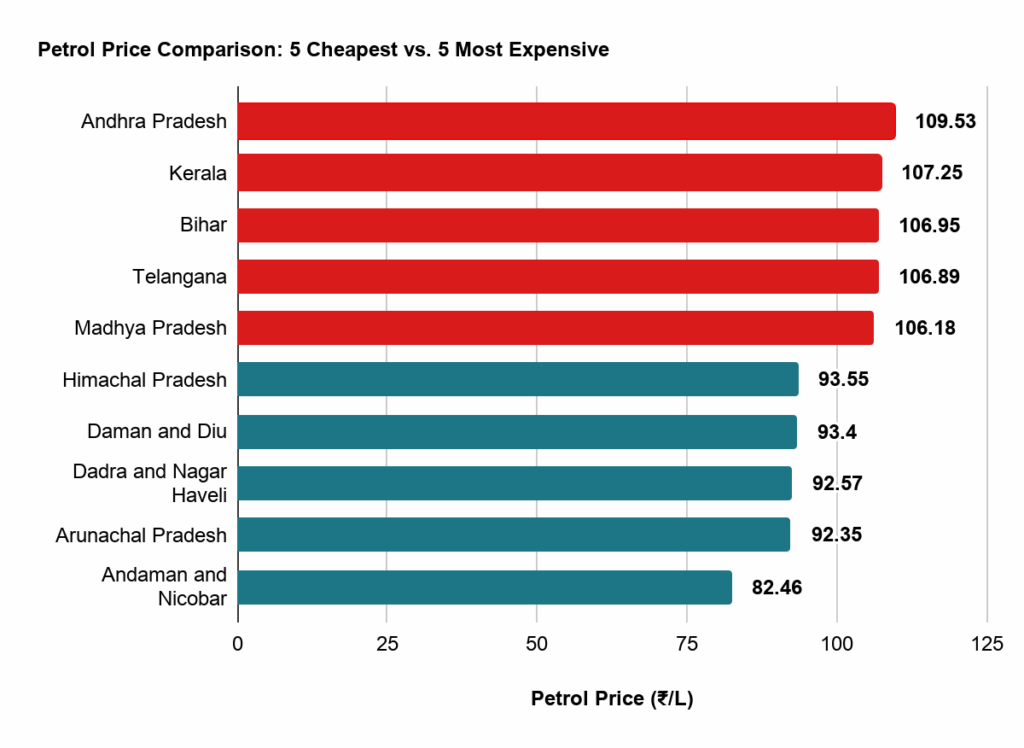
The difference is not gradual but clustered with high-price states grouped above ₹106 and low-price regions mostly below ₹94.
Why Some States Are More Expensive
The main reason behind the variation in petrol prices across states is taxation. Additionally petrol is not included under the GST framework thus state governments rely heavily on it as a consistent source of revenue and adjust VAT rates based on their fiscal requirements. The states which have a higher expenditure number tend to impose higher fuel taxes. That is why VAT acts as the single largest factor influencing the difference in petrol prices across India.
The Impact on Economy of Fuel Price Differences
Fuel prices have a cascading impact on both regular livelihood and the broader economy. Even small differences per litre can scale significantly when applied to daily consumption. When the petrol prices are on the higher end they increase commuting costs for individuals and raise transportation expenses for businesses. When the commuting cost increases in turn it leads to an increase in the price of goods and services. This creates inflationary pressure and can also affect business competitiveness by increasing operational costs compared to lower-tax regions.
Closing Insight
Petrol prices in India reflect a combination of global oil market trends and state-level taxation policies. The daily revision mechanism helps prices to remain aligned with international movements and the most significant variation still comes from differences in local tax structures. As long as petrol remains outside the GST framework, state VAT will continue to play a dominant role, daily price changes will remain marginal, and regional disparities in fuel costs are likely to persist in 2026.
Written by Kenbi Riba