
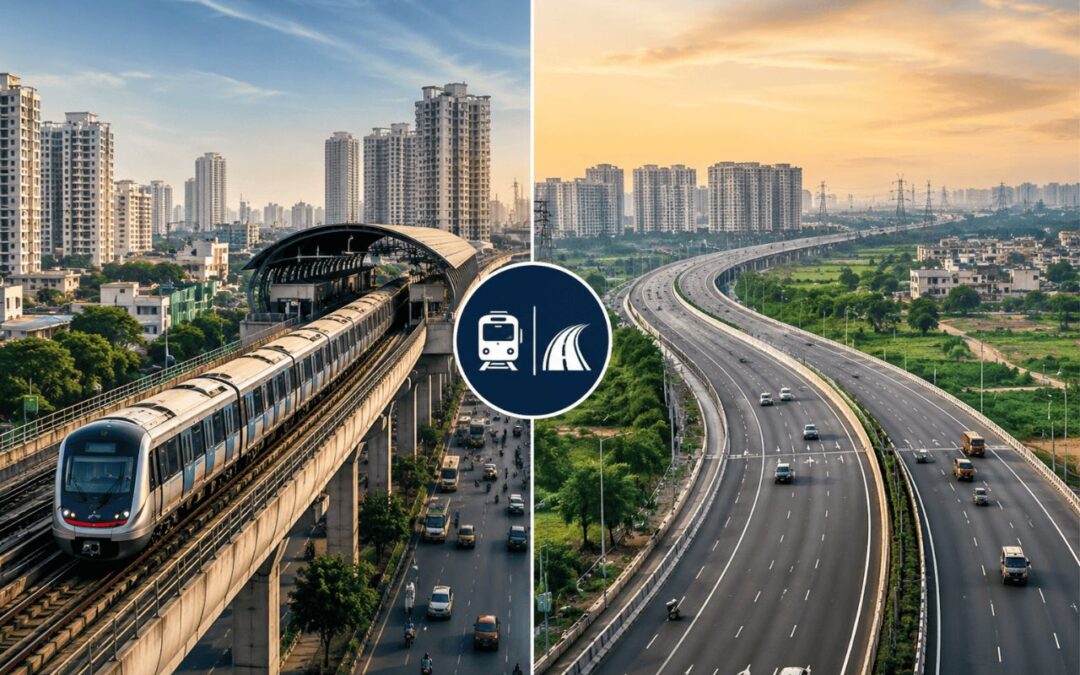
Synopsis: India’s real estate market is evolving with the introduction of metro corridors and ring roads that are all offering different forms of growth. Ideal investments will depend on each investor’s investment goals and time horizon. Metro corridors will foster demand for residential investment, while ring roads will drive large-scale land appreciation for investment.
Some of the most transformative roads have been metro rail corridors and ring roads, which have transformed connectivity and cut down journey times and facilitated new growth opportunities. But their effect on property values varies greatly. The metro corridors are more likely to be a driver of residential demand and rental appreciation, while the ring roads tend to open up large land parcels for large-scale townships, commercial hubs, and logistics parks. The value of these assets in helping to create real estate values is gaining a newfound significance for investors, developers and home buyers.
Why Infrastructure drives Real estate growth?
Infrastructure and real estate are very interconnected, and better connectivity frequently can spur property appreciation. Significant infrastructure investments can even revolutionize an entire real estate market by making things easier to get to and bringing in more economic activity.
- The role of connectivity in property value: Infrastructure projects shorten travel times and enhance access to employment areas, education and health care facilities, and business districts. The more convenient a place is, the more desirable it will be to home buyers and businesses, therefore increasing demand for the property.
- Economic growth and job creation: Greater connectivity encourages offices, retail and commercial development. The jobs that are produced provide a continuing demand for both homes and commercial properties.
- Urban and new development: Other areas that were not developed can now be expanded because of infrastructure. Developers typically react with new residential projects, integrated townships and commercial developments, thus accelerating urbanisation.
- Investor Confidence: Major public infrastructure projects are a sign of future growth. This tends to draw in individuals who desire capital gains and boost the need for real estate in general.
Metro corridors: How they create property value
The growth in connectivity and reduced travel time associated with metros increases the demand for both houses and offices in the metropolitan areas, which are located at the fringe of the city. Research has shown that homes within 500 metres to 1 kilometre of metro stations can fetch a 10-20% premium and in some metro corridors, homes have appreciated by 15-40% within 3-5 years of the metro’s opening.
- Transit Oriented Development (TOD): Highly developed urban centres are often located along land close to the metro stations, which have high density of residential and commercial developments.
- Strong Residential Demand: Located in the metros, homes are convenient to the home buyers, which causes the prices to rise and the homes to absorb quickly.
- Higher Rental Demand: Rental demand and occupancy rates increase when it is easy to access workplaces and educational facilities. However, on the newer lines in Mumbai, residential and commercial properties are projected to see value appreciation of 10-15% and rental markets have seen incremental value appreciation since the lines opened.
- Commercial Growth: Metro stations tend to attract retail, office, restaurant and service businesses together because of the large number of commuters. Business and investor interest in metros has been increasing with 20-25% growth in commercial and retail property values along metro corridors in several markets.
Also read: Data Centres or Warehouses? Which Investment Could Deliver Higher Returns Over the Next Decade?
Ring Roads: How they create property Value
Metro corridors value added mainly to existing urban neighbourhoods, ring roads value added to new growth zones. These links between the outskirts of the city and airports, industrial complexes, business centres and national highways afford ample scope for large scale development of real estate, and for the long-term appreciation of land.
- Land Appreciation Potential: Land value gains in India have been highest in ring roads. In the early 2010s, the land value in some micro-markets around ORR, like Kokapet and Narsingi, was estimated at ₹2,000-5,000 per sq. ft., which has now appreciated by more than 100% today.
- Township and Residential Growth: Availability of large lands has led to the development of integrated townships and gated communities. The Peripheral Ring Road (PRR) of Bengaluru and the ORR corridor of Hyderabad have been appreciating by 8-15% per annum in the last few years, outperforming many of the established city centre locations.
- Warehousing and Logistics Boom: Ring roads are key enablers for industrial and logistics growth. In the recent past, India’s warehousing leasing market has witnessed more than 40 million sq. ft. per year, with a substantial portion of it located in the ring roads, bypasses, and peripheral highway corridors. These developments offer jobs and raise demand for housing in the surrounding areas.
- Commercial Development: The ring road corridors become competitive for office parks, hotels, malls, hospitals and educational institutions as population density grows. In the ORR corridor and around the Financial District, Hyderabad; the rental of Grade-A office space has jumped to above ₹70-100 per sq. ft. per month, and the price of commercial land has gone up significantly with the growing expansion of corporates.
Metro Corridors vs Ring Roads
Example: ₹10 crore investment in areas around Ring Rods and Metro corridors
Suppose the investor had invested ₹10 crore in 2016 in two different corridors of growth based on infrastructure
Key Takeaway
Even though a metro corridor investment may not experience the same dramatic price appreciation seen in ring roads, it will still provide consistent rental income, making it an ideal investment for those who want cash flow. The capital gains that could be achieved from a ring road investment like that in rapidly growing corridors like Hyderabad’s ORR, could be substantial, but rely more on future growth and development and infrastructure.
Conclusion
While both corridors and ring roads are strong growth areas for real estate, the difference is that they each have a different effect. In general, the rentals of Metro corridors are strong and the appreciation rates are steady, whereas the long-term appreciation comes from land and commercial development along the ring roads. That depends on investors’ investment goal; they can have stable returns and cash flow from properties in the metros while ring road corridors offer greater capital appreciation potential.
Written By Boyapati Sai Jasmitha