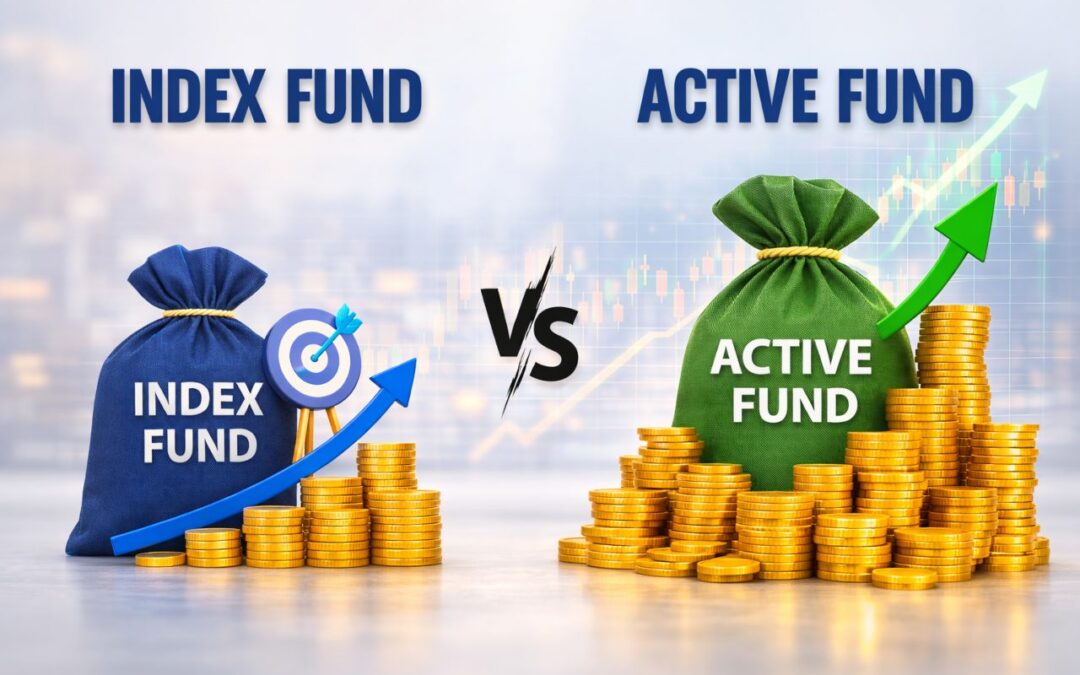
Synopsis: Two of the most popular mutual fund investments are active funds and index funds, but they have very different strategies. Whereas index funds tend to track the returns of the market, active funds tend to beat the market by picking the stocks strategically. This paper discusses the main distinctions and why active funds can present some benefits to the investors.
There are two broad categories of mutual funds, active funds and index funds, which are based on the management of the portfolio. Active funds are run by skilled fund managers who are involved in the process of actively choosing stocks, industries, and investment strategies in an effort to beat the market index.
Conversely, index funds use the passive style of investment in which the fund merely tracks a market index, like the Nifty 50 or Sensex, hoping to keep pace with it, and not outperform it. The distinction between the two approaches can assist investors in selecting the most appropriate strategy that meets their investment objectives, the level of risk, and the future of the market.
Active vs Index Funds
Example: Active Fund vs Index Fund (Nippon India)
Example of How ₹1,00,000 Investment Could Work
Advantages of Active Funds over Index Funds
1. Potential to outperform the market
Active funds supposedly seek to make more returns as compared to the index. Fund managers do an intensive study of the firms and choose the stocks that they feel will outperform the market.
2. Flexibility of Portfolio Management
Active funds, unlike index funds, allow managers the freedom to make changes to the holdings depending on the market conditions, sector trends or changes in the economy.
3. Ability to Avoid Weak Stocks
Index funds are based on all the firms within a given index, even those with low performance or poor fundamentals. Such stocks can be avoided by the active fund managers as they may concentrate on other better companies, which may result in better results of the portfolio as a whole.
4. Better opportunities in Weakly Efficient Markets
Active strategies are also very applicable in segments such as small-cap or emerging markets, where the markets are not able to put the actual value of the companies in terms of their prices. The presence of competent fund managers is able to spot under-priced stock and yield superior returns.
Who should choose Active Funds?
Active funds might be appropriate for those investors who seek to make more than the market and those who want the investment decisions to be made on their behalf by professional fund managers. They also suit well the people who are happy to pay a little more in order to get an active selection of stocks and have flexibility in the portfolio.
Who should choose Index Funds?
Index funds will suit the investor who wants to maintain a passive investment strategy, which is low-cost and which merely tracks the market. They are suited to long-term investors who prefer to have market-matching returns that are stable with little or no monitoring or participation.
Conclusion
Active as well as index funds are significant in the portfolio of an investor. Although index funds have advantages such as simplicity and reduced costs and matching returns in the market, the active funds have the opportunity of appearing to be more successful in the market due to research-based selection of stocks and management of the portfolio.
Finally, both the two options are determined by the financial objectives, the risk tolerance and the preference of an investor to either actively manage a portfolio or invest passively.
Written by Boyapati Sai Jasmitha