
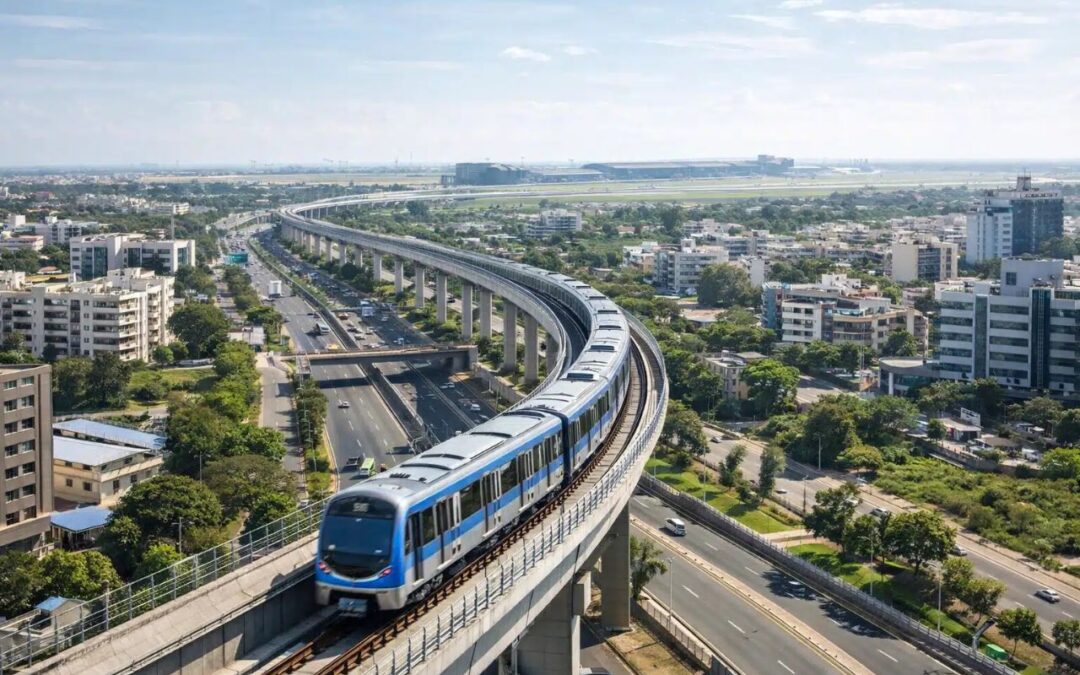
Synopsis: Namma metro is the largest contributor to the real estate boom in Bengaluru. This article covers the rise in prices of properties around the major stations of Namma Metro in the last 10 years, appreciation trends, impact of metro connectivity, and more.
In the last 10 years, Namma Metro has revolutionized the real estate sector in Bengaluru, and metro connectivity is one of the key factors that has become a determining factor in property values. As travel time decreased and connectivity improved, areas previously on the fringes have become prime spots for residential and investment opportunities.
Namma Metro at a Glance
Purple Line
The Purple Line is Namma Metro’s longest running line, stretching 43.49 km with 37 stations, between Whitefield (Kadugodi) and Challaghatta.
i) Whitefield (Kadugodi metro station)
The average appreciation of property prices in Whitefield from 2016 to 2026 is approximately 154% from ₹5000-6,500 per sq.ft. in 2016 to ₹7,000-16,000 per sq.ft. in 2026. With the addition of the Purple Line extension, and a strong IT sector, residential demand has increased significantly in the area.
ii) KR Puram Metro Station
The appreciation of average residential price in KR Puram from around ₹4200 per sq.ft. in 2016 to ₹10,500 per sq.ft. in 2026 represents an appreciation of around 144%. With better connectivity to Whitefield, Old Madras Road and Outer Ring Road, the KR Puram is one of the fastest growing residential markets in East Bengaluru.
iii) Indiranagar Metro Station
Already a premium locality in 2017, the average price per sq.ft. of Indiranagar properties have increased by 120%. Prices were ₹9,000-14,000 per sq.ft in 2016 to ₹16,000-28,000/sq.ft. in 2026.
iv) Baiyappanahalli Metro Station
The residential properties in and around Baiyappanahalli have seen an appreciation of around 110-120% from ₹5,500 per sq. ft. in 2016 to ₹11,500-12,000 per sq. ft. in 2026.
v) Vijayanagar Metro Station
Vijayanagar, on the other hand, saw a 120-130% increase in average residential appreciation from ₹6,000 per sq. ft. in 2016 to ₹16,000-20,000 per sq. ft. in 2026.
Green Line
The Green Line is a 33.46 km long line connecting Madavara to Silk Institute having 32 stations. It passes through the North-West, Central and South Bengaluru, has created good connectivity with established residentials areas and has seen regular capital appreciation in the past ten years.
i) Yeshwanthpur Metro Station
The average price in Yeshwanthpur is approximately ₹6000-8,000 per sq. ft. in 2016 to ₹13,000-16,000per sq. ft. in 2026, which translates to a 125% appreciation.
ii) Rajajinagar Metro Station
The prices of the houses at Rajajinagar have appreciated by 112% from about ₹7,000-12,000 per sq.ft. in 2016 to ₹15,000-25,000 per sq.ft. in 2026. It is one of the most popular markets in West Bengaluru due to its prime position, good developments and proximity to the metro station.
iii) Jalahalli Metro Station
The average residential price in Jalahalli has increased from approximately ₹4,800/sq. ft. in 2016 to ₹8,500-10,000/sq. ft. in 2026, which is a 112% appreciation. The metro connectivity, the proximity to Peenya Industrial Area and its continuous development of residential projects.
iv) Jayanagar Metro Station
Jayanagar has seen prices appreciate by approximately 105% from ₹11,500/sq. ft. in 2016 to ₹14,500-24,000/sq. ft. in 2026, marking it as one of the top residential areas in Bengaluru.
Yellow Line
The Yellow Line runs for 19.15 km from RV Road to Bommasandra, has 16 stations. The corridor has been opened just recently but the prices of properties along the line have been increasing for several years in expectation of metro connectivity.
i) Electronic City Metro Station
The average residential price in Electronic City is up 127% from ₹4,500 per sq. ft. in 2016 to ₹8,900 per sq. ft. in 2026. Enhanced connectivity, the clustering of IT firms and the operation of the Yellow Line have had a significant positive impact on housing demand.
ii) Bommasandra Metro Station
The property value in Bommasandra has appreciated by around 127% from ₹3,500-5,500 per sq. ft. in 2016 to ₹5,500-10,500 per sq. ft. in 2026. With affordable housing, industrial and IT hubs and metro connectivity, it’s been a preference among first-time home buyers and investors.
iii) Huskur Road Metro Station
Around Huskur Road, residential properties are valued at around ₹3500 per sq.ft. in 2016 to ₹7800-10,000 per sq.ft. in 2026, that is an appreciation of nearly 129%. The locality has received infrastructure development, there is great demand for employment and the strategic position along the Yellow Line corridor.
Blue Line
The Blue Line is under development in two phases, connecting Central Silk Board to Kempegowda International Airport and will be 58.19 km long with 30 stations once it is completed.
i) Hebbal Metro Station
In case of residential properties, the average price has jumped by approximately 118% from around ₹6,800-9,000 per sq.ft. in 2016 to ₹15,00-25,000 per sq.ft. in 2026. It has been consistently in demand, and its strategic location, near Manyata Tech Park, and the upcoming airport metro.
ii) Nagawara Metro Station
The appreciation rate of property prices has been around 115% from around ₹5,500 per sq. ft. in 2016 to ₹11,900-13,500 per sq. ft. in 2026. The better access to Outer Ring Road and airport corridor has bolstered residential and commercial demand.
iii) Yelahanka Metro Station
The Yelahanka residential price in 2016 was approximately ₹4700 per sq. ft., now increasing to ₹10,500-14,500 per sq. ft, marking an increase of around 112%.
Pink Line
The Pink Line, which will run from Kalena Agrahara to Nagawara, will be 21.26 km in length with 18 stations. Running along South and Central Bengaluru, the project is likely to enhance the east-west connectivity.
i) Bannerghatta Road
The appreciation of residential price per square feet has been around 119% along Bannerghatta Road from the average price of ₹3,500-5,500 per sq. ft. in 2016 to ₹10,000-14,000 per sq. ft. in 2026. The presence of IT parks, educational institutes, hospitals, and the upcoming metro corridor has been the driving factor for demand.
ii) Jayadeva
The prices of properties around Jayadeva have appreciated by around 119% from ₹6,000-9,000 per sq. ft. in 2016 to ₹13,500-17,000 per sq. ft. in 2026. The area will be a future development for the Yellow and Pink Lines interchange with more developments on the commercial and residential side.
iii) Dairy Circle
The appreciation in the value of residential property in Dairy Circle has been approximately 108% from around ₹7,200-12,000 per sq. ft. in 2016 to ₹12,000-21,000 per sq. ft. in 2026. Its prime location, close to job centres and soon to be metered connect, has made it attractive to home buyers and investors.
Top 10 metro stations with the highest property price appreciation: 2016-2026
What makes Metro connected properties cost more?
- Easier and quicker travel to work.
- Increased housing demand, from homeowners and renters.
- Improved access to IT hubs, business centres and social facilities.
- Increased demand for renting and higher investment profits.
- Sustained appreciation due to continued infrastructure growth.
Conclusion
In the last decade, Namma Metro has emerged as one of the largest contributors to the real estate boom in Bengaluru. Metro connectivity has already led to a major increase in property values, whether from a well-established line like the Purple Line or a newer route like the Yellow, Blue or Pink Lines. Existing and new metro stations will likely continue to be one of the city’s most attractive places to invest and live as the network expands.