
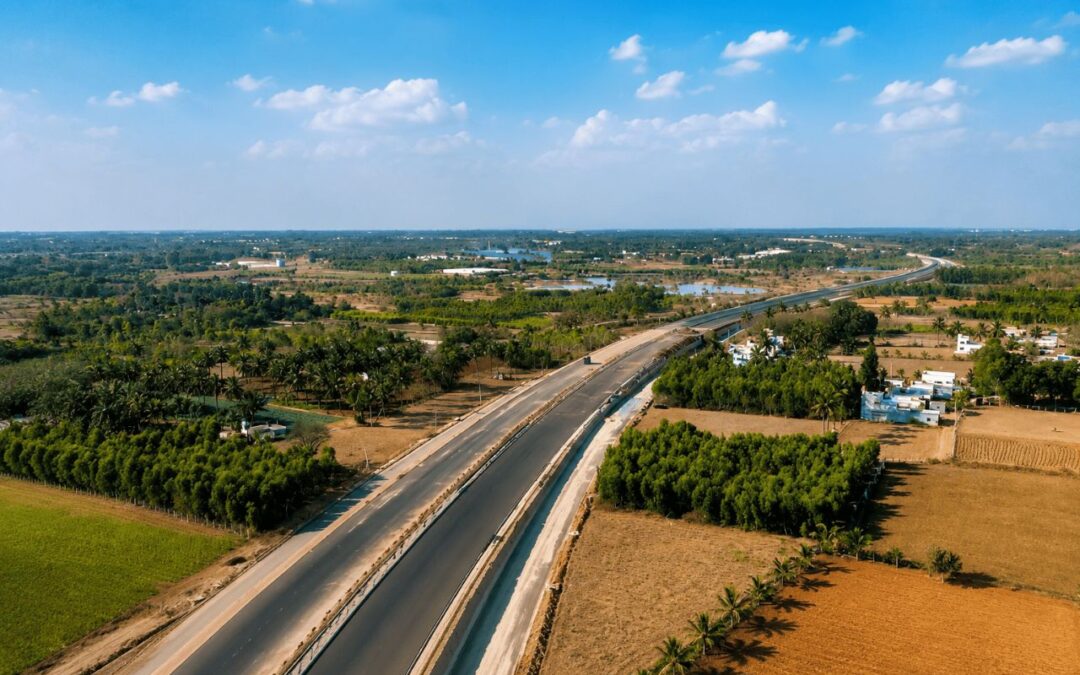
Synopsis: The Satellite Town Ring Road (STRR) is becoming one of the biggest drivers of Bengaluru’s next realty growth. STRR is poised to become the next big real-estate catalyst for the city with improved connectivity, growing industrial activity and investor interest in the periphery areas like Devanahalli, Hoskote and Bidadi.
The city is on a new growth trajectory in Bengaluru. Due to the close of the city population (nearly 14 million) and the number of cars being registered (1.2 crore), the pressure on the Central Business Districts and the main corridors like the ORR has increased. As congestion grows and commute distances extend, residential and industrial development is slowly moving outwards and as land values have risen, this is being driven by rising land costs.
Satellite Town Ring Road (STRR)
The National Highways Authority of India (NHAI) is developing the Satellite Town Ring Road (STRR), a proposed 280-km access-controlled highway project to enhance regional connectivity around Bengaluru. As an expanded outer mobility network to the existing Outer Ring Road (ORR), STRR is intended to link up important satellite cities, industrial corridors, logistics locations and national highways that ring the city.
The Greenfield corridor is expected to cut through significant growth areas such as Devanahalli, Doddaballapur, Hoskote, Sarjapur-side and Ramanagara industrial belts, Bidadi and Tumakuru-side without forcing traffic through Central Bengaluru. Unlike ORR, which focuses mostly on urban city traffic, STRR is designed to decongest the currently congested core roads of Bengaluru of the heavy freight movement and intercity traffic.
The project also enhances connectivity to strategic economic corridors like Kempegowda International Airport corridor, Industrial parks, Warehousing clusters, and Chennai-Bengaluru Industrial corridor. Once in operation, STRR is projected to shorten the time required to travel between peripheral areas, increase logistics efficiency, and provide ample land for township, industry and residential development.
Why Bengaluru needs STRR
- There are more than 1.2 crore registered vehicles in Bengaluru causing huge traffic jams on ORR, Silk Board, Hebbal and other key arterial roads.
- Several corridors have reported peak hour speeds below 18 km/h which is impacting commute and logistics costs.
- The rapid increase in land values, scarcity of development space and high infrastructural stress in Core Bengaluru is making it difficult to pursue large-scale residential and industrial development.
- City roads remain a vital part of the industrial freight network and are still heavily utilized for this purpose, which causes traffic congestion.
- The objective of the STRR is to push inter-city and heavy commercial vehicles out of the city centre and away from Bengaluru with the creation of a 280-km high-speed corridor that will link the satellite towns.
- The project will also be able to spur growth in the surrounding areas like Devanahalli, Hoskote, Doddaballapur and Bidadi, which will be made easier and faster through the project.
STRR as Infrastructure Multiplier for the City
The project will link various economic corridors such as Bengaluru–Chennai Expressway, Tumakuru Road, Hosur Road and the Kempegowda International Airport region.
- The increased speed of freight transport will help to decrease the use of other congested city routes, like ORR and NICE Road, thus increasing the efficiency of the freight logistics sector and in particular that of industries and ecommerce businesses.
- The corridor is also expected to facilitate the shift of Bengaluru from a city of a single nucleus to a multi-node metropolitan city with disbursed economic centres.
Satellite Towns as Realty Hotspots
Devanahalli (North Bengaluru)
- The proximity to Kempegowda International Airport has been driving up the demand for residential and commercial space.
- Land is being absorbed by Aerospace SEZ, Blue Line Metro Expansion, Business centres and warehousing developments.
- The plot prices at several micro-markets of North Bengaluru have seen appreciation in the range roughly between ₹4,500-₹8,000 sq ft.
Also read: Devanahalli Growth Story: Why It Has Emerged as the Strongest STRR-Led Corridor
Hoskote & East Corridor
- It benefits from STRR connectivity, Bengaluru-Chennai Expressway, Industrial clusters and Whitefield spillover demand.
- The real-estate business is growing as a result of increases in manufacturing, logistics parks and industrial investments.
- Better highway access is driving growth in the demand for apartments, plotted developments, and warehousing.
Nelamangala & Doddaballapur Belt
- Availability of relatively affordable land parcels is attracting plotted-development projects.
- The region is seeing some residential development as a result of textile and manufacturing activity.
- These northwestern belts are seeing industrial parks, warehousing, logistics expansion and land banking activity.
Bidadi–Ramanagara Corridor
- The demand for towns and houses is rising with industrial expansion, particularly in the manufacturing ecosystems.
- The long-term investment interest in the corridor is growing due to the area availability and its connectivity with STRR.
STRR and the Industrial Expansion Boom
The biggest reason behind STRR’s importance is Logistics. Bengaluru’s warehousing and industrial demand is rising due to E-commerce, Manufacturing, Airport cargo and supply chain expansion.
- STRR is expected to enhance freight efficiency, linking major national highways and industrial corridors in Bengaluru.
- The corridor will also help to diminish the need for using city roads for heavy trucks, thereby reducing logistics delays and transport expenses.
- Demand for: Peripheral belts along STRR are seeing growth in, Warehousing parks, Manufacturing units, Logistics hubs, Industrial townships
- The corridors in North and East of Bangalore are becoming major warehousing hubs as they are connected to the airport and have access to highways.
- The increasing demand for land use for e-commerce, third-party logistics (3PL), and industrial supply chains continues to drive up land demand throughout the STRR-related areas.
Conclusion
The STRR project is part of Bengaluru’s slow move from a single-core city to a sprawling network of satellite growth corridors. Integrating peripheral areas and regions, beyond the traditional city boundaries, is becoming a reality with growing residential, industrial and logistics activity. As investors are interested, infrastructure is expanding and land parcels are becoming larger, the company is likely to be one of the biggest drivers in Bengaluru’s next phase of real estate development.
Written by Jasmitha