

Synopsis: The cost of living in India differs majorly across cities which is largely by housing, income levels, and job opportunities. Where metros cities tops the most expensive place to reside there are several other cities that offer better affordability.
India’s urban lifestyle is constantly upgrading along with various changes that add more comfort and enjoyment to one’s life. The people who reside in the metropolitan cities understand that the cost of living does not always equate to the average salary the city offers. The lifestyle inflation saw it starting to rise when the prices of groceries to transportation went a massive jump.
The important part to understand is that not all cities are expensive in 2026. The division is clear with very few cities being on top of high maintenance ones. Let’s say for an example a monthly salary that may barely sustain a middle-class lifestyle in Mumbai could provide a much more comfortable living in Lucknow. To elucidate more in this article we will learn more about the cost of living across major Indian cities and compare living expenses with salary levels and advantages.
1. Mumbai
Mumbai remains India’s most expensive city in many aspects. The high cost of living is driven by limited land availability, dense population, and its status as the country’s financial capital. The brighter side is that it offers some of the highest-paying roles but the cost of living often offsets these advantages.
Housing is the main factor that dominates the majority of expenses as rents are among the highest in India. Even with the rising cost Mumbai continues to attract people due to its popularity in many domains both in professional and entertainment.
- Average monthly cost for individual: ₹30,000
- Average monthly cost of family: ₹70,000
- Average salary Annually: ₹3 to 7 LPA
2. Bengaluru
Bengaluru has established itself as India’s leading technology hub that attracts a large number of professionals each year. This demand has steadily increased both salary slab and living costs particularly in IT-dominated areas.
It is a bit more affordable than Mumbai but rising housing demand has pushed rents higher. The salary growth in the tech sector helps balance the cost of living for some of the population.
- Average monthly cost individual: ₹35,000
- Average monthly cost family: ₹70,000
- Average salary Annually: ₹3-10 LPA
3. Delhi
Delhi’s cost structure depends on the locality with premium areas significantly increasing the overall average. At the same time, peripheral regions provide more affordable options. The city benefits from its infrastructure and a diverse job market including government and corporate.
- Average monthly cost individual: ₹30,000
- Average monthly cost family: ₹80,000
- Average salary annually: ₹3-9 LPA
4. Hyderabad
It is one of the most prominent cities that offer a very under budget lifestyle. The city provides its dwellers a balance of affordable cost of living and job and other opportunities. The growth in IT and pharmaceuticals is the main reason behind the attractiveness of this destination. Compared to other Tier-1 cities, Hyderabad offers lower housing costs which directly play a big role in making the city affordable.
- Average monthly cost ALone: ₹25,000
- Average monthly cost family: ₹60,000
- Average salary annually: ₹3-10 LPA
5. Lucknow
Lucknow is a city which often pops up when speaking of the affordability advantage of tier-2 cities. The lower housing costs and a moderate lifestyle inflation make it more budget-friendly than metro cities. The reduced cost of living helps individuals to maintain better savings even though the salary brackets are lower.
- Average monthly cost individual: ₹15,000
- Average monthly cost of family: ₹40,000
- Average salary Annually: ₹2-4 LPA
(Note: The data is taken and averaged from NoBroker and Numbeo)
Also read: 7 Indian States Where Non-Locals Cannot Buy Property – Is Yours on the List?
Comparative Cost Snapshot
| City | Tier | Individual Cost p.m (₹) | Family Cost p.m (₹) | Avg Salary (LPA) |
| Mumbai | 1 | 50K–70K | 1L–1.5L | 4–8 |
| Bengaluru | 1 | 35K–55K | 70K–1.2L | 4–10 |
| Delhi | 1 | 30K–50K | 80K–1.3L | 4–9 |
| Hyderabad | 1 | 25K–45K | 60K–1L | 3–10 |
| Lucknow | 2 | 15K–30K | 40K–80K | 2–4 |
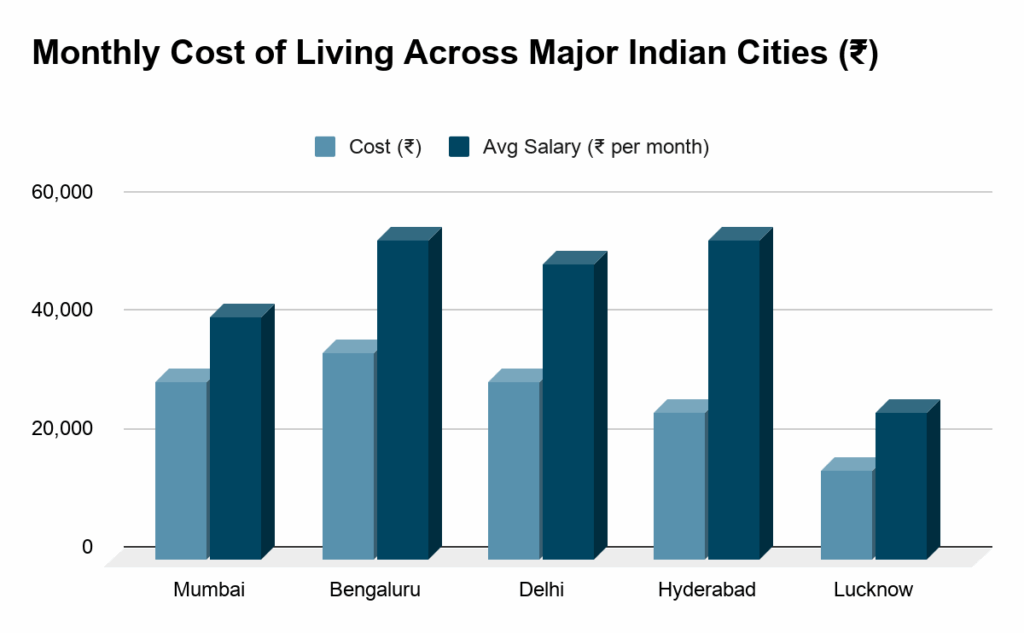
(Source: Aggregated estimates from Numbeo, NoBroker, and Glassdoor)
Data Insight
The data is a combination of various publicly available sources. Some of the details might be outdated as living expenses are growing very quickly each year. Readers are advised to check along for more concrete up to date numbers. With that said, the cities with higher rent indices consistently rank as more expensive which make the role of housing as the primary cost driver.
Though salaries are higher in metros, the difference in expenses often reduces actual savings. In contrast, tier-2 cities offer lower income levels but significantly better cost of living which can improve overall financial outcomes.
Conclusion
India’s cost of living varies across cities which makes location an important factor for financial decisions. Tier-1 cities provide higher income opportunities but come with higher expenses particularly in housing. Whereas Tier-2 cities provide affordability but may not provide some of the luxury as that of major metro cities.
FAQs
Mumbai. It is so mainly because of the housing costs.
Lucknow offers lower living costs compared to metros.
The biggest factor is often housing and rent.
Yes. As the infrastructure is improving and costs are lower it invites migration.
Written by Kenbi Riba
Disclaimer: All figures are indicative averages based on a combination of data collected from Numbeo, LivingCost.org, and NoBroker. The actual costs may vary depending on individual factors and market conditions.