
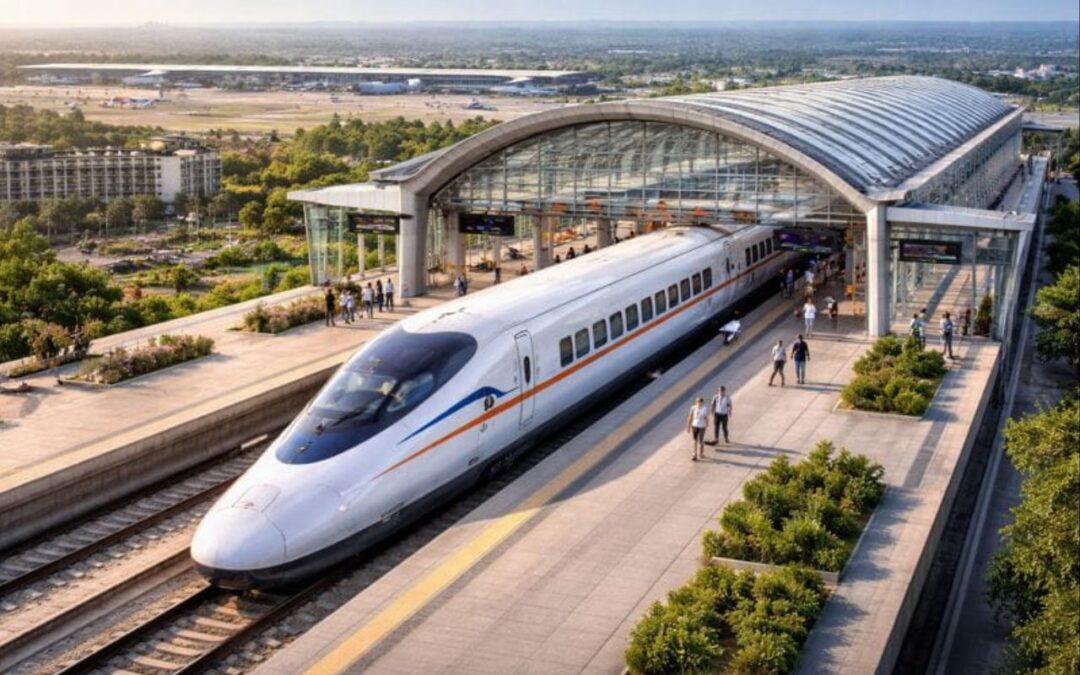
Synopsis: Hyderabad is set to become South India’s High speed rail powerhouse with 3 bullet train corridors that will improve the regional economies. This article covers the details about the corridors, benefits and reduction in travel time.
Hyderabad is poised to be a key hub for the Indian high speed rail network, featuring three proposed high speed rail links to Bengaluru, Chennai and Pune. These projects will have a significant impact on the travel times, regional connectivity and improvement of Hyderabad’s economic and transportation hub status in southern India.
Why Hyderabad was chosen
The railway is an attractive alternative for Hyderabad because of its strategic location, ensuring easy connectivity between the southern and western parts of the country. The city is one of the biggest business and passenger traffic centres of India in the field of IT, pharmaceuticals, aerospace, and manufacturing.
The infrastructure of the area is well developed, the Rajiv Gandhi International Airport, Outer Ring Road, a well developed National Highway network and the growing Metro Rail network, further reinforces its suitability as a high speed rail junction point. The proposed corridors have the potential to enhance regional mobility, promote economic development, and contribute to sustainable urban growth in various regions.
The 3 Dedicated Bullet Train Corridors
Hyderabad–Bengaluru
Hyderabad and Bengaluru are two major technology and innovation hubs of India which will be connected through the proposed bullet train route. The high-speed rail line will be about 570-626 km long and is expected to shave off the current 8-12 hours conventional train travel time and bring the journey down to 2-2.5 hours. The corridor is likely to traverse the major urban areas of Kurnool and Anantapur and will be connected to Bengaluru, improving the connectivity between the two states of Telangana and Andhra Pradesh and Karnataka.
Hyderabad–Chennai
The Hyderabad–Chennai route would be approximately 700-760km long, connecting India’s major industrial and port cities. The current train ride time is 10-13 hours, but it can take only 2.5-3 hours. It is likely that the route will go through significant points such as Amaravati and Guntur , boosting the connectivity between Telangana, Andhra Pradesh and Tamil Nadu.
Hyderabad-Pune
The proposed Hyderabad–Pune bullet train corridor will provide a fast connection between two major centres for IT, manufacturing, education, and the automobile industry. The trip time of the corridor is estimated to be reduced from 8-11 hours to almost 2-2.5 hours, covering an area of 560 km. It is expected to traverse through important cities like Zaheerabad, Kalaburagi and Solapur, thus interconnecting Telangana, Karnataka, Maharashtra and western India.
Expected Benefits
- The time required for travel between Hyderabad and Bengaluru, Chennai and Pune can be reduced from 8-13 hours to 2-3 hours.
- Enhance business travel: Higher connectivity will make it easier for workers to travel between key IT, manufacturing, pharmaceutical, and automotive hubs.
- Increased tourism: With improved access, there is an expectation of improved domestic tourism, as well as weekend trips from connected cities.
- Economic development: improved connectivity could draw new investment, promote industrial development and encourage economic development within the region.
- Real estate appreciation: Areas near proposed high-speed rail stations may see increased real estate development, both residential and commercial, and mixed use.
- Job creation: The project will generate thousands of jobs, both direct and indirect, during the construction and operation phases.
- Improved multimodal transport: improved airport-, metro- and national highway-, as well as traditional rail connectivity.
- Enhanced regional connectivity: The corridors will enhance the connectivity between Telangana, Karnataka, Andhra Pradesh, Tamil Nadu and Maharashtra which will help in the balanced development of the region.
Conclusion
The bullet train plans for Hyderabad Bengaluru, Hyderabad Chennai, and Hyderabad Pune covering distances of 353 km, 512 km, and 813 km, respectively, are important as part of India’s high-speed rail plans. The projects are currently on the proposal stage but their successful implementation may be able to change the way people travel between cities, boost economic integration between the regions, and help solidify Hyderabad’s status as one of the most critical transportation and commerce hubs in the country.