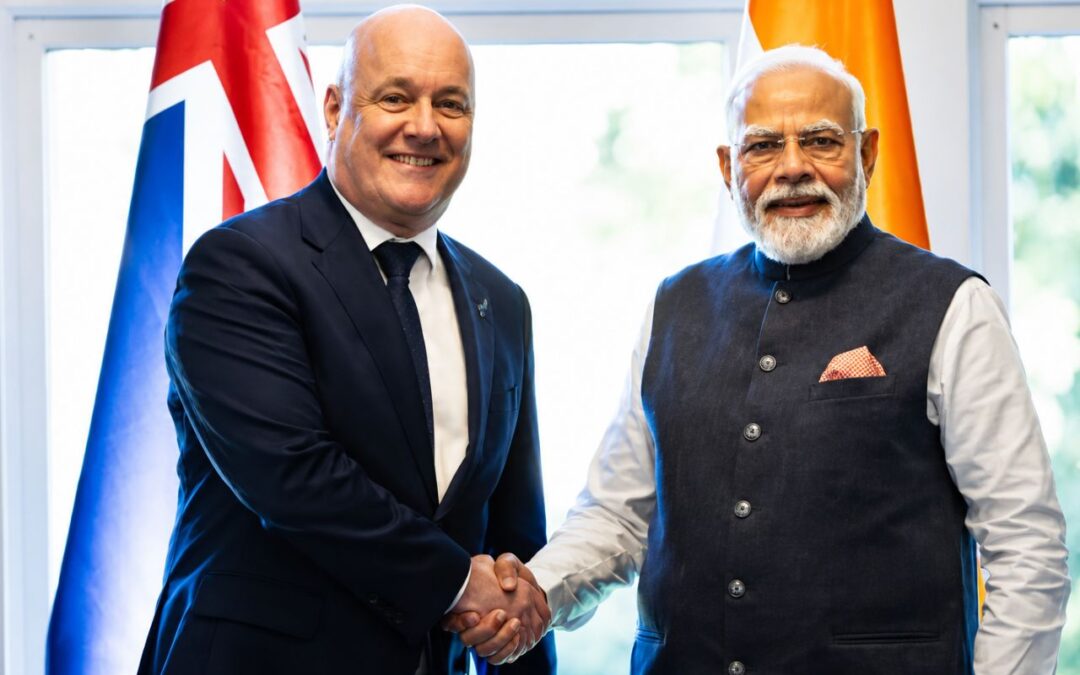
Synopsis: India and New Zealand raised bilateral ties to a Strategic Partnership backed by a new Roadmap for 2030 built around six pillars. The framework charts out an ambitious goal of doubling bilateral trade, and includes a significant investment commitment by New Zealand into India.
Prime Minister Narendra Modi’s tour to Auckland, as the first Indian PM visiting New Zealand in 40 years, concluded with the two nations signing the “India-New Zealand Strategic Partnership: Roadmap to 2030”, and this visit came with 18 outcomes, which includes 10 signed agreements, and the roadmap which sets out a course of action for the next four years.
A Non-Binding Framework
The roadmap is described as non-binding as it creates no legal obligations under domestic or international law and involves no financial commitments. It’s best understood as a shared reference point for coordinated action across ministries in both countries.
The Six Pillars
The roadmap is structured around six areas of cooperation:
- Political and Diplomatic engagement
- Defence and Security cooperation
- Trade and Economic cooperation
- People, Culture and Sport
- Education, Research, Science and Technology, and Disaster Management
- Regional and Multilateral cooperation
Both sides of government have committed to a consistent high-level engagement, Prime Minister-level meetings, Cabinet-level dialogue, a strengthened Foreign Ministers’ Dialogue, parliamentary exchanges, and annual Secretary-level consultations to track the progress.
Trade and Investment
- Trade target: Double bilateral two-way trade in goods and services to NZD 7 billion of approximately ₹35,000 crore by 2030
- Investment commitment: New Zealand has pledged approximately USD 20 billion in investment into India over the next 15 years
- FTA: The India-New Zealand Free Trade Agreement, concluded in a record nine months, is set to move toward early entry into force
- Customs facilitation: The 2025 AEO Mutual Recognition Arrangement will be operationalised under the 2024 Customs Cooperation Arrangement to speed up trusted trade
Defence and Maritime Security
- A institutionalise structured defence engagement, building on the 2025 MoU on Defence Cooperation, from both the sides of government
- A new maritime cooperation framework for the Indo-Pacific covers naval exercises, logistics support and hydrography
- A dedicated Joint Working Group on counter-terrorism has been set up, with reference to the Pahalgam, April 2025 and Red Fort, November 2025 attacks
- New Zealand will join the Maritime Security Pillar of India’s Indo-Pacific Oceans Initiative (IPOI)
Agriculture, Innovation and Clean Energy
- Deeper cooperation planned in horticulture, forestry, animal husbandry and dairying, through joint research and market development
- New Zealand will join the Global Biofuels Alliance, supporting reduced fossil fuel dependence
People and Tourism
- Expansion of the Tourism Memorandum of Arrangement, encouraging two-way visitor flows
- Push for direct non-stop flights under an updated Air Services Agreement
- Broader push on education partnerships and cultural exchange
All in all
With six pillars and specific goals around trade, investment, defence and clean energy the Roadmap to 2030 provides a concrete, 4 year framework for India and New Zealand, to build the relationship beyond the trade and diplomatic ties.