
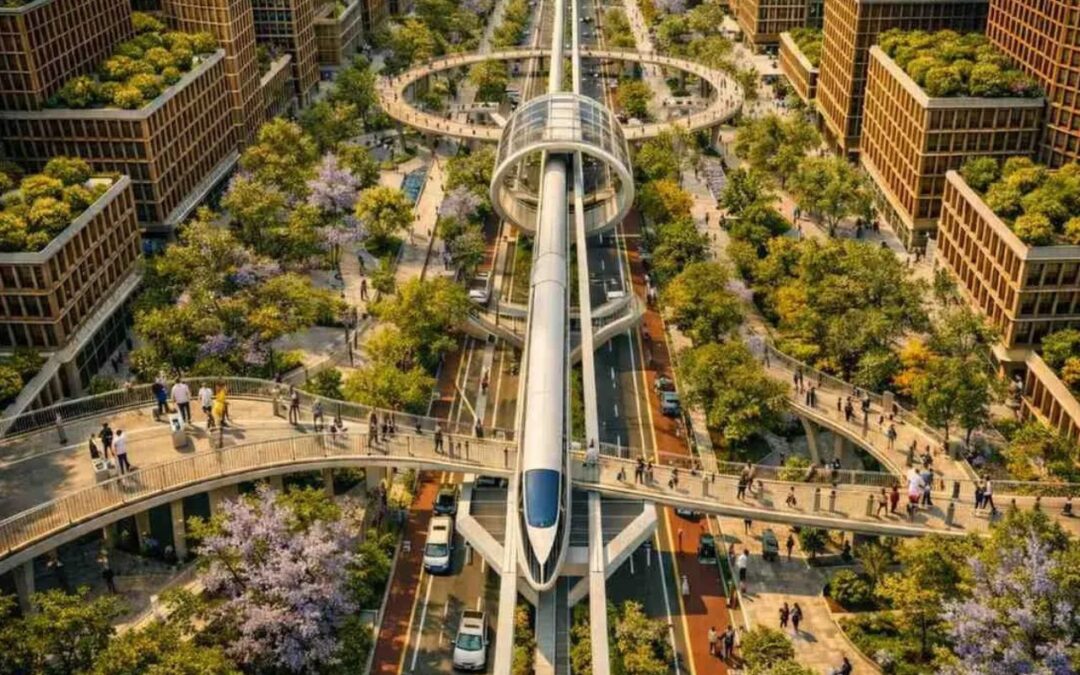
Synopsis: These four futuristic cities of Bengaluru are transforming the city into a multi-nodal global innovation hub. This article discusses the mini cities, what they offer, the growth and everything an investor needs to know.
Bengaluru is gearing up for a transformative journey into the future with four futuristic satellite cities; KWIN City, SWIFT City, AI City and Quantum City. The initiatives are to decongest the city and generate new technology, innovation, research and modern infrastructure focus areas around Bengaluru. Whether it’s the creation of AI-driven townships or deep-tech research ecosystems, Karnataka’s vision has the potential to transform the city’s skyline, economy, real estate landscape, and future growth corridors.
Why does Bengaluru need Satellite Cities?
As Bengaluru has grown at a fast rate, massive traffic congestion, population growth, escalating property costs and strain on infrastructure have emerged as significant challenges. With the rapid urbanisation, the space outside the core city is becoming an urgent need, where existing urban congestion and traffic jams are a regular occurrence, such as in Whitefield, Electronic City and Outer Ring Road.
To address this, the Karnataka government is looking to create decentralised mini cities that can develop into economic and residential hubs around Bengaluru. These satellite townships are anticipated to enhance infrastructure distribution, draw in international investments, create jobs and decrease the reliance on the city centre, in addition to providing for long-term city expansion.
1. KWIN City
KWIN City (earlier KHIR City) is an ambitious mega smart-township initiative by Government of Karnataka to ease the increasing strain on the city of Bengaluru’s infrastructure and population. The project envisages a parallel ‘twin city’ to create a self-sustaining urban ecosystem, where people can live, work, study and innovate in one integrated region.
The project is divided into almost 5,800 acres in Dabaspet and Doddaballapur of North Bengaluru. It is about 45 minutes from Kempegowda International Airport and will be connected with the Satellite Town Ring Road (STRR) and major roads. KWIN City has been designed to four primary districts:
- Knowledge District is a collaboration of universities and educational institutions.
- Health District concentrated on biotechnology and health care
- Innovation District for new mobility and aerospace, semiconductors.
- Research District focused on biopharma and scientific research and development
Economic & Future Impact
The project will bring about investments of nearly ₹40,000 crore and jobs of around 80,000–100,000 in high skill areas. KWIN City will not only be a township, it is also a growth corridor for future expansion that will help alleviate the pressure on central Bengaluru while enabling sustainable urban growth. The Karnataka Government has also identified another 2,100 acres of adjacent area for future industrial development, which demonstrates the extent of planned development in North Bengaluru.
2. SWIFT City
The Karnataka Government announced SWIFT City, a large-scale smart city and industrial project, to establish a modern start-up and technology hub in Bengaluru. The project is being conceived by the Karnataka Industrial Areas Development Board (KIADB) as a futuristic alternative to the more established tech corridors such as Electronic City and ITPL.
The project will be developed on 1,000+ acres in Sarjapur-Anekal area of Southeast Bengaluru, near to major IT corridors like Bellandur, ORR, and Kadubeesanahalli. It is engineered by wide inner roads with high connectivity to NH-44, NH-48, upcoming Metro Phase-3 roads and the proposed Peripheral Ring Road (PRR).
- Tech campuses that can be set up in a matter of moments for specific segments such as AI, FinTech, robotics and analytics.
- Flexible space to start up and run SMEs.Flexible land and workspace for startups and SMEs.
- Zones with integrated residential, school, health care facilities.
- Walkable/Mixed Use Planning for better Work-Life Balance
Economic Impact
The project is expected to create more than 100,000 direct and indirect jobs and create demand for housing, rentals and commercial development in the surrounding neighbourhoods like Attibele, Chandapura and Anekal. SWIFT City is in the planning phase and land acquisition phase. Local groups of farmers have also raised objections about the acquisition of fertile agricultural land and the government has examined these objections and land use concerns.
Also read: Where Bengaluru Will Expand Next: 7 Potential Growth Corridors Investors Should Watch
3. AI City- (GBIT)
Bidadi is located approximately 30 kms away from Bengaluru, and development of the Greater Bengaluru Integrated Township (GBIT) has been conceived as an AI smart city and the second Central Business District (CBD) of the region. The Karnataka government has announced the project, which will ease the burden on the city of Bengaluru and develop a modern “Work-Live-Play” urban system.
The township, spread over an area of almost 9000 acres, is a huge Rs.20,000 crore development which will be realized in several phases. The city is designed to be a smart, connected urban community that brings together residential, commercial, health, education and entertainment areas. GBIT is seen as India’s first city that will be operated using a Digital Twin system and intelligence based on IoT infrastructure. AI Systems will help optimize water flows, energy consumption, waste management, air quality and mobility in real time.
- Traffic and Transitions Management powered by Artificial Intelligence.
- A large room for very fast connections to the internet.
- The concept of Zero Carbon and Zero Waste sustainability targets.Sustainability targets of Zero Carbon and Zero Waste.
- Over 1,100 acres dedicated to parks, lakes and green spaces
Economic & Real Estate Impact
GBIT is set to become a significant future employment hub with over 2,000 acres slated for the development of AI, IT, startups and technology industries. The project is likely to create mega jobs of high skills and boost the residential and commercial real estate development in the city of Bengaluru.
Land & Community Model
The government has presented a “farmers as partners” plan to support land acquisition. In accordance with this model, those who will own the developed plots in the urban areas are awarded part of the plots and interim financial assistance, and that the existing residential villages within the township limit will be protected from displacement.
4. Quantum City
Quantum City or Q-City is a flagship initiative of Government of Karnataka for the creation of the first dedicated Quantum Technology Zone in India. The development is taking place near Hesaraghatta on the north-western outskirts of Bengaluru with about 6.23 acres of land set aside by the government for the first phase of the project. The site was selected for its features of less congestion, campus-like development, and proximity to Kempegowda International Airport and prominent research and development institutions. Some of the planned features are:
- Fabrication or integration of quantum hardware and chips
- Advanced cryogenic and precision testing laboratories
- A Quantum HPC data center is defined by the way it processes data.A Quantum HPC data center is determined by the manner it handles data.
- Start up incubators and research hothouses.
- International centres of collaboration like the proposed Swiss-Karnataka Quantum Collaboration Centre
Funding & Government Support
The project is a part of Karnataka’s bigger Quantum Mission aimed at creating a $20 billion quantum economy by 2035. It is backed up by dedicated funding from the Indian government, investment in deep technology and the Government of India’s National Quantum Mission.
Development Status
The execution and planning of Quantum City are underway at an early stage and is run via a Public-Private Partnership (PPP) model. The detailed planning and land inspection for the project are underway, and the Karnataka government aims to launch the project by 2028.
Economic & Regional Impact
This project is projected to create new avenues for research in the realm of quantum information and for semiconductor manufacturing and high-performance computing. The announcement has led to a significant boost in long-term real estate and infrastructure interest in the Hesaraghatta region of Bengaluru, apart from establishing a deep tech ecosystem.
Conclusion
Karnataka is working on a series of projects and these projects are part of the state’s broader strategy to create decentralized, future-focused growth corridors, from smart townships and start-up hubs to research and development centres based on quantum technologies. They seek to alleviate the strain on central Bangalore, and make the city one of the most sophisticated innovation and economic centres in the coming decades.
Written by Boyapati Sai Jasmitha