
Synopsis: Road tax on vehicles in India varies widely across states and ranges from about 6% to 18% of a car’s price. This article compares the lowest and highest road tax states and explains how these differences impact your total on-road cost of your vehicle.
Road tax in India is not uniform and the difference between states change how much you pay for the same car. Where some states keep road tax quite low to ease vehicle ownership on the other hand others impose much higher rates. The rate disparity directly increases the on-road price by a substantial margin.
These variations are not minor. In many cases, the gap between the lowest and highest road tax states can reach up to 10% to 12%. This shows up into a difference of ₹1 to ₹2 lakh for medium price range cars. This makes it essential to clearly identify which states offer the lowest road tax and which fall at the higher end. This case scenario is especially for buyers who are looking to minimize overall vehicle costs.
How Road Tax Works in India?
- Road tax in India is a compulsory state wise tax which is paid at the time of vehicle registration. The total amounting sum is collected by the vehicle dealer and deposited to the Regional Transport Office (RTO). The major important factor to understand is that without it a vehicle cannot legally be driven on public roads.
- Each state applies its own rule structure, commonly charging a percentage of the ex-showroom price but layering it with additional criteria such as engine capacity, vehicle weight, fuel type, and price slabs. In most cases, tax rates fall between 6% and 15%, but high-tax states can go up to 17-18% for higher-value cars.
- The structure is usually progressive.The less priced cars are taxed at a lower percentage and vehicles above ₹10 lakh or ₹20 lakh attract higher slabs. Diesel vehicles may attract slightly higher rates in some states and electric vehicles often receive partial or full exemptions.
- Private vehicles are generally paid as a one-time amount valid for 15 years after which a smaller renewal fee applies. Commercial vehicles follow a different model and are taxed periodically, quarterly or annually.
There are also practical implications that directly affect buyers. If you relocate to another state for extended periods, you are required to re-register the vehicle and pay road tax again in the new state. Refunds of the original tax can be claimed but it is usually adjusted on a depreciated basis and involves procedural delays which is why many buyers factor this in before purchasing.
- Tax range: 6% to 18% depending on state and vehicle value
- Slab based system: higher-priced cars fall into higher tax brackets
- Other factors: price, engine capacity, fuel type, and vehicle category
- One-time payment for private vehicles (15 years validity)
- Re-registration required when shifting states, with partial refund mechanism
Top 5 States with Lowest Road Tax
| State | Road Tax Range |
| Himachal Pradesh | 6% – 10% |
| Punjab | 6% – 11% |
| Uttarakhand | 6% – 10% |
| Gujarat | 6% – 9% |
| Odisha | 7% – 11% |
These states maintain lower tax burdens which keeps the on-road cost of vehicles more affordable. The difference becomes more noticeable in mid-range and premium segments where slab increases are less aggressive.
Top 5 States Highest Road Tax
| State | Road Tax Range |
| Andhra Pradesh | 12% – 18% |
| Maharashtra | 11% – 16% |
| Telangana | 12% – 18% |
| Karnataka | 13% – 18% |
| Kerala | 10% – 20% (up to 22% for luxury) |
These states represent the top end of road tax in India and show that the higher in the luxury segment the tax slab can be significantly higher. The chart below visually compares the average road tax in the top 5 lowest and highest states in India. It highlights how vehicle ownership costs vary significantly depending on the state of registration.
Also read: 9 Indian States With Surprising Tax Policies – Is Yours One of Them?
State-wise Road Tax Differences in India
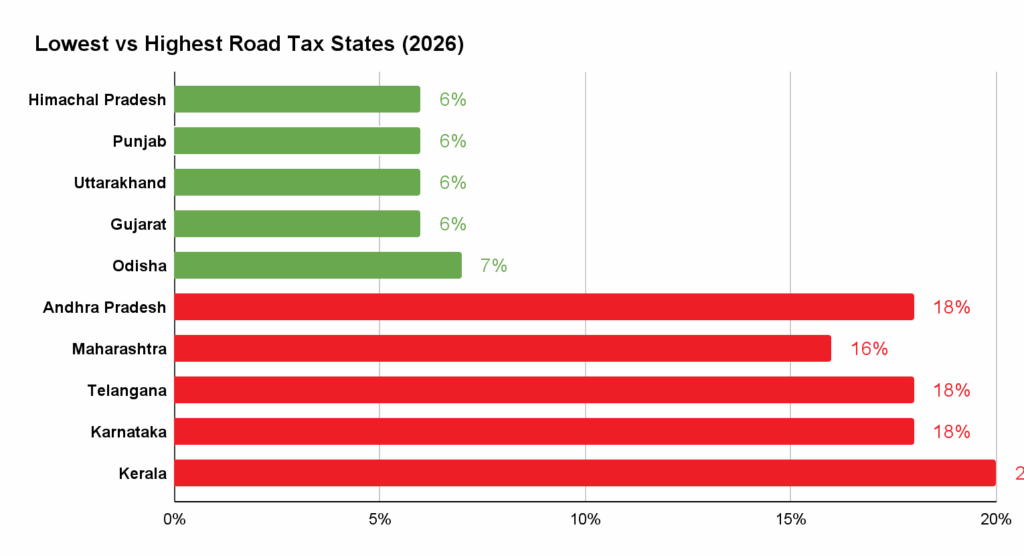
Shows minimum tax in the 5 lowest-tax states and maximum tax in the 5 highest-tax states. Percentages reflect standard private vehicle rates.
Additional Insights
Even after viewing the chart, it is clear that road tax differences have practical consequences for buyers. The mid-range cars could lead to a variation that adds ₹1–2 lakh to the on-road price. Furthermore, for luxury cars the difference may exceed ₹5 lakh. Many a time it is seen that the buyers consider registering vehicles in lower tax slab states to lower the long-term costs burden. To add to that some businesses may also factor state tax into operational planning. The higher tax slab states often offer partial or full exemptions for electric vehicles. The important policies changes can adjust tax slabs periodically that is why monitoring updates is advisable before making any purchase.
Conclusion
Road tax is a major contributor to the on-road cost of vehicles in India. Those states with lower tax rates offer more affordable vehicle ownership and high-tax states increase costs that are seen majorly for mid-range and luxury vehicles. The chart clearly shows the gap between the lowest and highest-tax states and it indirectly states the importance of awareness of these differences.
Disclaimer: This article is a general information about road tax rates in India as of 2026. The rates vary by vehicle category, fuel type, engine capacity, and state policies. Thus always verify current tax rates with the local RTO before making financial decisions. This article is for informational purposes only and does not constitute any legal advice.
Written by Kenbi Riba