
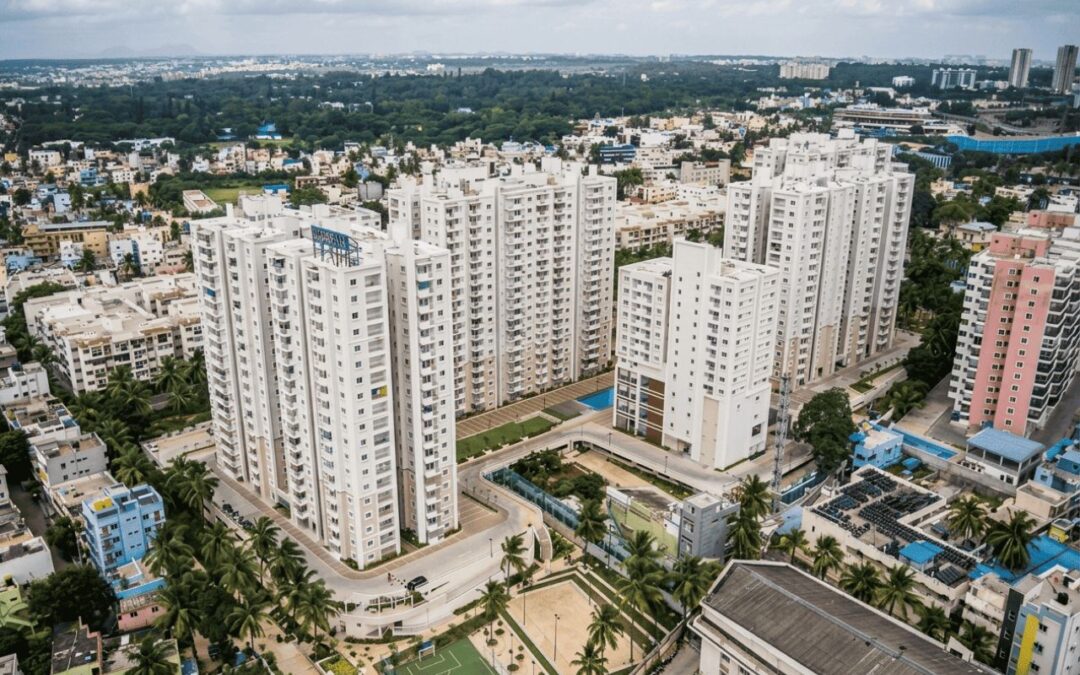
Synopsis: The article covers the performance of top seven housing markets in Q1 2026, such as housing sale statistics, new launches, price trends and key residential corridors.
The residential real estate sector saw a cooling trend in the initial Q1 of 2026, with housing transactions falling in the seven major cities of the country as compared to the corresponding quarter of the previous year (PY). In some markets, demand was cooling as homebuyer sentiment shifted and so did the prices, while several cities saw strong demand as a result of infrastructure developments, job growth and high demand for premium homes. Performance had significant variations across different cities, which is a result of a variety of factors including the market dynamics, the level of supply additions as well as the preferences of buyers.
Overall Launches and Sales of Top 7 Cities
India’s top seven residential markets witnessed nearly 1,26,300 new housing launches in Q1 2026, which was 2% higher than Q4 2025 and 26% higher than Q1 2025. The supply expansion was led by the Mumbai Metropolitan Region, Bengaluru and Hyderabad. MMR and Bengaluru accounted for more than half of the launches in the quarter. Demand-side comprises housing sales in the top seven cities, which were at around 1,01,650 units in Q1 2026, 7% less than in Q4 2025 but 9% higher than in Q1 2025 when sales stood at 93,300 units. While buyers’ sentiment has been cautious and geopolitical concerns have tempered sales in the quarter, demand for residential real estate was found to be fairly robust on an annual basis, suggesting that India’s real estate market is faring well in the long-term.
MMR (Mumbai Metropolitan Region)
In Q1 2026, MMR will become the biggest residential market among the top 7 cities. The city recorded 40,000 new launches, up 6% QoQ and 30% YoY, while 32,800 units were sold, down 5% QoQ but up 4% YoY. MMR alone represented about 32% of the total number of launches and sales in the top 7 cities. The cities with the highest available inventory of 1,86,450 units and high inventory overhang of 17 months were in the highest position among all the cities. The average residential rate clocked in at ₹17,600 per sq. ft., up 4% from 2025 and 1% from the previous quarter.
- Key Numbers:
- New Launches: 40,000 units
- Units Sold: 32,800 units
- Available Inventory: 1,86,450 units
- Average Price: ₹17,600/sq. ft.
- Inventory Overhang: 17 months
Bengaluru
Bengaluru remained one of the best performing housing markets in India with 24,400 new launches in Q1 2026, growing by 7% QoQ and 17% YoY. Housing sales in Bengaluru totalled at 16,450 units, a 5% decline QoQ but 10% increase YoY, to claim the second largest position after MMR. Available inventory increased to 72,800 units, which grew by the highest rate in the top 7 cities plus, up by 12% QoQ and 24% YoY. The average residential price rose by 2% QoQ and 8% YoY to ₹9,310 per sq. ft. and the city had the lowest inventory overhang of 14 months, reflecting high demand absorption.
- Key Numbers:
- New Launches: 24,400 units
- Units Sold: 16,450 units
- Available Inventory: 72,800 units
- Average Price: ₹9,310/sq. ft.
- Inventory Overhang: 14 months
NCR
In Q1 2026, NCR had 16,000 new launches, which is 44% year-on-year growth and a 17% decrease quarter-on-quarter. Housing sales fell 8% QoQ to 15,200 units and rose 21% YoY, while down slightly from the previous quarter, it continued to show strong demand from buyers. The total available inventory for NCR was 91,250 units, which was 1% lower than the previous quarter and 8% higher than a year ago. The average price per sq. ft. of a residential property was at ₹9,620, the highest annual gain across the seven cities. The improvement was in NCR’s inventory overhang which narrowed to 18 months compared with the prior quarter’s 18.5 months, due to stronger sales momentum.
- Key Numbers:
- New Launches: 16,000 units
- Units Sold: 15,200 units
- Available Inventory: 91,250 units
- Average Price: ₹9,620/sq. ft.
- Inventory Overhang: 18 months
Pune
In Q1 2026, Pune witnessed a 9% decrease in new launches from Q4 2025, and a 5% decrease from Q1 2025. Pune is the only among the top seven cities to see a decline in housing sales year-on-year, as sales dropped 10% from Q4 2025 and even fell 5% from Q1 2025. Available inventory increased 1% from the prior quarter and 3% year-over-year to 84,200 units. The average residential price stood at ₹8,220 per sq. ft., an increase of 2% QoQ and 5% YoY, with the city’s inventory overhang at a relatively healthy level of 16 months, thus keeping the market balanced.
- Key Numbers:
- New Launches: 16,000 units
- Units Sold: 15,300 units
- Available Inventory: 84,200 units
- Average Price: ₹8,220/sq. ft
- Inventory Overhang: 16 months
Hyderabad
Among all seven cities, Hyderabad had the highest growth with 19,300 new launches with a remarkable 87% YoY increase and 46% QoQ increase. Housing sales were 12,400 units, showing very little change both quarter-on-quarter and year-on-year, and a healthy growth rate of 23%. Available inventory rose by 7% QoQ to 1,03,000 units and 5% YoY. The average residential price reached at ₹7,990 per sq. ft. which is up 2% QoQ and 6% YoY. The city of Hyderabad also showed the highest inventory overhang in the top seven cities, with 26-months, which means that while aggressively new launches have been coming in, it has been taking a while to get absorbed.
- Key Numbers:
- New Launches: 19,300 units
- Units Sold: 12,400 units
- Available Inventory: 1,03,000 units
- Average Price: ₹7,990/sq. ft.
- Inventory Overhang: 26 months
Also read: Top 5 Fastest-Growing States in India Over the Last 5 Years According to RBI Data
Chennai
The number of new launches in Chennai dipped 28% QoQ to 5,400 in Q1 2026, but rose 14% YOY. Among the top seven cities, housing sales fell by 18% year-on-year, making it the biggest quarterly drop, according to the most recent data. Yet, the annual sales growth was an all-time high of 31% for Chennai, showing a better trend in the long term. Available stock was 33,500 units, down a bit from the previous quarter but up 15% year-on-year. The average residential price touched ₹7,165 per sq. ft. and increased by 1% on a quarterly basis and 4% on a year-on-year basis. This month, the overhang in Chennai improved to 17 months, down 5% from the previous quarter, which showed that the absorption was good given the slowdown in sales.
- Key Numbers:
- New Launches: 5,400 units
- Units Sold: 5,300 units
- Available Inventory: 33,500 units
- Average Price: ₹7,165/sq. ft.
- Inventory Overhang: 17 months
Kolkata
Kolkata saw an increase in the number of new launches by 10% QoQ and 4% YoY at 5,200. Housing sales were 4,200 units, up 8% compared to Q1 2025 but 9% below Q4 2025, marking a moderate increase year on year. Available inventory was 30,000 units, which is a 3% QoQ increase and a 7% YOY increase. The average price of residential property rose to ₹6,290 per sq. ft. The stock level at Kolkata was 22 months, which was the second highest after Hyderabad, where the absorption was relatively low.
- Key Numbers:
- New Launches: 5,200 units
- Units Sold: 4,200 units
- Available Inventory: 30,000 units
- Average Price: ₹6,290/sq. ft.
- Inventory Overhang: 22 months
Also Read: Top 5 States Leading India’s Monthly UPI Transactions of ₹29.9 Lakh Crore in May 2026
Outlook for 2026
- Housing demand is expected to stay robust due to urbanisation, investments in infrastructure and end user demand till 2026.
- The premium and luxury segment sales will be driven by the sales in Mumbai, Delhi-NCR, Bengaluru, Hyderabad and other cities across the country where the sales activity will be strong.
- The growth of the cities with a strong IT and employment base like Bengaluru, Hyderabad, Pune, Chennai is likely to gain traction from buyers.
- The developers will probably consider rolling out their products to well-established and proven micro-markets.
- Rising prices should not be enough to derail market growth in the short term, since the level of inventories is healthy and infrastructure projects are ongoing.
Conclusion
The residential market was still relatively solid despite a year-over-year decrease in housing sales in each of the top seven markets during Q1 2026. The industry is expected to receive some strong demand, ongoing infrastructure projects and keen demand for premium housing in the coming few quarters.
Written by Boyapati Sai Jasmitha