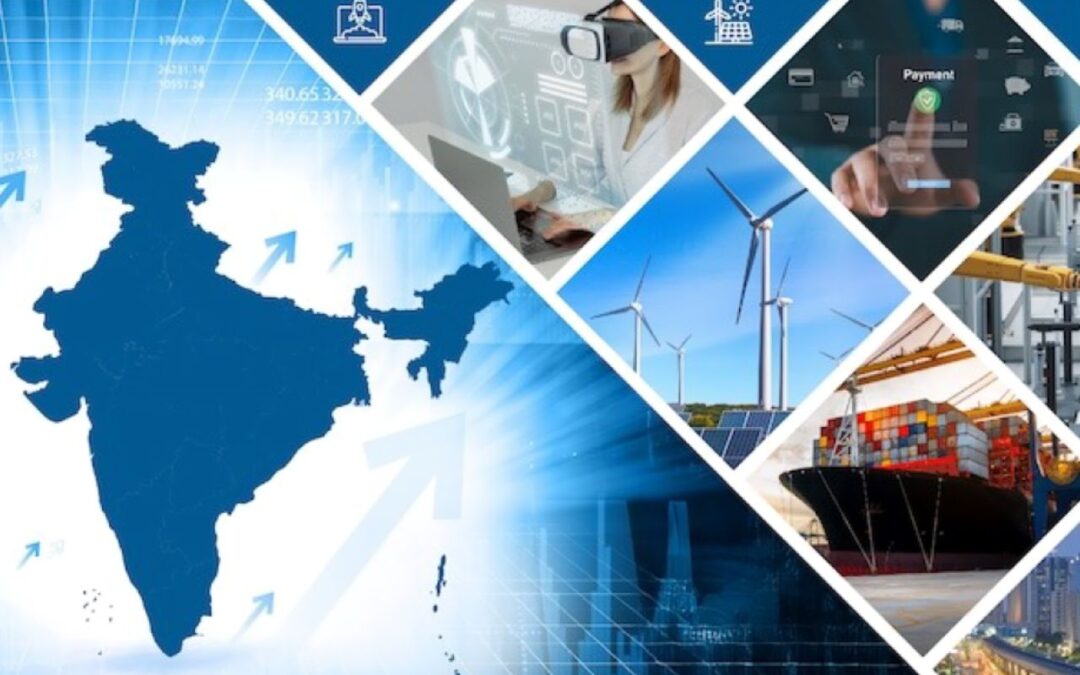
Synopsis: India stands 4th globally in HNWI count with 85,698 ultra-wealthy, up 4.4% in 2024 driven by economic boost and increase in number of startups. As the country moves toward its USD 7 trillion economy goal, a few sectors are standing out in their potential that are positioned to shape India’s next generation of billionaires.
From startups to mega infrastructure projects, India’s next wave of billionaires will be the ones shaping AI, clean energy, fintech and premium brands. The Indian economy is evolving faster than ever, creating spaces where bold ideas meet big money. Whether it’s artificial intelligence, renewable energy, electric vehicles, or lifestyle brands, the sectors attracting capital today are laying the foundation for tomorrow’s wealth creators.
I. Tech-Led Wealth Creation
1. Artificial Intelligence & Digital Infrastructure
India is rapidly emerging as a global AI hub, attracting massive investments from Mukesh Ambani’s Reliance, global private equity, and tech giants. The government has committed ₹10,300+ crore for the IndiaAI Mission over five years, deploying 38,000 GPUs, while Google is investing $15 billion in AI data centres and Microsoft $17.5 billion to scale AI across the population. The Adani Group is also investing Rs 1 trillion in Andhra Pradesh, partnering with Google to create a major AI hub in Visakhapatnam. Key hotspots include Maharashtra, Tamil Nadu, and Telangana, with major players like Reliance Jio, global hyperscalers, and Indian data-centre operators leading the charge.
2. Semiconductors & Electronics Manufacturing
India’s semiconductor sector is booming, backed by Tata Group, global chipmakers, and government consortia. The ₹76,000 crore PLI scheme with ₹65,000 crore already committed and 10 approved ISM projects totaling ₹1.6 lakh crore across six states are driving massive investment into fabs, OSAT units, and electronics clusters. Key hubs are Gujarat, Tamil Nadu, and Karnataka, with Tata Electronics, Micron, and Foxconn leading the charge. Semiconductors sit at the heart of every digital and industrial system. With high entry barriers and strategic importance, early leaders are set to build globally relevant, billionaire-level businesses.
3. Defence & Aerospace
India’s defence and aerospace sector is booming, with investments from Tata Group, Adani Group, Larsen & Toubro, and government-linked funds. Multi-billion-dollar programs span manufacturing, R&D, and exports, with production hitting ₹1.27 lakh crore in FY 2023-24 and exports reaching ₹23,622 crore in FY 2024-25. Strategic hubs include Maharashtra, Tamil Nadu, Karnataka, and Telangana, with Tata Advanced Systems, Adani Defence & Aerospace, and L&T Defence leading the way.
Also read: Make in India 2.0: 5 Promising Sectors Contributing the Most to India’s GDP by 2030
II. Energy-Led & Industrial Transformation
1. Renewable Energy & Energy Transition
India’s clean energy sector is attracting huge investments from Gautam Adani, Mukesh Ambani, and sovereign & infrastructure funds, spanning solar, wind, green hydrogen, and energy storage. Strategic locations include Gujarat, Rajasthan, and Tamil Nadu, with major players like Adani Green, Reliance New Energy, and ReNew driving growth. The government is also boosting nuclear innovation through the Nuclear Energy Mission, announced in the Union Budget 2025-26, which allocates ₹20,000 crore for the design, development, and deployment of Small Modular Reactors (SMRs).
2. Electric Mobility & Clean Transportation
India’s EV sector is booming, backed by auto majors, private equity, and strategic investors. Deal flow hit $4.6 billion in Q3 2025, with EVs targeting 30% of all vehicle sales by 2023 and some of the key hubs are present in Tamil Nadu, Maharashtra, and Gujarat, led by Tata Motors, Ola Electric, and Ather. EVs aren’t just a product shift but they’re an ecosystem shift. Companies controlling platforms, supply chains, and batteries stand to capture huge value, creating billionaire-level wealth.
III. Manufacturing & Export-Led Growth
1. Advanced Manufacturing & Make-in-India Scale-Up
India’s manufacturing is moving from low-cost assembly to high-value, export-focused production, attracting growth capital from Ashish Kacholia, domestic institutions, and family offices. Billions are flowing into electronics, EV components, and specialty chemicals, supported by PLI schemes and the National Manufacturing Mission. Electronics production rose from ₹1.9 lakh crore in 2014‑15 to ₹11.3 lakh crore in 2024‑25, while exports jumped from ₹38,000 crore to ₹3.27 lakh crore. Key hubs are Maharashtra, Gujarat, and Tamil Nadu, with mid-cap firms scaling globally. This is about building world-class companies, not just products.
IV. Consumption & Financialization
1. Financial Services & Fintech
India’s fintech and financial services sector is attracting big global interest, including strategic backing from the Reliance ecosystem, VC funds, global investors, and Japanese partners. One of the biggest recent moves came from Japan’s Mitsubishi UFJ Financial Group (MUFG), which agreed to invest ₹39,618 crore (about $4.4 billion) to acquire a 20 % stake in Shriram Finance, marking one of the largest foreign investments in India’s financial space.
Investment here tends to be asset‑light but high‑valuation, focused on digital payments, lending, and wealth platforms. The main hubs are Mumbai, Bengaluru, and the NCR, with firms like Jio Financial Services and other leading fintech platforms driving growth.
Finance in India remains under‑penetrated, and with strategic capital inflows and partnerships combining distribution, data, and trust, these platforms can scale rapidly, creating high‑margin businesses with strong network effects—and a clear path to billionaire‑level wealth.
2. Consumer Brands & Premiumisation
India’s consumer sector is attracting Ashish Kacholia, private equity, and consumer-focused funds, with over ₹12,000 crore invested in D2C, lifestyle, and quick-commerce startups in the past year alone. E-commerce and venture capital support have helped these brands scale rapidly. Key hubs are Mumbai, NCR, and Bengaluru, where leading D2C and lifestyle companies are expanding distribution and building strong consumer recall.
As incomes rise, consumption is shifting from unbranded to aspirational products. Companies that establish loyalty, brand recall, and robust distribution early can dominate categories and command premium valuations, creating billionaire-level wealth.
V. Asset-Heavy Compounding Sectors
1. Infrastructure and Logistics
India’s infrastructure and logistics ecosystem is drawing huge commitments from Gautam Adani, sovereign funds, and long‑term infrastructure capital, with over ₹22 lakh crore planned under national infrastructure pipelines over the next few years and major projects underway across ports, airports, road, rail, and warehousing segments. Strategic locations include Gujarat, Maharashtra, and pan‑India corridors, led by players such as Adani Ports, major airport operators, and organized warehousing platforms.
Infrastructure investments are typically very large and long‑duration, delivering stable returns once operational. Because these assets generate predictable cash flows and underpin economic activity, companies that build and manage them effectively can capture lasting value, positioning promoters and backers for billionaire‑level wealth as India’s economy continues to expand.
Future Outlook
With investments pouring in from domestic and global investors, and government initiatives supporting innovation and scale, these sectors are set to grow exponentially. The next decade promises not just business success, but the rise of entrepreneurs who will define India’s billionaire story.
Written by Aditee Das