Synopsis:- The company closed FY26 with revenue up 29 percent and profit surging 70 percent, while expanding its recycling capacity to 82,000 metric tonnes annually and pushing into lithium-ion battery recycling.
A small-cap recycling company has quietly become one of the sharper performers on the exchanges this year, and unlike many multibagger stories, this one appears to be backed by genuine operational scale-up rather than pure sentiment. Whether that scale-up can sustain the kind of returns investors have already enjoyed is the more interesting question going forward.

Namo eWaste Management was trading around Rs. 290.70, up 2 percent from its previous close of Rs. 285 along with a market capitalization near Rs. 664.76 crore and a P/E ratio close to 46.29 times. The stock has delivered a return of 100 percent from the beginning of the financial year.
Strong FY26 Earnings
Total income increased 29 percent from Rs. 151.18 crore in FY25 to Rs. 195.13 crore in FY26, while EBITDA grew 56 percent from Rs. 14.76 crore to Rs. 23.10 crore, with EBITDA margin expanding from 9.76 percent to 11.87 percent. Reported net profit surged 70 percent from Rs. 8.46 crore to Rs. 14.35 crore, significantly outpacing revenue growth and reflecting improving operating leverage.

The second half of FY26 saw an even stronger acceleration, with total income rising 28 percent from Rs. 84.18 crore to Rs. 107.42 crore, EBITDA increasing 48 percent from Rs. 7.96 crore to Rs. 11.80 crore, and net profit more than doubling by 136 percent from Rs. 3.12 crore to Rs. 7.36 crore, highlighting stronger earnings momentum in the latter half of the year.
That kind of widening gap between top-line and bottom-line growth typically signals a business finally converting scale into disproportionate profit, though investors should watch whether this margin trajectory holds once growth normalises from its current pace.

Building One of India’s Largest Recycling Platforms
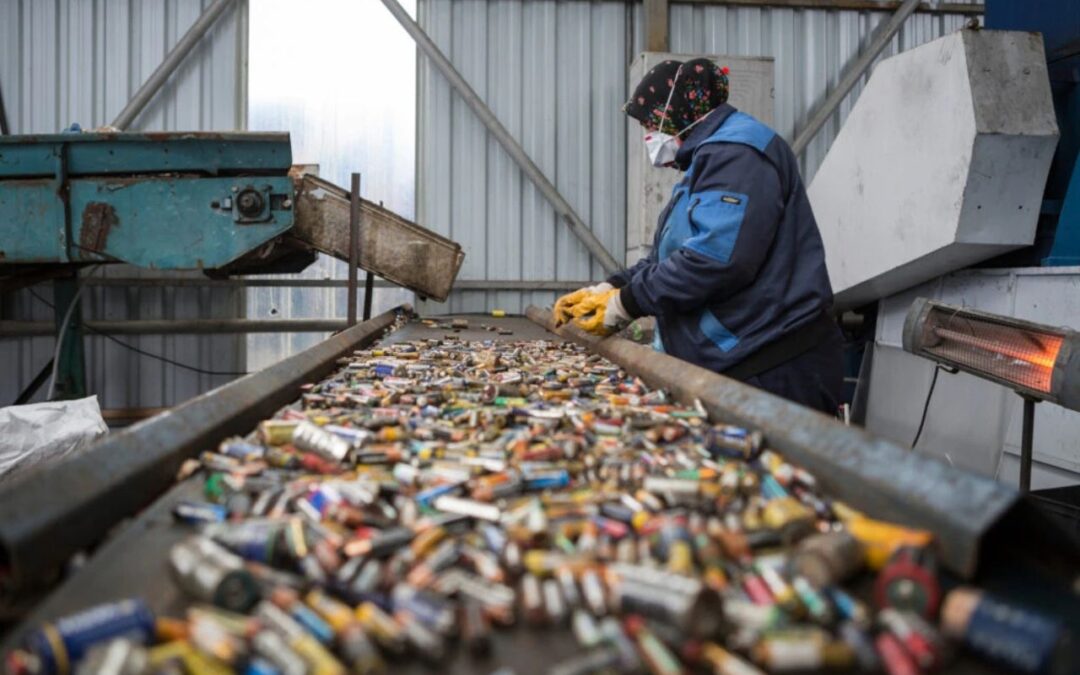
Installed recycling capacity now stands at 82,000 metric tonnes per annum, split between 70,000 MTPA of e-waste recycling and just over 12,000 MTPA of battery recycling. Management has laid out plans to push e-waste capacity further to 72,000 MTPA by Q2 FY27, alongside a fourth e-waste plant coming up in Hyderabad and a hydrometallurgy facility in Nashik dedicated to processing black mass.
This is a company that has moved from a single plant in Faridabad in 2015 to four operational recycling facilities and 26-plus collection centres across India within roughly a decade, a pace of physical infrastructure build-out that is unusual for a company of this size and worth watching for execution discipline as it scales further.
Battery Recycling Is the Next Growth Engine
The more forward-looking part of the story sits in lithium-ion battery recycling. Management is positioning the company to benefit from India’s rapidly expanding battery market, where electric vehicles are projected to account for 70 to 75 percent of lithium-ion demand by 2030, alongside total demand expected to cross 260 gigawatt-hours.

The company’s stated approach centres on hydrometallurgy technology capable of recovering 90 to 95 percent of critical battery metals, including lithium, nickel, cobalt, manganese, and copper, from spent batteries.
This matters strategically beyond just recycling economics. India’s government has separately committed roughly Rs. 1,500 crore under its National Critical Mineral Mission to accelerate battery recycling infrastructure, framing domestic battery recycling as a genuine alternative to mining for securing critical mineral supply chains rather than a niche environmental service.
A company with early-mover hydrometallurgy capability in this space is positioning itself against a policy tailwind rather than working against one, though it is worth noting this segment remains a small fraction of the company’s current revenue base and its economics are still unproven at meaningful scale.
Hyderabad Expansion Opens a Large Addressable Market
The upcoming 25,000 MT Hyderabad facility, expected to become operational within Telangana’s electronics manufacturing cluster, gives the company access to an estimated 60,000-plus tonnes of annual e-waste generated by Hyderabad’s IT sector alone.
The IT Sector sits in proximity to over 1,500 IT and ITES companies including major names like Amazon, TCS, and Infosys, and exposure to a Southern India market that reportedly generates 22 percent of India’s total e-waste but remains underserved by formal recyclers. Telangana’s own e-waste policy, the first of its kind among Indian states to offer recycler incentives, adds a further regulatory tailwind specific to this geographic push.
Structural Industry Tailwinds Support Long-Term Growth
Zooming out, India is already the world’s fourth-largest e-waste generator, with formal recycling penetration still low, roughly 20 percent of the market currently runs through organised recyclers, while the remaining 80 percent moves through informal channels with far lower recovery rates, contributing to an estimated Rs. 20,000 crore in annual metal value lost to inefficient processing.
India’s formal e-waste recycling market itself is projected to grow from Rs. 13,300 crore in 2024 to Rs. 25,400 crore by 2034, and tightening Extended Producer Responsibility enforcement is expected to accelerate the shift from informal to formal recycling channels over that period.
What Investors Should Weigh
The fundamentals here look genuinely constructive: real capacity expansion, margin improvement, and a battery recycling bet aligned with a clear policy push. But a P/E above 45 times, at a premium to peers, already prices in a good deal of that growth story executing smoothly.
Given this is a small-cap SME-listed stock with limited trading liquidity, investors should treat near-term price volatility as a structural feature of the stock rather than a signal about the underlying business, and focus instead on whether the promised Hyderabad and Nashik capacity additions come online on schedule over the next few quarters.
Disclaimer: The views and investment tips expressed by investment experts/broking houses/rating agencies on tradebrains.in are their own, and not that of the website or its management. Investing in equities poses a risk of financial losses. Investors must therefore exercise due caution while investing or trading in stocks. Trade Brains Technologies Private Limited or the author are not liable for any losses caused as a result of the decision based on this article. Please consult your investment advisor before investing.