
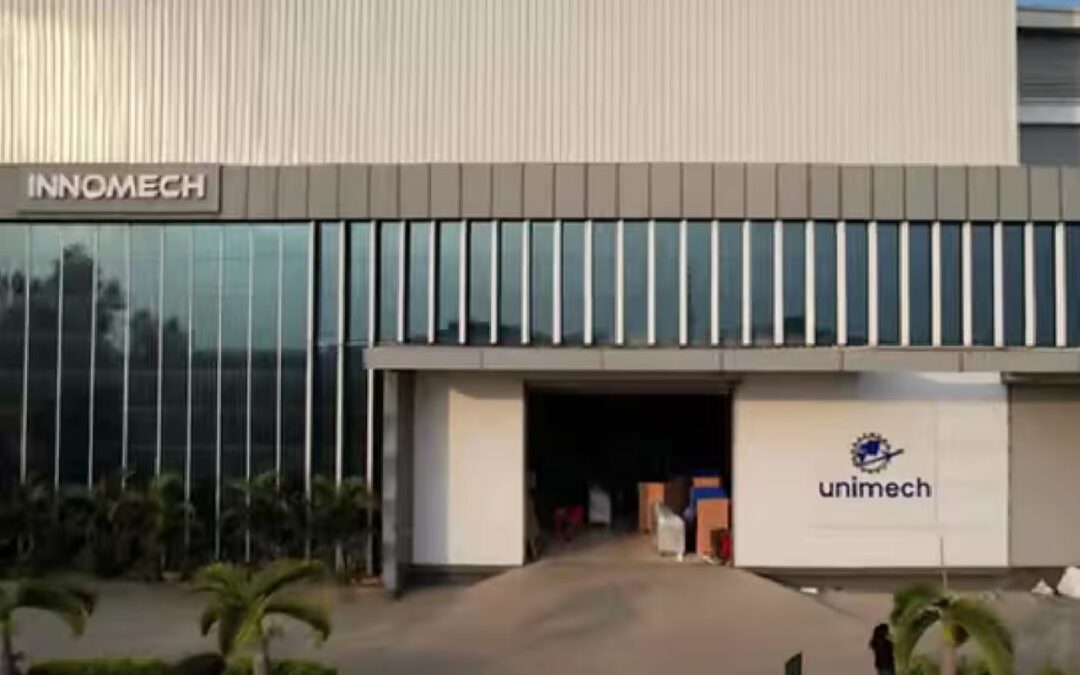
Synopsis: Unimech enters FY27 with improving aerospace demand, a record Rs 314 crore order book, Rs 87 crore in nuclear orders, and strategic growth initiatives such as the Hobel Bellows acquisition and Saudi Arabia JV. As customer inventories normalise and new opportunities emerge across precision engineering segments, the company appears positioned for stronger growth.
India’s precision engineering and aerospace manufacturing ecosystem continues to evolve as global supply chains diversify and demand for specialised components increases. Companies with strong engineering capabilities, customer relationships, and niche manufacturing expertise are increasingly finding opportunities across aerospace, defence, energy, and industrial sectors.

Against this backdrop, Unimech Aerospace and Manufacturing is expanding its capabilities through new qualifications, strategic acquisitions, and international partnerships. The company is now entering a phase where recent investments could potentially translate into stronger operational execution and growth. With a market cap of Rs 5,500 crore, the shares of Unimech Aerospace and Manufacturing Ltd are trading at Rs 1,087 and are trading at a PE of 87 compared to their industry’s PE of 63.
A Strong Finish to FY26 Signals a Shift in Momentum
After dealing with tariff issues, streamlining inventory, and slower demand in aerospace during FY26, Unimech Aerospace and Manufacturing finished the year on a better note. Their Q4 was one of the best quarters for revenue and EBITDA.

The revenue from operations for the company stood at Rs 82 crore in Q4 FY26 compared to the Q4 FY25 revenue of Rs 68 crore, up by about 21 per cent YoY. Similarly, the net profit stood at Rs 26 crore in Q4 FY26, down compared to the Rs 29 crore profit in Q4 FY25.
Unimech Aerospace reported a marginal decline in revenue during FY26, with sales slipping to Rs 240 crore from Rs 243 crore in FY25. Despite the largely stable revenue performance, profitability witnessed a sharper correction.

Net profit declined by around 24% year-on-year to Rs 63 crore in FY26 from Rs 83 crore in FY25. The decline in earnings was driven by lower operating margins, which contracted from 38% to 31%, along with a significant increase in depreciation and interest costs during the year. However, the company remained profitable and continued to generate healthy operating profits of Rs 75 crore, reflecting resilience despite a challenging operating environment.
Management pointed out that ordering from customers had bounced back nicely, making their plans clearer. They think the return to normal aerospace demand and customers slowly restocking supplies is making their business more forward-looking.
FY26 wasn’t quite the growth spike they hoped for, but the team said they focused on building a solid base for the future. With rising demand, more orders coming in, and a bunch of strategies starting to pay off, they’re optimistic about FY27. Things are moving from just setting up plans to actually putting them into action, which has everyone feeling pretty good about what’s ahead.

Aerospace Recovery Remains the Core Growth Driver
Aerospace is the backbone of Unimech’s business. In FY26, aero engine and airframe tooling made up over 90% of their revenue, showing how vital this part is. They did face some issues, like tariff problems in the US and customers correcting their inventories. This led to delayed orders and slower shipments.
On the bright side, after tariff rates went down, customer talks got more positive. Order inflows got much better, and inventory rebuilding started again with major aerospace clients. This trend is expected to carry on into FY27.
Because aerospace tooling has shorter execution cycles, when demand normalises, revenue should get stronger. So, the expected recovery in aerospace demand is set to drive Unimech’s growth in the next phase.
Qualification Engine Continues to Expand Future Opportunities
Unimech has been beefing up its qualifications beyond just recovering immediate demands. In FY26, the company carried out more than 200 first article inspections across aerospace, semiconductor, and defence apps and boosted its qualified SKU base to around 6,000.
Now, while management points out that getting these qualifications doesn’t mean instant cash due to the high-mix, low-volume stuff in aerospace tooling, the approvals create more chances for future production work. Each new qualification helps cement relationships with customers and bumps up the odds of getting recurring orders down the line.
Unimech’s plan is to amp up qualification activities again in FY27, pumping up their pipeline of potential deals across several industries. This all shows Unimech’s aim to grow sustainably through their strong engineering skills, not just quick win orders.
Nuclear Energy Emerges as a Significant New Opportunity
Most of these orders come from places like the Tarapur and Madras reactor projects, and the work should wrap up within the next year and a half. Looking ahead, the team anticipates more bids are coming in from upcoming nuclear ventures. Since Unimech keeps qualifying for new stuff, they expect to get involved with all sorts of other subsystems and parts too.
Considering nuke projects usually drag out for years and include steady maintenance contracts, pulling off these tasks successfully could set them up with reliable income well beyond just aerospace tooling.
Record Order Book Provides Visibility Into FY27
The company’s order book shows a strong hint of future growth. Unimech reported an impressive Rs 314 crore as of May 2026, after including Hobel Bellows’ orders. That amount is way more than what they’ve had historically, doubling it in fact. The surge is due to better market conditions and investments they made recently.
Managers are thrilled because the order book is much more diverse now. Before, most orders came from aerospace tooling. But currently, they have orders from nuclear programmes, precision parts, and various other growing areas. This variety decreases their reliance on any one area and makes spotting growth easier.
With a broader range of projects, they become more adaptable too, especially since different markets operate on vastly different schedules.
Hobel Bellows Acquisition Expands Engineering Capabilities
The acquisition of Hobel Bellows in April 2026 is one of Unimech’s biggest moves ever. It’s not just about quick money, though; Hobel Bellows adds unique skills like making metallic bellows, flexible tubing, and doing precision engineering.
This would’ve taken forever for Unimech to develop on its own. With Hobel, they get immediate access to pros in their field, customers Hobel already knows, and solid export methods too.
This also boosts Unimech’s footprint in industries like locomotives and power generation. Down the line, managers see chances for Hobel’s stuff in nuclear, aerospace, and semiconductors, and more ways to sell their products elsewhere. Overall, this deal makes Unimech stronger in engineering and lets them work on more complex projects.
Saudi Arabia JV Opens a New Geographic Growth Platform
Besides acquisitions, Unimech is expanding internationally via a joint venture with the Yusuf Bin Ahmed Kanoo Group in Saudi Arabia. This venture is setting up a precision manufacturing platform for the Middle East energy ecosystem. They’ve already gotten approval, planned facilities, and begun buying equipment. It’s projected to cost about $30 million in the first three years, with Unimech having the majority stake.
While the venture might take up to three years to break even, management sees its importance as more strategic than financial right now. It will help Unimech get closer to customers, diversify geographically, and participate in energy infrastructure and industrial localisation initiatives in the Gulf region. With global supply chains moving towards regional manufacturing, this Saudi platform could be key to Unimech’s long-term growth.
A Broader Precision Engineering Platform Takes Shape
Unimech in today’s FY27 stands out from where it started in FY26, mostly because of its broadened growth. While aerospace still leads in earnings, the company isn’t stuck just on tooling revenue anymore.
There’s a big movement in nuclear energy and semiconductors; Hobel Bellows brings fresh engineering skills, and their Saudi joint venture expands where they can operate. Plus, they now have way more resources, running over 150 CNC machines and looking to keep that plant usage at about 50%.
Management keeps stressing that most of the key investments made earlier are almost done. This means for FY27, the focus shifts from building up capacity to making current plans work and seeing returns on them.
If aerospace keeps bouncing back, nuclear projects start coming through, and strategic moves pay off, Unimech might hit a major growth boost, stronger than what they had the previous year.
Unimech heads into FY27 with several growth engines running at once. Aerospace demand is bouncing back, customer inventories are being restocked, and nuclear orders are climbing. Plus, initiatives like Hobel Bellows and the Saudi joint venture are expanding the company’s abilities and reach.
Supported by a record order book of roughly Rs 314 crore and a growing qualification system, the company seems to be shifting from focusing on big investments to actually executing those plans.
Although their quarterly results will still rely on when aerospace parts ship out and what nuclear project goals and qualifications get met, things look much stronger overall compared to last year. For investors, the main thing to watch is whether all these growth drivers can come together to start Unimech’s next big surge of growth in FY27.
Disclaimer: The views and investment tips expressed by investment experts/broking houses/rating agencies on tradebrains.in are their own, and not that of the website or its management. Investing in equities poses a risk of financial losses. Investors must therefore exercise due caution while investing or trading in stocks. Trade Brains Technologies Private Limited or the author are not liable for any losses caused as a result of the decision based on this article. Please consult your investment advisor before investing.