
Synopsis: India’s organized mattress sector threw up a sharp contrast in FY26. One company reported consolidated revenue of Rs.3,821 crore backed by legacy brands, international operations, and a foam-led industrial franchise, while the other posted Rs.1,489 crore, entirely domestic, entirely direct, and growing faster. The comparison pits decades of distribution muscle against a decade of digital-first disruption.
India’s mattress industry is in the middle of a structural upgrade. The unorganized segment, which controlled nearly three-quarters of the market as recently as 2019, is steadily ceding ground to branded, organized players.

Two listed companies stand at opposite ends of that transition: one built over five decades with dealer networks, international subsidiaries, and backward integration into foam; and the other, a nine-year-old D2C disruptor that reached profitability just last year and is now building out physical stores at pace.
FY26 Financials: How Both Companies Performed
Sheela Foam delivered consolidated revenue of Rs.3,821 crore in FY26, up 11 percent year-on-year. Core EBITDA grew 46 percent to Rs.414 crore, with margins expanding 261 basis points to 10.8 percent. Consolidated PAT came in at Rs.161 crore, up 78 percent, with PAT margins at 4.2 percent. Mattress volumes grew 12 percent and foam volumes rose 18 percent during the year, while the e-commerce channel delivered 49 percent volume growth. Cash ROCE stood at 18 percent on a consolidated basis, and the company reduced net debt by Rs.156 crore during the year.

Wakefit Innovations posted revenue of Rs.1,489 crore for FY26, up 17 percent year-on-year, marking its highest-ever annual performance. Operating EBITDA surged to Rs.112 crore from Rs.18 crore in FY25, with margins expanding to 7.5 percent. PAT for the year came in at Rs.189 crore, though this included a deferred tax asset recognition of Rs.98 crore, making the underlying profit picture more modest. The mattress category, which contributes 61 percent of revenues, grew approximately 17 percent, while furniture added 24 percent growth.
Where the Two Models Diverge
Sheela Foam’s competitive moat is built around brand equity and backward integration. Its Sleepwell and Kurlon brands together command roughly 30 percent of India’s branded mattress market. The company operates across India, Australia through Joyce Foam, and Spain through Interplasp, giving it a genuinely multinational revenue base. Its foam manufacturing franchise serves third-party industrial customers alongside its mattress business, providing a revenue buffer independent of consumer sentiment.

The U20 now spans 8,400-plus dealers across 5,500 towns and 24 states. The company added 600 net new showrooms in FY26 and launched a personalized mattress platform, MyMattress, as it pushes into digital commerce from a traditional retail base.
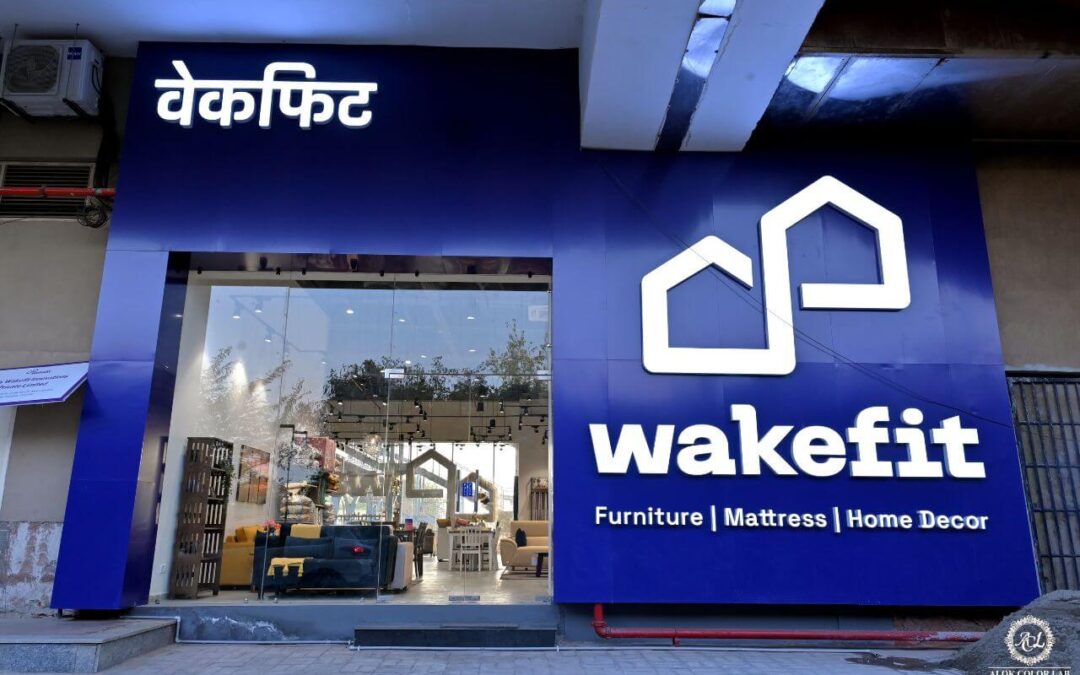
Wakefit is structured entirely differently. It is the largest D2C home and furnishing company in India, with revenues 3.2 times its nearest D2C peer. Unlike Sheela Foam’s multi-brand, multi-geography spread, Wakefit operates under a single brand across mattresses, furniture, and furnishings, using a flywheel model where mattress customers are cross-sold furniture and furnishings. Its own channels, the website, and 139 COCO stores now account for 67 percent of total revenues, up from 55 percent two years ago.
The company ended March 2026 with investable cash of Rs.958 crore and zero debt, funded entirely from internal accruals. Its retail channel grew 49 percent in FY26, and MBO store count rose 30 percent to 1,948 stores across 536 cities.

FY27 Growth Triggers: What Could Drive Growth Ahead?
Sheela Foam’s near-term growth levers are reasonably concrete. The e-commerce segment, which posted 136 percent sales growth on its own website in FY26, is still small relative to the overall revenue base and carries significant headroom. The Kurlon brand is being repositioned through influencer-led digital campaigns.
International operations in Australia and Spain are now generating double-digit EBITDA margins after years of drag, which should support consolidated margin improvement. The U20 mass-market format gives the company exposure to tier-3 and tier-4 markets where organized mattress penetration is still low.
Wakefit’s forward momentum is anchored in three places. First, physical store expansion: the company is committed to adding 117 more COCO stores using IPO proceeds, with a specific focus on tier-2 towns. Second, raw material price increases implemented in March and April 2026 following a 30 to 160 percent spike in key inputs like polyols and TDI should flow into margins in FY27 as volumes recover.
Third, the Board has approved an MOA expansion that allows the company to enter adjacent categories, including home improvement and lifestyle solutions, widening the total addressable basket per customer.
Investor Overview
Both companies are credible plays on the formalization of India’s Rs.14,000-crore-plus mattress market. Sheela Foam is the safer, more complete franchise, a diversified business with international revenue, a commanding market share in branded mattresses, and a proven track record of margin recovery. Wakefit is the faster-growing story with a cleaner D2C model, a stronger balance sheet, and a longer runway in physical retail expansion.
For investors wanting steady cash flows and established brand moats, Sheela Foam fits the bill. For those willing to back a young, capital-light platform compounding at a faster rate, Wakefit makes the more compelling case over a five-year horizon.
Disclaimer: The views and investment tips expressed by investment experts/broking houses/rating agencies on tradebrains.in are their own, and not that of the website or its management. Investing in equities poses a risk of financial losses. Investors must therefore exercise due caution while investing or trading in stocks. Trade Brains Technologies Private Limited or the author are not liable for any losses caused as a result of the decision based on this article. Please consult your investment advisor before investing.