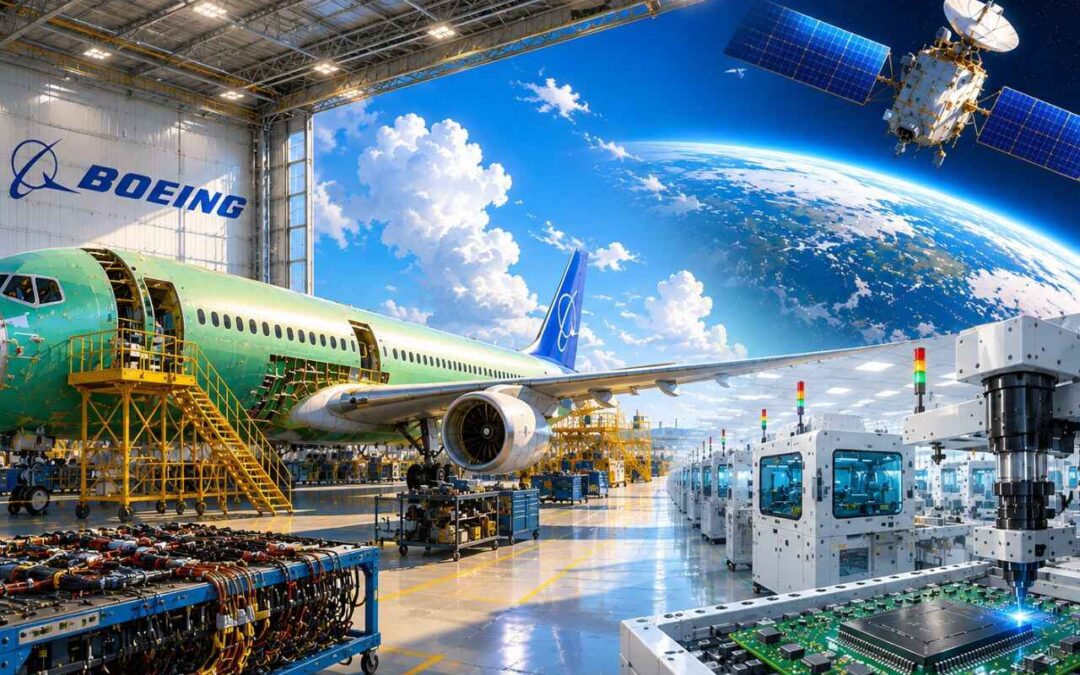
Synopsis: For years, this company quietly operated behind the scenes with some of the world’s largest global customers, including Boeing. Now, management is making a series of moves that could significantly change the business over the next few years. What is happening, and why could it matter?
India’s defence manufacturing story is usually discussed through large platforms such as fighter aircraft, missiles, helicopters and warships. But behind every large platform, there is a smaller and more complex supply chain that makes these systems work.

Wiring systems, electronic assemblies, panels, testing equipment and integration solutions may not look very large from the outside, but they are critical because even a small failure can affect the performance of the entire platform.
This is the space where Rossell Techsys has built its business. The company supplies high-reliability electrical and electronic systems to global aerospace and defence original equipment manufacturers. Its journey started with Boeing, but the company is now trying to build a wider business across aerospace, defence, semiconductors and space. That raises an important question.

The Boeing Connection
Rossell Techsys’ story began with Boeing. The company started in 2013 by fulfilling Boeing’s offset obligations in India. In simple terms, when foreign defence companies win large contracts in India, they may be required to invest a part of that contract value back into India. This creates an opportunity for Indian companies to become part of global defence and aerospace supply chains.
Rossell Techsys used this opportunity to enter Boeing’s supply chain. The company began supplying electrical wiring interconnection systems and custom electronics assemblies for defence programs. These are not ordinary products. In aerospace and defence, wiring systems and electronic assemblies need very high quality, strict documentation, traceability and reliability. Once a supplier proves itself in such programs, the relationship can become long term.

This Boeing relationship gave Rossell Techsys credibility. It proved that an Indian company could meet the quality and delivery standards of a global aerospace major. Over time, this helped Rossell expand beyond Boeing and win other global customers.
From Boeing Dependence To A Wider Customer Base
Rossell Techsys was once highly dependent on Boeing. As per India Ratings, Boeing contributed around 90 percent of the company’s revenue in FY22. That kind of dependence can be risky because any slowdown in one customer’s program can directly hurt the company’s growth.
But the picture has changed. Boeing’s share reduced to around 50 percent in FY24 and further to around 41 percent in FY25. In the first half of FY26, Boeing still contributed around 40 percent of revenue, but the company had clearly become less dependent on one customer.

At the same time, Rossell Techsys expanded its active customer base from less than 10 in FY22 to around 26-30 active customers by 1HFY26. Its customer list now includes global names such as Honeywell, InterConnect Wiring and Lockheed Martin.
The relationship with Boeing, however, remains important. In the Q4FY26 call, management said Boeing appreciated Rossell’s execution and agreed to level-load future schedules. This is important because level loading can make production smoother and reduce sudden pressure on execution. It also shows that Boeing still sees Rossell as a reliable long-term partner.
Why Semiconductors And Space Make Sense
Rossell Techsys is entering semiconductors and space because these sectors need the same kind of high-reliability manufacturing skills that the company already uses in aerospace and defence.
Rossell Techsys is not manufacturing semiconductor chips. Instead, it is building wire harnesses and related systems for the machines that manufacture semiconductors. The opportunity is a natural extension of the company’s existing expertise in aerospace and defence wiring systems.
In Q3FY26, management said the semiconductor equipment manufacturing segment generated more than Rs. 10 crore in revenue in its very first quarter after qualification. By Q4FY26, the company said volumes ramped up immediately after customer qualification, indicating that the business is beginning to scale.
The company is also taking its wire harness expertise into the space sector. The company is manufacturing wire harnesses for satellite programs, similar to the work it already performs for aerospace and defence customers. In FY26, Rossell secured a multi-year space contract worth around Rs. 400 crore. Management also said the company executed its first large production batches in the space segment and is well placed to scale this business meaningfully in FY27.
Management has also disclosed that it is currently working with Amazon on its space programs and is looking to expand its customer base further. With customer qualifications moving into commercial execution, the company believes the space business can scale meaningfully over the coming years.
So, this is not random diversification. Rossell is not leaving its core business. It is using the same engineering, wiring and electronic manufacturing capabilities in newer sectors where quality and reliability matter.
The Bigger Growth Plan
FY26 was a strong year for Rossell Techsys. Standalone Revenue grew from Rs. 259 crore in FY25 to Rs. 485 crore in FY26, a rise of 87 percent. EBITDA increased from Rs. 38 crore to Rs. 66 crore, while profit before tax rose from Rs. 10.71 crore to Rs. 27.44 crore whereas profit for the period stood at Rs. 20.74 crore compared to Rs. 7.13 crore in FY25. Q4FY26 was the strongest quarter in the company’s history, with revenue of around Rs. 142 crore and profit of around Rs. 9.5 crore.
The order visibility has also improved. As of Q4FY26, Rossell had confirmed purchase orders of around Rs. 715 crore. It also had strategic agreements of around Rs. 3,000 crore and had submitted bids worth nearly Rs. 4,500 crore across aerospace, defence, semiconductor and space segments during the year. During FY26, the company received orders worth around Rs. 570 crore.
This order visibility matters because Rossell works in long-term programs. Strategic agreements may not turn into revenue immediately, but they give visibility over future work. Confirmed orders give near-term execution visibility, while bids show the future opportunity pipeline.
Management has also indicated that the business mix can change over time. As per India Ratings, defence contributed around 93 percent of revenue in FY25, but management is targeting to reduce defence’s share to around 50 percent over the medium term. This does not mean defence will shrink. It means semiconductors, space and other segments may grow faster.
The company is also adding capacity. In Q1FY26, it spoke about a 15,000 square feet expansion within its existing premises. In Q3FY26, management said it was assessing the lease of an additional 210,000 square feet facility to address the sharp rise in demand.
The Risks Investors Should Watch
The biggest risk in Rossell Techsys is working capital. The business needs large inventory because many raw materials are imported, programs are long term and critical components must be available on time. As per India Ratings, the net working capital cycle stretched to 607 days in FY25, mainly because inventory days stood at 566. More than 80 percent of raw materials are imported, which adds to transit time.
There has already been some improvement. According to India Ratings, the net working capital cycle improved from 607 days in FY25 to 387 days in 1HFY26 as inventory days reduced from 566 to 398. Management also highlighted in the Q4FY26 earnings call, that inventory coverage improved from around 10 months historically to 7.67 months despite revenue growing 87 percent during the year, reflecting better working capital management.
The company is trying to improve this further by aligning procurement closer to production schedules, using shorter-tenure contracts outside defence, consolidating suppliers, exploring third-party inventory holding and seeking advance payments from customers. Management has stated that its long-term goal is to reduce inventory coverage further and eventually operate as a four-month inventory business.
Customer concentration is another risk. The top five customers contributed around 91 percent of revenue in FY25. Boeing’s share has reduced, but it is still the largest customer. The good part is that these are long-term relationships, but the company still needs to keep adding more customers and programs.
Conclusion
Rossell Techsys is entering semiconductors and space because its core capability is not limited to defence. Its real strength is high-reliability engineering and manufacturing. Boeing helped the company build credibility, quality systems and global trust. Now, Rossell is trying to use that same foundation to enter faster-growing areas such as semiconductor equipment and space systems.
The company is not abandoning Boeing or defence. Instead, it is trying to become bigger than its original Boeing story. With Rs. 715 crore of confirmed orders, Rs. 3,000 crore of strategic agreements and a large bid pipeline, the growth opportunity looks visible. But the company also has to manage high working capital and customer concentration.
Disclaimer: The views and investment tips expressed by investment experts/broking houses/rating agencies on tradebrains.in are their own, and not that of the website or its management. Investing in equities poses a risk of financial losses. Investors must therefore exercise due caution while investing or trading in stocks. Trade Brains Technologies Private Limited or the author are not liable for any losses caused as a result of the decision based on this article. Please consult your investment advisor before investing.