
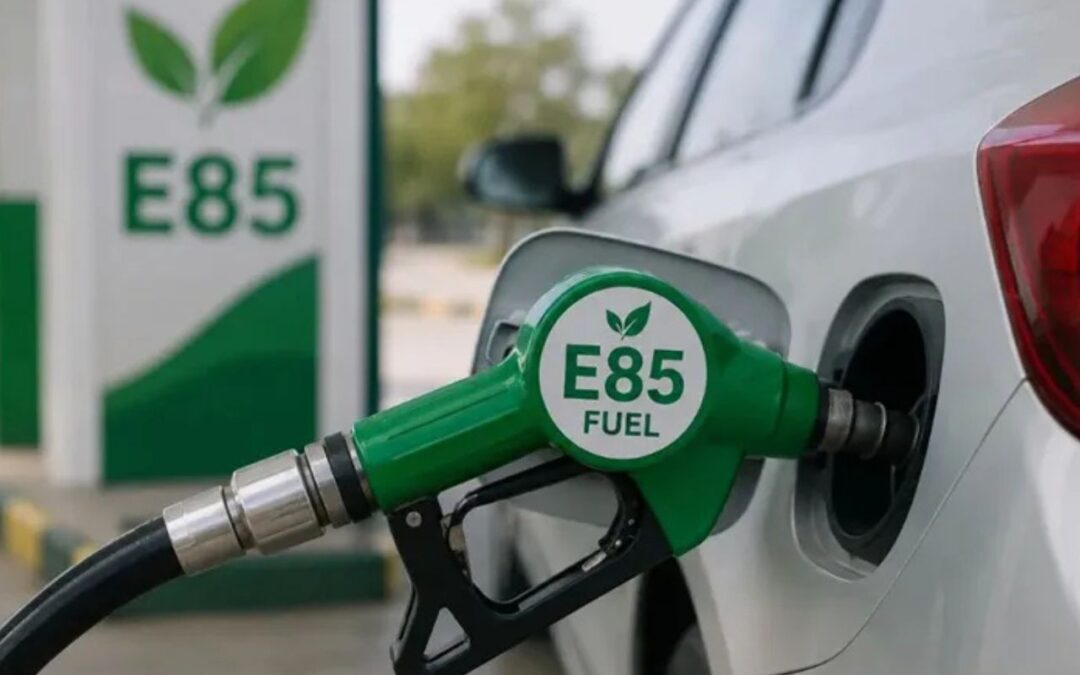
Synopsis: India’s push to expand E85 fuel availability marks a new phase in the country’s clean mobility journey, creating opportunities across the automotive, energy and agriculture value chain while raising vehicle compatibility questions.
Ethanol-based fuels have emerged as a key part of India’s strategy to reduce dependence on imported crude oil, lower carbon emissions and strengthen energy security. Produced mainly from sugarcane, maize and other agricultural feedstocks, ethanol can be blended with petrol in varying proportions to create cleaner-burning fuels.

Over the past decade, India has rapidly increased ethanol blending in petrol, helping save foreign exchange, support farmers and build a more sustainable fuel ecosystem. The launch of higher ethanol blends such as E85 represents the next step in this transition, alongside the development of flex-fuel vehicles designed to operate on multiple fuel blends.
What is E85 Fuel and Why is it Important?
E85 is a high-ethanol fuel blend containing about 80-85percent ethanol and 15-20percent petrol. Unlike conventional petrol or E20 fuel, E85 is specifically designed for flex-fuel vehicles (FFVs), which can run on ethanol blends ranging from E20 to E100. The government recently launched E85 at 48 fuel stations and plans to expand availability to around 500 outlets by December 2026 and approximately 5,000 outlets by the end of 2027.

The importance of E85 extends beyond transportation. India imports a large portion of its crude oil requirements, making the economy vulnerable to global price fluctuations. Greater ethanol usage can reduce this dependence while creating a stable domestic market for agricultural feedstocks such as sugarcane and maize. The fuel is also expected to lower emissions and support the government’s broader clean-energy objectives. E85 has been introduced at a price nearly Rs. 20 per litre lower than conventional petrol, potentially offering operating cost benefits for compatible vehicle owners.
Future Outlook: Building a Flex-Fuel Ecosystem
The E85 rollout is part of a larger effort to create a nationwide flex-fuel ecosystem. Policymakers expect the expansion of E85 infrastructure to encourage automobile manufacturers to introduce more flex-fuel vehicle models in India. The government has already proposed regulatory changes to formally permit higher ethanol blends such as E85 and E100, indicating long-term policy support for ethanol-based mobility.

India’s ethanol blending programme has already achieved significant progress, with blending levels rising from 1.53percent in 2014 to 20percent in 2026. Officials have indicated that wider adoption of E85 and flex-fuel vehicles could help push aggregate ethanol blending levels to nearly 26percent by 2030-31. The planned network of 5,000 E85 stations, supported by public-sector oil marketing companies, could become a major catalyst for growth across the ethanol, automotive and agricultural sectors
Vehicle Compatibility: A Key Consideration
While E85 offers several advantages, it is important to note that it cannot be used in regular petrol vehicles. The fuel is intended exclusively for flex-fuel vehicles equipped with specially designed engines, fuel lines and components capable of handling high ethanol concentrations. Using E85 in a standard petrol vehicle may lead to performance and durability issues. As a result, the success of E85 will depend not only on fuel station expansion but also on the pace at which automakers introduce compatible flex-fuel models in the Indian market.
Automakers Prepare for India’s Flex-Fuel Future
Maruti Suzuki WagonR Flex Fuel
Maruti Suzuki has introduced the WagonR Flex Fuel, making it India’s first mass-market flex-fuel passenger vehicle. The car is designed to run on ethanol-petrol blends ranging from E20 to E100 and is currently homologated for E85 fuel. Equipped with an advanced ECU calibration system, the WagonR can automatically adjust engine performance based on the ethanol content in the fuel, supporting the country’s shift towards cleaner mobility solutions.

Hero Splendor+ Flex Fuel
Hero MotoCorp’s Splendor+ Flex Fuel is among the first motorcycles in India capable of operating on ethanol blends from E20 to E85. Powered by a 97.2 cc engine, the motorcycle produces 6.3 kW of power and 8.3 Nm of torque when running on E85 fuel. It also features Hero’s i3S idle-stop-start technology, a digital-analogue instrument cluster and upgraded fuel system components designed for higher ethanol compatibility.
Hero HF Deluxe Flex Fuel
The HF Deluxe Flex Fuel further expands Hero MotoCorp’s flex-fuel portfolio. Like the Splendor+, it uses a 97.2 cc engine that generates 6.3 kW of power and 8.3 Nm of torque on E85 fuel and supports ethanol blends from E20 to E85. The motorcycle comes with a revised ECU, upgraded fuel delivery system, side-stand engine cut-off feature and tubeless tyres, reinforcing Hero’s focus on supporting India’s ethanol-based mobility ecosystem.
Stocks to Benefit
CIAN Agro Industries & Infrastructure Ltd
CIAN Agro Industries & Infrastructure Ltd has exposure to India’s ethanol sector through its subsidiary, Manas Agro Industries, which operates in sugar manufacturing, distillery operations and ethanol production. The company has also partnered with the Ram Charan Group to explore ethanol production from carbon dioxide, aligning with India’s growing focus on biofuels and ethanol blending.
With the market capitalization of Rs. 4299 Crores, the shares of CIAN Agro Industries & Infrastructure Ltd were trading at around Rs. 1536 per share which is 57 percent discount from its 52 weeks high of Rs. 3633 per share and is trading at a P/E of 19.3 whereas industry P/E stands at 18.4
Revenue from operations has increased on a yearly basis from Rs. 490 Crores to Rs, 656 Crores, up 34 percent. Operating profit has increased from Rs. 46 Crores to Rs. 123 Crores, up 167 percent and net profit has increased from Rs. 8 Crores to Rs. 64 Crores, up 700 percent
Praj Industries
Praj Industries is a Pune-based industrial biotechnology and engineering company specializing in ethanol production technology, bioenergy solutions and sustainable processing systems. Established in 1983, the company serves customers across more than 100 countries. Praj plays a key role in India’s ethanol blending programme by supplying technology and equipment for grain- and sugar-based ethanol plants.
With the market capitalization of Rs. 6,104 Crores, the shares of Praj Industries Ltd were trading at around Rs. 332 per share, which is 35 percent discount from its 52 weeks high of Rs. 514 per share and is trading at a P/E of 315 whereas industry P/E stands at 30.5
Revenue from operations has decreased on a yearly basis from Rs. 860 Crores to Rs. 845 Crores, down 1.7 percent. Operating profit has decreased from Rs. 75 Crores to Rs. 23 Crores, down 69 percent and net profit has decreased from Rs. 40 Crores to Rs. 12 Crores, down 70 percent.
Balrampur Chini Mills
Balrampur Chini Mills is one of India’s largest integrated sugar manufacturing companies, with operations spanning sugar production, ethanol manufacturing and cogeneration of power. The company has significantly expanded its distillery capacity to capitalize on India’s ethanol blending programme. Its diversified business model provides exposure to both the sugar and biofuel sectors.
With the market capitalization of Rs. 11,407 Crores, the shares of Balrampur Chini Mills Ltd were trading at around Rs. 540 per share which is 14 percent discount from its 52 week high of Rs. 628 per share and is trading at a P/E of 30.1 whereas industry P/E stands at 16.2
Revenue from operations has increased on a yearly basis from Rs. 1504 Crores to Rs. 1604 Crores, up 206 percent. Operating profit has decreased from Rs. 365 Crores to Rs. 285 Crores, down 22 percent and net profit has decreased from Rs. 229 Crores to Rs. 160 Crores, down 30 percent
Maruti Suzuki
Maruti Suzuki India is India’s largest passenger vehicle maker and a key participant in the country’s flex-fuel mobility transition. The company introduced the WagonR Flex Fuel, India’s first mass-market flex-fuel car, capable of running on ethanol blends up to E100. This positions Maruti Suzuki to benefit from the expanding E85 fuel ecosystem and government-backed ethanol initiatives.
With the market capitalization of Rs. 4,20,230 Crores, the shares of Maruti Suzuki India Ltd were trading at around Rs. 13,366 per share which is 23 percent discount from its 52 week high of Rs. 17,372 per share and is trading at a P/E of 28.6 whereas industry P/E stands at 28.5
Revenue from operations has increased on a yearly basis from Rs. 40,920 Crores to Rs. 52,462 Crores, up 28 percent. Operating profit has increased from Rs. 4,844 Crores to Rs. 6158 Crores, up 27 percent and net profit has increased from Rs. 3911 Crores to Rs. 3659 Crores, up 6.4 percent
Hero MotoCorp
Hero MotoCorp is India’s largest two-wheeler maker and an early mover in flex-fuel mobility. The company has launched the Splendor+ Flex Fuel and HF Deluxe Flex Fuel motorcycles, both compatible with ethanol blends from E20 to E85. As E85 availability expands, Hero MotoCorp is well positioned to benefit from growing demand for ethanol-compatible two-wheelers.
With the market capitalization of Rs. 99,307 Crores, the shares of Hero MotoCorp Ltd were trading at around Rs. 4963 per share which is 22 percent discount from its 52 weeks high of Rs. 6390 per share and is trading at a P/E of 17 whereas industry P/E stands at 35.4
Revenue from operations has increased on a yearly basis from Rs. 9970 Crores to Rs. 12,978 Crores, up 30 percent. Operating profit has increased from Rs. 1441 Crores to Rs. 1870 Crores, up 29 percent and net profit has increased from Rs. 1169 Crores to Rs. 1474 Crores, up 26 percent.
Disclaimer: The views and investment tips expressed by investment experts/broking houses/rating agencies on tradebrains.in are their own, and not that of the website or its management. Investing in equities poses a risk of financial losses. Investors must therefore exercise due caution while investing or trading in stocks. Trade Brains Technologies Private Limited or the author are not liable for any losses caused as a result of the decision based on this article. Please consult your investment advisor before investing.