Synopsis:- Indian Railways has commissioned the full 2,843 km Dedicated Freight Corridor, letting freight trains run at up to 100 km/h against a historical average of 25 km/h. A UNSW study pegs the GDP gain at around Rs. 16,000 crore, with RVNL, CONCOR, Gateway Distriparks, Adani Ports and Siemens India among the likely beneficiaries.
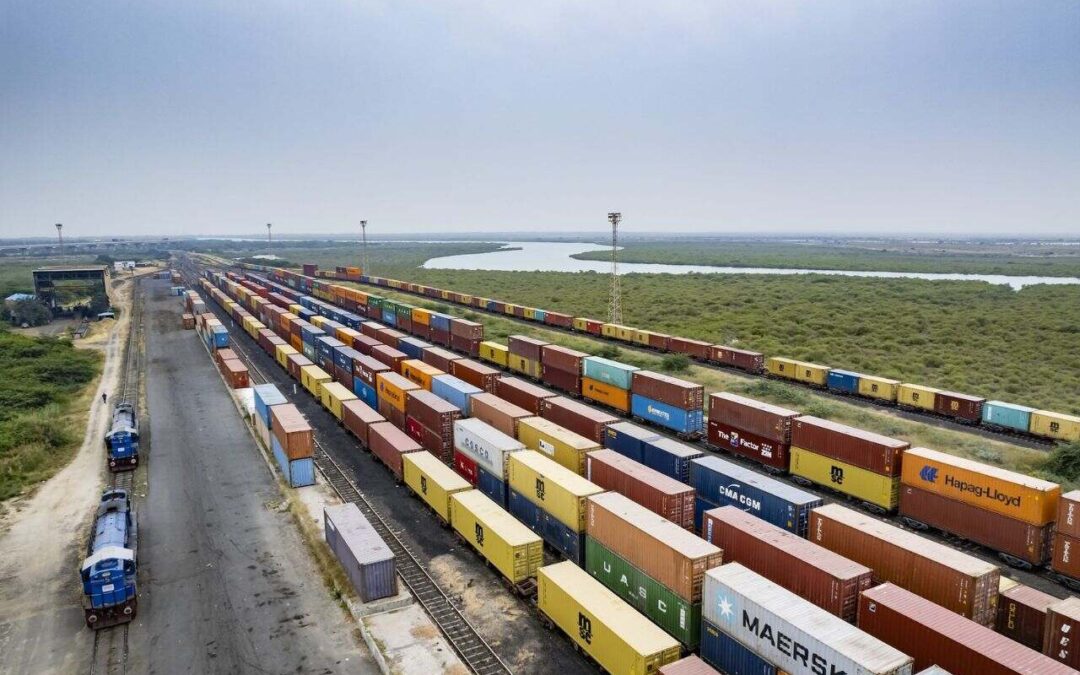
For most of its history, Indian Railways has run freight and passenger trains on the same tracks, which meant goods trains queued behind everything else and rarely moved faster than a truck stuck in traffic. That’s the problem the Dedicated Freight Corridor was built to solve, and after roughly two decades of construction, delays and cost overruns, the project has finally reached the finish line.

What’s the news?
The Eastern DFC, running 1,337 km from Ludhiana to Sonnagar, has been fully operational since 2024. The Western DFC, covering 1,506 km between Dadri and Jawaharlal Nehru Port near Mumbai, was the last piece of the puzzle, and its final stretch was commissioned on March 31, 2026. Together, the two corridors add up to the full 2,843 km network, built exclusively for cargo traffic and kept separate from the congested passenger lines that freight trains used to share.
The upgrade matters because of what it does to speed. Freight trains on conventional Indian Railways tracks have historically averaged around 25 km/h, weighed down by frequent stops, signal delays and passenger priority. On the dedicated tracks, that average has already climbed past 50-60 km/h, with the corridor built to eventually support speeds of up to 100 km/h.

A study by the University of New South Wales, cited by the Dedicated Freight Corridor Corporation of India, estimates this could add roughly Rs. 16,000 crore to India’s GDP by cutting freight costs, shortening transit times and making Indian industry more competitive globally. The same study also found that regions closer to the corridors, particularly along the western route, have already seen measurably faster economic gains than areas further away.
For a country where logistics costs still eat up somewhere between 13 and 15 percent of GDP, well above the government’s own target of bringing that down closer to 8 percent, a freight network that runs four times faster than before is not a minor upgrade. It touches everything from how quickly a factory in Gujarat can get its output to a port, to how much it costs to move coal, steel or containers across the country.

Companies in the Line of Sight
RVNL
Rail Vikas Nigam has built a chunk of India’s railway infrastructure over the past two decades, and the DFC’s completion feeds directly into its order pipeline for electrification, signalling and allied works tied to freight expansion.
The stock closed on Thursday around Rs. 224.13 with a market capitalisation near Rs. 46,892.10 crore, has fallen sharply from its 52-week high of Rs. 400.70 and now carries a fairly rich price-to-earnings ratio near 59.89 given the stock’s recent de-rating.
Container Corporation of India (CONCOR)
CONCOR runs the country’s largest network of inland container depots and is the dominant player in rail-based container movement, holding more than half the market in both the domestic and EXIM segments. Faster freight trains and better port connectivity translate almost directly into shorter turnaround times for CONCOR’s container rakes. Shares closed on Thursday trading around Rs. 480.50, valuing the company near Rs. 36,626.21 crore, at a price-to-earnings ratio of about 30.15.

Gateway Distriparks
A smaller player than CONCOR but focused squarely on rail freight and container logistics through its subsidiary Gateway Rail Freight, the company operates container train services connecting inland depots to major ports, including JNPT, which sits at the western end of the newly completed corridor. The stock closed on Thursday around Rs. 57.09, with a market capitalisation of roughly Rs. 2,848.47 crore.
Adani Ports & SEZ
India’s largest private port operator stands to gain from better last-mile rail connectivity into its terminals, particularly at Mundra and JNPT, both of which sit close to the Western DFC’s route.
Adani Ports shares closed on Thursday near Rs 1,778.50, with a market capitalisation above Rs 4,10,335.12 crore, making it comfortably the largest company on this list, though also one trading at a considerably higher valuation multiple than its logistics peers.
Siemens India
Siemens supplies electrification and signalling systems, the kind of equipment that underpins the DFC’s ability to run faster, safer freight trains. The company’s exposure here sits within its broader mobility and infrastructure business rather than being tied to freight alone.
Shares closed on Thursday trading around Rs 3,686.30, with a market capitalisation near Rs 1,30,874.29 crore and a price-to-earnings ratio close to 102.82, reflecting the premium the market already places on its diversified industrial franchise.
Where do they stand?
The logic connecting these five names is straightforward even if their businesses are quite different. Higher train speeds and dedicated capacity reduce the time a wagon spends idle, which raises asset utilisation for anyone running rolling stock. That helps RVNL and Siemens on the build-and-equip side, and CONCOR and Gateway Distriparks on the operate side, since both effectively rent out capacity on the network and get paid more efficiently when trains move faster. Adani Ports sits at the other end of the chain, benefiting whenever cargo reaches its terminals faster and cheaper, regardless of who is running the trains.
None of this means every company benefits equally or immediately. RVNL and Siemens depend on future order flow from Indian Railways and DFCCIL rather than a one-time revenue bump, and much of that order book was likely already priced in as construction progressed. CONCOR and Gateway Distriparks compete with road freight and with each other for market share, so faster rail speeds help only if they can convert that into more volume rather than simply matching cost savings competitors also enjoy.
What Should Investors Look Out For?
Valuations across this list vary enormously, from Gateway Distriparks near a price-to-earnings ratio of 11 to Siemens near 103, so the same piece of infrastructure news means very different things depending on what’s already priced in. RVNL’s order inflow growth has slowed over the past year even as the stock corrected sharply, which is worth checking against fresh DFC-linked contract wins rather than assuming past momentum continues.
CONCOR’s market share in container rail freight has drifted down from about 74 percent a few years ago as private operators expanded, so a faster network alone may not reverse that trend. And a second DFC corridor, from Dankuni to Surat, was announced in the Union Budget 2026-27, which means investors should track execution risk on the next phase rather than treating the current network as the end of the story.
Disclaimer: The views and investment tips expressed by investment experts/broking houses/rating agencies on tradebrains.in are their own, and not that of the website or its management. Investing in equities poses a risk of financial losses. Investors must therefore exercise due caution while investing or trading in stocks. Trade Brains Technologies Private Limited or the author are not liable for any losses caused as a result of the decision based on this article. Please consult your investment advisor before investing.