
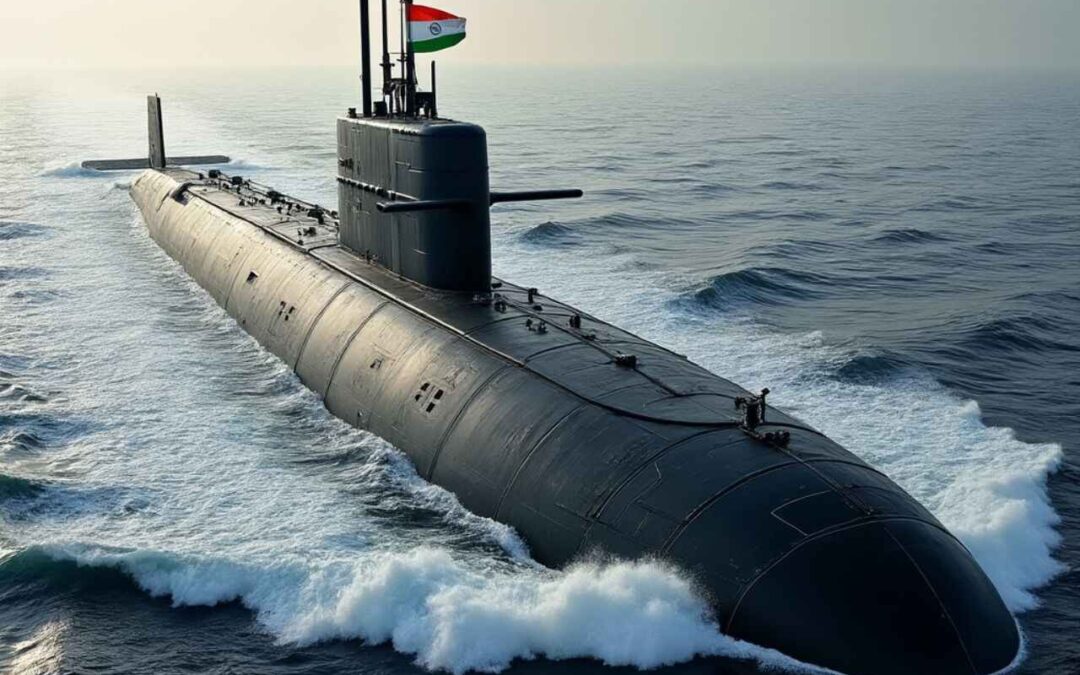
Synopsis: India’s underwater defence modernisation is creating opportunities beyond submarine construction. Rising investments in submarines, sonar systems, anti-submarine warfare, autonomous underwater vehicles and underwater surveillance could benefit companies across the defence ecosystem. Mazagon Dock, BEL, BDL, L&T, CFF Fluid Control and Data Patterns are positioned to participate in this long-term strategic theme.
As India strengthens its maritime security amid rising geopolitical tensions in the Indo-Pacific, underwater defence is emerging as a key focus area. Beyond conventional submarines, the Indian Navy is investing in advanced sonar systems, underwater surveillance, anti-submarine warfare and autonomous underwater vehicles.

This expanding ecosystem is expected to create opportunities for companies involved in submarine construction, defence electronics, underwater weapons and specialised engineering. Here are six stocks that could benefit from India’s growing underwater defence modernisation programme.
India’s Silent Defence Build-Up
Indian naval modernisation is gradually moving below water in light of rising geopolitics in the Indo-Pacific region. With more Chinese submarines being deployed and the requirement to defend crucial sea routes, there has been a growing need for India’s navy to strengthen its underwater warfare capabilities.

This involves not just submarines but also sonars, undersea sensors, torpedoes, AUVs, UUVs, and AI-based surveillance mechanisms. India is further expanding its engagement with the US in sectors such as sonobuoys, autonomous maritime systems, and undersea domain awareness. It underlines the significance of underwater defence in the context of Indian naval modernisation.
As the navy makes further investments in the underwater domain, the opportunity may emerge for firms engaged in the construction of submarines and other underwater technologies, including electronics, weapons, and specialised components.

The Next Wave of Naval Spending
The underwater defence strategy of India focuses on its Project-75(I) that seeks to acquire six submarines that have state-of-the-art AIP technology along with their combat systems. Along with this, India is upgrading its indigenous capacity to make nuclear submarines as well as increasing its investment in anti-submarine warfare and underwater surveillance technologies.
The form of naval warfare itself has changed over time. Modern naval warfare uses integrated systems of sonars, underwater sensors, AI-driven surveillance, and unmanned underwater vehicles instead of submarines. India has already declared its partnership with the US to manufacture sonobuoys and towed-array sonar systems in India.
Mazagon Dock’s Submarine Bet
Mazagon Dock Shipbuilders stands out as the largest listed company to benefit from submarine upgrades in India. It happens to be the sole dockyard that is known to construct conventional submarines, having supplied all six submarines of the Scorpene class under Project-75. With a market cap of Rs 93,000 crore, the shares of Mazagon Dock Shipbuilders Ltd are trading at Rs 2,300 and are trading at a PE of 36 compared to their industry’s PE of 44.

In the future, the company is likely to have a very important role to play in submarine development, especially in Project 75(I). As far as submarine replacements are concerned in India, there could be enough orders for the company, as there are several submarines that are slated to be retired in the coming years.
BEL and BDL’s Underwater Arsenal
With a market cap of Rs 2.97 lakh crore, the shares of Bharat Electronics Ltd are trading at Rs 406 and are trading at a PE of 49 compared to their industry’s PE of 66, and with the market cap of Rs 45,700 crore, the shares of Bharat Dynamics Ltd are trading at Rs 1,247 and are trading at a PE of 109 compared to their industry’s PE of 66.
However, apart from submarines, sophisticated sensors and underwater weaponry also become important. Indian company Bharat Electronics has developed indigenous sonars, combat management systems and underwater surveillance equipment and is now working together with L3Harris to produce towed array sonar systems in India.
The role of Bharat Dynamics in this ecosystem is to produce heavyweight torpedoes and ASW equipment. Besides that, it has joined hands with Ultra Maritime for production of sonobuoys in India. With the increased involvement of technology in underwater warfare, it becomes evident that both BEL and BDL will be able to take advantage of growing investments in underwater surveillance and ASW equipment.
L&T and CFF’s Strategic Role
With a market cap of Rs 5.23 lakh crore, the shares of Larsen & Toubro Ltd are trading at Rs 3,800 and are trading at a PE of 32 compared to their industry’s PE of 16, and with the market cap of Rs 2,000 crore, the shares of CFF Fluid Control Ltd are trading at Rs 960 and are trading at a PE of 51 compared to their industry’s PE of 66.
Apart from submarine manufacturing, the underwater defence ecosystem in India relies on a chain of companies which provide engineering systems and parts. In particular, Larsen & Toubro (L&T) has gained considerable experience in submarine engineering due to the company’s partnership in India’s indigenous nuclear submarine project.
L&T provides parts of pressure hulls, launch systems, heavy engineering products and other engineering systems which need advanced engineering techniques. Besides submarines and underwater systems, the company is active in developing naval platforms, weapons launch systems and strategic infrastructure, which gives it an opportunity to be engaged in submarine projects in the future.
CFF Fluid Control can be considered a niche yet very important company in this ecosystem. It produces submarines’ fluid control systems, propulsion components, underwater communication equipment and other specialised engineering systems which are used by the Indian Navy.
By means of the joint venture between CFF and Germany’s Atlas Elektronik, the company supplies low frequency variable depth sonar (LFVDS) and underwater communication systems which are part of ASW-SWC program of the Indian Navy. In line with the increase in localisation of highly valuable submarine components, companies such as CFF may expect more opportunities in their niche market.
The Future of Underwater Drones
The next step of underwater warfare would be propelled not only by submarines but also by autonomous systems. Autonomous Underwater Vehicles (AUVs) and Unmanned Underwater Vehicles (UUVs) are becoming a popular choice for use by various navies of the world for surveillance purposes, intelligence collection, mine hunting, seabed surveying and anti-submarine warfare.
These platforms can remain underwater for extended periods while carrying out specialised missions without risking human crews and at a lower operating cost than conventional submarines
India is developing its capabilities in this sector through the collaboration between DRDO, the Indian Navy and international technology companies. The rising importance of underwater surveillance using artificial intelligence, autonomous guidance and underwater communication networks indicates the increasing role of unmanned underwater vessels in future procurement along with the conventional submarines. Even though the commercial application of such technology is at its emerging stages in India, it shows a clear path of naval development.
With a market cap of Rs 25,600 crore, the shares of Data Patterns (India) Ltd are trading at Rs 4,574 and are trading at a PE of 104 compared to their industry’s PE of 66.Among listed companies, Data Patterns offers indirect exposure to this emerging theme. The company specialises in mission computers, embedded electronics, radar and signal processing, data links and autonomous technologies that can be integrated into future underwater platforms. While it has not disclosed a dedicated underwater drone programme, its technological capabilities position it well to participate if indigenous underwater drone programmes gather pace over the coming years.
Six Stocks Riding the Theme
Each one of these six companies holds its own unique position in the underwater defence value chain of India. The Mazagon Dock is the most direct beneficiary through the construction of submarines and further possibilities in Project 75(I).
Bharat Electronics enhances the capability of the Navy to conduct underwater surveillance through sonar systems, combat management systems, and advanced defence electronics, while Bharat Dynamics helps through heavyweight torpedoes and the indigenous manufacture of sonobuoys for ASW.
Larsen & Toubro works on submarine engineering and naval infrastructures, and therefore, it acts as an important facilitator for indigenous submarine projects. While CFF Fluid Control supplements the abovementioned large players through specialised submarine systems having a technological entry barrier and little competition in the country.
Data Patterns, on the other hand, stands out from the rest. It supplies neither submarines nor underwater equipment but defence electronics, which may become more relevant in the future as there is increasing development and use of autonomous underwater vehicles and AI-based surveillance systems.
Investment Outlook
Modernisation of underwater defence in India is now shifting focus to become a long-term strategic objective on account of national security considerations, changing maritime responsibilities and the rise in submarines operating in the Indo-Pacific region. The window of opportunity is now going beyond merely increasing numbers of submarines in the country’s navy.
Funds will also start being channelled into sonar systems, underwater sensors, autonomous systems, underwater communications, torpedoes and advanced surveillance networks for underwater warfare. This creates investment opportunities outside of traditional shipbuilders for underwater defence systems.
While Mazagon Dock stands out as the purest submarine play, Bharat Electronics, Bharat Dynamics, L&T, CFF Fluid Control and, to a degree, Data Patterns can gain from some part of this ecosystem. Initiatives such as the Aatmanirbhar Bharat programme, rising defence capital spending and increasing localisation of technology in the strategic sector also bode well for the outlook.
However, while the defence acquisition process may be unpredictable and projects can take many years to complete, India’s underwater defence ecosystem looks set to reap the benefits of a decades-long naval modernisation programme.
Disclaimer: The views and investment tips expressed by investment experts/broking houses/rating agencies on tradebrains.in are their own, and not that of the website or its management. Investing in equities poses a risk of financial losses. Investors must therefore exercise due caution while investing or trading in stocks. Trade Brains Technologies Private Limited or the author are not liable for any losses caused as a result of the decision based on this article. Please consult your investment advisor before investing.