
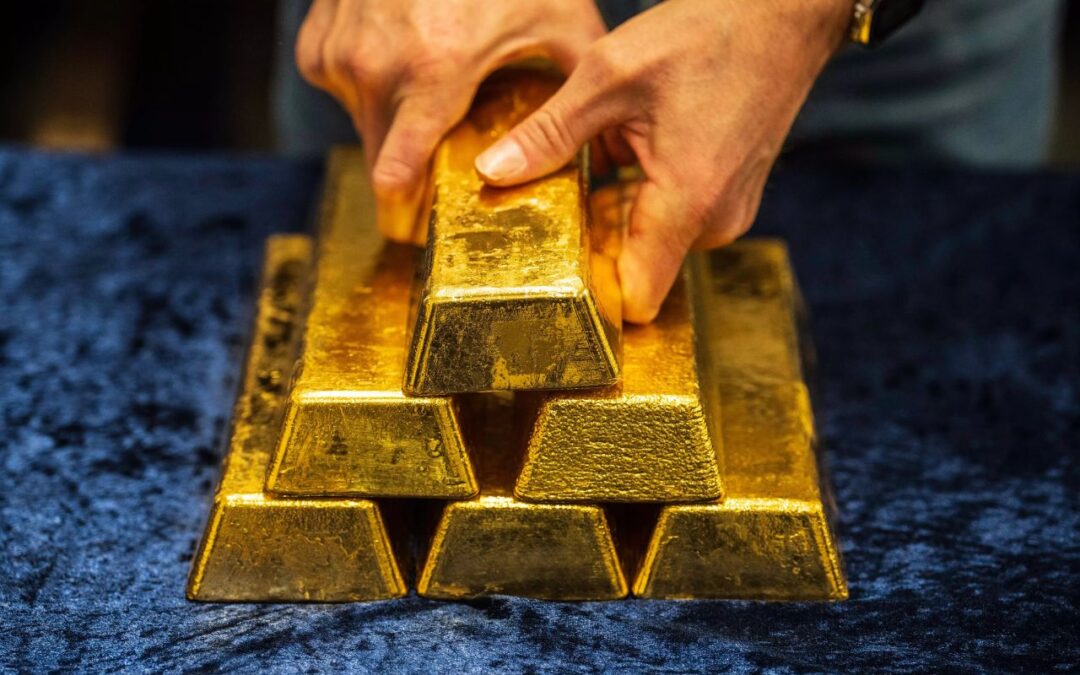
Synopsis: In a counterintuitive market move, gold and silver extended their weekly decline on June 5, 2026, as the inflationary spillover from the US-Iran conflict reinforced Federal Reserve “higher-for-longer” rate signals, driving investors away from non-yielding precious metals and toward the dollar and bond yields with short-term price action likely to remain hostage to Non-Farm Payrolls data and the evolving peace-talk narrative.
Both gold and silver are on track for notable weekly losses, with price action on June 5 defying the traditional safe-haven playbook. Rather than benefiting from an active geopolitical conflict in West Asia, precious metals are bearing the cost of what that conflict is doing to inflation expectations and, by extension, to monetary policy.

On domestic exchanges, MCX Gold Futures (August delivery) slipped roughly 1 percent to approximately Rs. 1,58,213 per 10 grams. MCX Silver Futures (July delivery) fell harder, shedding over Rs. 5,600 or around 2 percent to trade near Rs. 2,59,167 per kilogram. On international markets, spot gold pulled back to $4,452.20 per ounce (approximately Rs. 4,22,700 per ounce at 1 USD = Rs. 94.94), down roughly 1.8 percent for the week. Spot silver dropped to $72.89 per ounce (approximately Rs. 6,920 per ounce).
The Conflict-Inflation Paradox
Ordinarily, armed conflict drives investors into gold. What the US-Iran conflict is producing instead is a different chain reaction. Military disruptions and intercepted Iranian missile attacks targeting regions including Kuwait and Bahrain have kept crude oil prices elevated and volatile. Higher oil feeds directly into global inflation expectations. When inflation expectations rise, the Federal Reserve has less room to cut and when rate cuts are pushed out or replaced with hike signals, the opportunity cost of holding non-yielding gold climbs sharply against bonds and dollar-denominated assets.

Federal Reserve officials have reinforced this dynamic publicly. Cleveland Fed President Beth Hammack and Kansas City Fed President Jeffrey Schmid both signalled that rates may need to stay elevated or move higher if oil-driven inflation persists. The US Dollar Index remains firm near 99.4, adding pressure on gold priced in dollars.
Diplomatic developments have not helped. While President Trump expressed optimism around an interim agreement with Tehran, Iran-backed Hezbollah’s rejection of a new ceasefire proposal in Lebanon and Israel’s refusal of troop withdrawals unwound those expectations, triggering commodity liquidation rather than the relief rally gold bulls had briefly anticipated.

Near-Term Technical Picture
The short-term bias leans bearish ahead of upcoming US Non-Farm Payrolls data. Analysts at Prithvi Finmart (Manoj Kumar Jain) recommend booking profits on temporary rallies in this environment rather than adding exposure. For spot gold, immediate support sits in the $4,420–$4,467 per ounce band (approximately Rs. 4,19,635–Rs. 4,24,100), with resistance capped between $4,535 and $4,580 per ounce (approximately Rs. 4,30,550–Rs. 4,34,825). The consensus view is that near-term bearishness does not fully clear until gold posts a clean weekly close above $4,680 per ounce. For silver, support rests between $69 and $72 per ounce, with resistance at $76.60–$78.80 per ounce.
Medium-Term Outlook
Despite the current pullback, major global banks are maintaining structurally bullish stances on gold for the remainder of 2026. J.P. Morgan Global Research has a year-end target of $5,055 per ounce (approximately Rs. 4,79,920), backed by steady central bank accumulation which it estimates at 190 tonnes per quarter and a resumption of ETF inflows. UBS carries a more aggressive target of $5,900 per ounce (approximately Rs. 5,60,150) by December 2026, with the thesis anchored on physical investment demand, sovereign debt expansion, and currency debasement as long-duration structural drivers.
Commodities consultancy Metals Focus adds a supply-side angle, projecting that global physical investment demand in bars and coins will surpass jewellery demand for the first time in 2026. The mechanism is straightforward: record-high prices have eroded retail jewellery buying in price-sensitive markets, while investment buyers remain active.

Disclaimer: The views and investment tips expressed by investment experts/broking houses/rating agencies on tradebrains.in are their own, and not that of the website or its management. Investing in equities poses a risk of financial losses. Investors must therefore exercise due caution while investing or trading in stocks. Trade Brains Technologies Private Limited or the author are not liable for any losses caused as a result of the decision based on this article. Please consult your investment advisor before investing.