
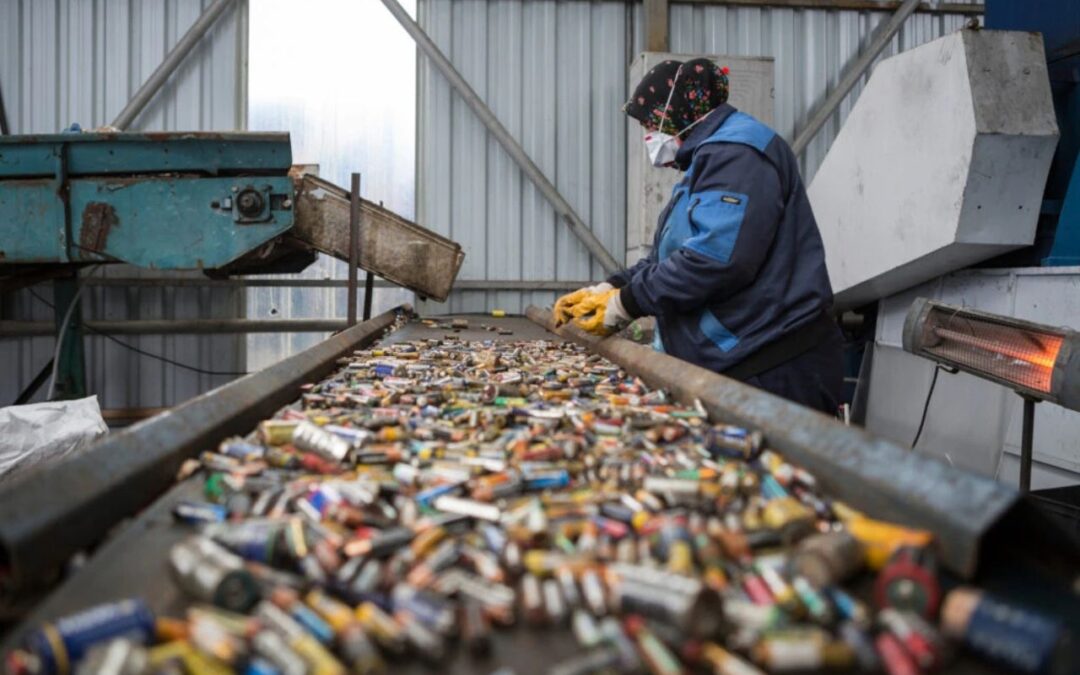
Synopsis: From discarded PET bottles to scrapped circuit boards, a set of listed players is building sizeable businesses out of what most industries treat as waste. Their common thread: turning raw scrap into processed materials that manufacturers actually need, at a time when recycled content rules are tightening across sectors.
Circular economy businesses are no longer a niche theme in Indian markets. A handful of companies have quietly scaled operations around collecting, processing, and refining waste streams that would otherwise end up in landfills or informal scrapyards.

Government policy support for recycling, Extended Producer Responsibility (EPR) norms, and tighter global supply of virgin metals are turning waste processing into an increasingly attractive business opportunity. Here’s a look at four companies building this space, and what’s driving the industry around them.
Ganesha Ecosphere – PET Waste to Textile Fibre
Ganesha Ecosphere is one of India’s oldest and largest recycled polyester manufacturers, built around collecting post-consumer PET bottles and converting them into high-value recycled products for the textile and packaging industries. Its portfolio includes recycled polyester staple fibre (RPSF), spun yarn, dyed texturised yarn, and food-grade rPET granules, serving applications across garments, home furnishings, industrial textiles, and sustainable packaging.

The company operates manufacturing facilities in Kanpur, a 64,500 TPA food-grade rPET facility in Warangal (including a newly commissioned 22,500 TPA line awaiting regulatory approvals), and a 12,000 TPA unit in Nepal. Backed by a PET bottle collection network developed over three decades, Ganesha has shifted its expansion strategy from a proposed Greenfield project in Odisha to a lower-cost Brownfield expansion at Warangal.
It is adding another 22,500 TPA rPET line along with debottlenecking initiatives, which will increase its total installed rPET capacity to nearly 1,00,000 TPA by the end of FY27. Management expects strong utilization of the expanded capacity, supported by regulatory clarity on mandatory recycled-content norms, rising demand from global consumer brands, and qualification of its recycled filament yarn with leading international textile customers.

Baheti Recycling – Aluminium Scrap to Value-Added Alloys
Baheti Recycling’s core business is straightforward but essential to heavy industry: taking aluminium scrap that would otherwise be discarded or exported as low-value raw material and processing it into ready-to-use alloys for manufacturers requiring consistent metal quality at scale.
The company converts aluminium-based scrap into aluminium alloys and de-oxidant products, supplying them as ingots, cubes, shots and notch bars to automotive, steel and construction manufacturers. With an installed smelting capacity of 38,000 metric tonnes per annum, it supplies Tier-1 automotive and steel customers while continuously modernising its manufacturing infrastructure with energy-efficient electric furnaces and solar power integration to improve productivity and reduce operating costs.
Looking ahead, Baheti plans to strengthen its position in the aluminium value chain through a two-phase aluminium wire rod project. The first phase will add 12,500 MTPA of capacity, with the second phase doubling it to 25,000 MTPA, taking the total revenue potential of the business to around ₹500 crore.

The company is also targeting higher utilization of its existing facilities, additional smelting capacity of 5,000–7,000 tonnes at its current plant, deeper penetration into automotive OEMs, and expanding its portfolio of value-added aluminum products to drive long-term growth and improve margins.
Eco Recycling – E-Waste to Precious Metal Recovery
Eco Recycling, popularly known as Ecoreco, was built on the idea that electronic waste is not garbage but a valuable source of recoverable materials. Established in 2005, it is India’s first organised e-waste recycling company and provides end-to-end solutions across reverse logistics, IT asset disposition (ITAD), data destruction, e-waste recycling, lamp recycling, precious metal recovery, and EPR implementation.
The company collects electronic waste such as laptops, desktops, servers, telecom equipment, medical devices, and other electrical and electronic equipment. These are processed through systematic sorting, dismantling, shredding, and material separation to recover valuable metals including gold, silver, copper, and aluminium, while reusable IT assets are refurbished through its ITAD business. It also offers secure data destruction and lamp recycling services to corporates, government bodies, and multinational clients.
Ecoreco has expanded its total recycling capacity to 31,200 tonnes per annum (MTPA), including a newly commissioned 6,000 MTPA lithium-ion battery recycling facility for black mass production. The battery recycling unit is designed to recover critical minerals such as cobalt, nickel, and manganese, supporting India’s growing EV and energy storage ecosystem while reducing dependence on imports.
Jain Resource Recycling – Copper Scrap to Refined Metals
Jain Resource Recycling operates one of India’s largest global metal recycling businesses, sourcing copper, lead, and aluminium scrap from over 120 countries and converting it into copper anodes, cathodes, wire rods, busbars, lead alloys, and other value-added products for electrical and industrial applications. The company recently commissioned the first furnace under its copper anode expansion, adding 800 MT per month, with a second furnace of equal capacity set for commissioning shortly.
Its joint venture with C&Y Group Investments in Ahmedabad will process 72,000 tonnes of copper-bearing scrap annually, producing around 25,000 tonnes of copper products. It has also invested in a Kuwait-based recycler to strengthen raw material sourcing in the Middle East and is setting up a 1,000 MT lead-antimony bullion processing project. Looking ahead, management expects multiple capacity additions across copper cathodes, wire rods, busbars, the Ahmedabad JV, and antimony operations in FY27, supporting higher value-added output and stronger margins.
Industry Outlook
India’s metal and material recycling industry is still in its early, formalizing stage. Government policies promoting Extended Producer Responsibility (EPR), battery recycling, plastic recycled-content obligations, and greater use of recycled materials are encouraging manufacturers to increasingly source from organized recyclers.
The National Critical Mineral Mission’s incentive scheme adds further impetus for battery and e-waste recycling, with capital subsidies aimed at hydrometallurgical and precious-metal recovery infrastructure. Increasing regulatory oversight and producer compliance requirements are expected to gradually shift recycling volumes toward organized players. . Industry estimates peg India’s metal recycling market growing from roughly $14 billion in 2024 to over $21 billion by 2030, giving organised players a long runway to expand capacity and diversify into higher-value products.
Disclaimer: The views and investment tips expressed by investment experts/broking houses/rating agencies on tradebrains.in are their own, and not that of the website or its management. Investing in equities poses a risk of financial losses. Investors must therefore exercise due caution while investing or trading in stocks. Trade Brains Technologies Private Limited or the author are not liable for any losses caused as a result of the decision based on this article. Please consult your investment advisor before investing.