
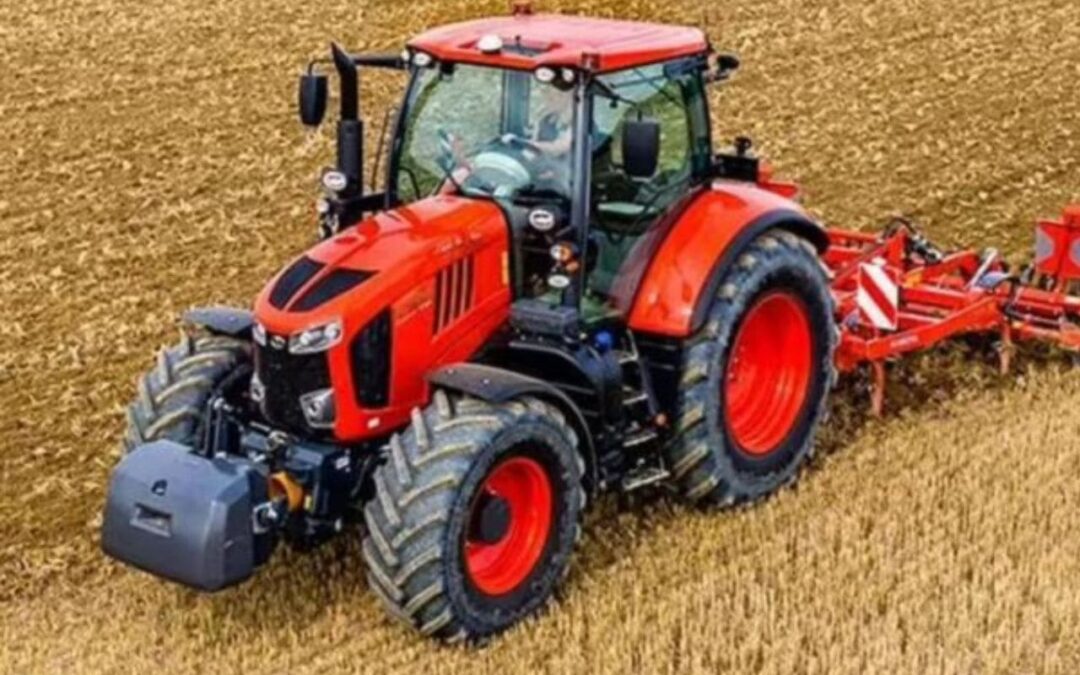
Synopsis: VST Tillers Tractors closed FY26 with revenue up 25 percent and operating EBITDA up 49 percent, and is now backing an ambitious product and technology roadmap, a Rs. 100 crore Global Tech Centre, 16 to 20 new product launches over the next 18 months, and international expansion into Europe and the US, aimed at pushing India’s largest power tiller maker into higher horsepower tractors and connected farm equipment.
A company that built its identity manufacturing power tillers for small and marginal farmers is now placing a genuinely large bet on becoming a technology-led player across the entire farm mechanisation spectrum. The scale of investment being committed here, relative to the company’s size, is worth understanding properly before assuming this is simply another incremental product cycle.

VST Tillers Tractors Closed on Friday at Rs. 4,525.30, with a market capitalization at Rs. 3,935.27 crore, and a P/E ratio of 37.59 times. The stock has moved within a wide 52-week band of Rs. 4,176.10 to Rs. 6,374.
Technology Investment
VST Tillers is committing over Rs. 100 crore toward a Global Tech Centre, on top of an existing annual research and development spend of Rs. 50 to 60 crore that it has maintained consistently over the past four to five years.

Combined, that’s a meaningfully larger technology commitment than the company’s historical R&D pattern would suggest, and management has framed the tech centre specifically as reducing dependence on external agencies for product development, a dependency that currently slows down how quickly the company can bring new products to market.
For a company of this size, a Rs. 100 crore infrastructure commitment is not a trivial rounding error on the balance sheet. It represents a genuine strategic pivot toward building in-house design and engineering capability rather than continuing to outsource key development work, which should, over time, shorten product development cycles and reduce the company’s reliance on third parties for its innovation pipeline.

20 New Products in the Pipeline
Management has laid out plans to launch 16 to 20 new products over the next 18 months, an unusually dense product pipeline for a company operating in agricultural machinery. This includes three new compact tractor platforms translating into 12 to 16 variants, alongside electric tillers, electric weeders, and a genuinely new product category positioned between tractors and tillers that doesn’t currently exist in the company’s lineup.
Creating an entirely new product category, rather than simply iterating on existing tractor and tiller platforms, suggests the company sees a gap in the market between its two core product lines that it believes it can fill. Whether that gap represents genuine unmet farmer demand or a more speculative bet will become clearer once the product actually reaches the market.
Building the Future of Farm Mechanisation
The upcoming tech centre’s stated focus areas, artificial intelligence, IoT-enabled farming solutions, and connected equipment, position the company for a longer-term shift in agricultural technology that management itself acknowledged is still in its early stages globally. Management was candid on this point, describing the next three to five years as the early stages of intelligent farming solutions becoming a reality, rather than claiming this transformation is imminent.

That candour is a useful signal for investors. A company overselling how quickly AI and connected farming technology will generate revenue would be a red flag; one that frames this as a multi-year capability-building exercise, while still committing real capital to it now, is taking a more measured and arguably more credible approach to a genuinely emerging technology category.
Expanding Globally
On the international front, the company is establishing operations in the Netherlands specifically to address a logistics problem rather than a demand problem. Management explained that shipping delays from India, stretching from a historical 30 to 45 days to 90 to 120 days due to the ongoing geopolitical situation affecting shipping routes, have constrained inventory rotation and limited growth in Europe even though underlying demand has held up reasonably well. A local Netherlands operation should directly address that bottleneck.
Separately, the company remains on track to ship tractors to the US by the end of calendar 2026, with a commercial market launch planned for the end of CY2027. This is a multi-year market entry process rather than an imminent revenue driver, and investors should calibrate expectations accordingly rather than treating the US launch as a near-term catalyst.
Strong Financial Backing
Revenue increased by 25 percent from Rs. 994 crore in FY25 to Rs. 1,240 crore in FY26, while operating EBITDA grew a faster 49 percent from Rs. 111.1 crore to Rs. 165.9 crore, with operating EBITDA margin expanding from 11.2 percent to 13.4 percent, reflecting improved operating leverage.
Reported net profit rose 15 percent from Rs. 95 crore to Rs. 106 crore, while profit excluding fair value gains and losses surged 61 percent from Rs. 70 crore to Rs. 113 crore, highlighting a significantly stronger underlying earnings performance.
The company also held around Rs. 634 crore in investments at the end of FY26, providing financial flexibility to pursue acquisitions in adjacent businesses, with management indicating that at least one transaction could be concluded over the next six months.
What Retail Investors Should Weigh
Management itself has been unusually direct about near-term uncertainty, declining to provide formal FY27 guidance given inflationary pressure and a below-average monsoon forecast that could weigh on rain-fed farming regions specifically.
That caution is worth respecting rather than dismissing, since tractor and tiller demand in India remains genuinely monsoon-dependent, and the company’s own commentary suggests industry volumes are likely to stay broadly flat this year absent fresh state-level subsidy schemes.
The technology and product investments described here are a multi-year structural story, and investors should treat near-term monsoon and inflation headwinds as a separate, shorter-term variable rather than a reason to discount the longer-term mechanisation thesis.
Disclaimer: The views and investment tips expressed by investment experts/broking houses/rating agencies on tradebrains.in are their own, and not that of the website or its management. Investing in equities poses a risk of financial losses. Investors must therefore exercise due caution while investing or trading in stocks. Trade Brains Technologies Private Limited or the author are not liable for any losses caused as a result of the decision based on this article. Please consult your investment advisor before investing.