
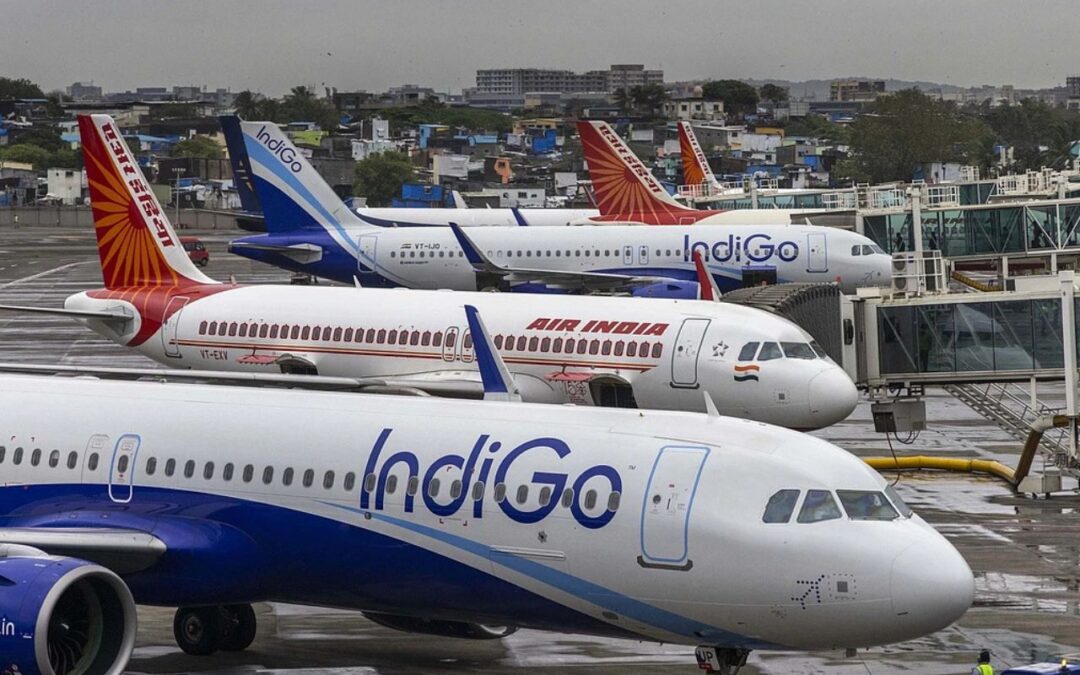
Synopsis: India’s domestic aviation market carried 1.34 crore passengers in June, with IndiGo and the Air India group now cornering more than 90 percent of that traffic between them, while SpiceJet has slipped to under 2 percent and even Akasa Air’s fast-growing third position remains a distant single-digit share.
Anyone who has booked a domestic flight in India over the past year has probably noticed the choices narrowing. Fares on busy routes feel less negotiable, seat availability on smaller carriers has gotten patchier, and the two big names, IndiGo and Air India, keep showing up first no matter which app you check. The latest DGCA traffic data for June puts numbers behind that feeling, and the picture it paints is one of a market moving unusually fast toward concentration.

IndiGo (InterGlobe Aviation)
IndiGo carried 89.2 lakh passengers in June, accounting for 66.3 percent of the entire domestic market. Such a kind of data requires attention because these monopolistic tendencies are seen in highly regulated markets rather than in the aviation industry.
The airline’s scale advantage compounds itself. A single-family Airbus fleet keeps maintenance and crew training simpler, high aircraft utilisation spreads fixed costs across more flying hours, and an expanding network into Tier 2 and Tier 3 cities locks in demand before smaller rivals can reach those markets. None of this is new to IndiGo’s playbook, but a 66 percent share suggests the playbook is working better than ever, partly because the competition around it has weakened rather than strengthened.

Air India Group
The Tata-owned Air India Group, which combines Air India, Air India Express and the now-merged Vistara, carried 32.22 lakh passengers in June for a 23.9 percent share, comfortably holding its position as the second-largest operator. Between IndiGo and the Air India Group, more than 90 percent of India’s domestic air travel now runs through just two corporate owners.
The Tata Group’s integration strategy has been to run Air India Express as the low-cost counter to IndiGo on price-sensitive routes while keeping the full-service Air India brand for premium trunk routes and long-haul connections. That dual positioning appears to be holding the group’s share steady rather than growing it aggressively, which is arguably the more realistic outcome for a still-mid-integration carrier competing against an airline with close to two decades of single-brand focus.

Akasa Air
Akasa Air moved 8.61 lakh passengers in June, a 6.4 percent share that makes it India’s third-largest domestic carrier, still some distance behind the top two but ahead of every other private operator. Its growth has come on the back of a fast-expanding Boeing 737 MAX fleet and a reputation for punctuality that has made it attractive to business travellers who might otherwise default to IndiGo purely out of habit.
Akasa’s position is worth watching less for its current share than for its trajectory. Starting from nothing in 2022, reaching third place ahead of a much older brand like SpiceJet says more about the direction of travel in this market than the current percentage does.
SpiceJet
SpiceJet’s June numbers tell a starker story. The airline carried just 2.63 lakh passengers, a market share of 1.9 percent, its first time slipping below the 2 percent mark. The decline traces back to a familiar set of problems, aircraft groundings, disputes with lessors, and financial restructuring pressure that has steadily shrunk the airline’s active fleet. Every aircraft SpiceJet takes out of service effectively hands its route frequencies and airport slots to larger rivals, which is part of why its market share erosion has been so persistent rather than a one-quarter blip.

What This Means for the Industry
A combined share above 90 percent for two operators is unusual for any large economy’s aviation market, and it raises a question that regulators, competitors and travellers will all care about differently, whether reduced competition on specific routes eventually shows up in higher average fares. For now, industry watchers are simply flagging the concentration as a structural shift worth monitoring rather than drawing conclusions about pricing, since route-level fare data would be needed to say anything more definitive.
Beyond the headline shares, the sector is also dealing with more mundane cost pressures, jet fuel price volatility and currency swings continue to weigh on margins across every operator, IndiGo and Air India included. Tier 2 and Tier 3 airport expansion remains a genuine growth lever for whoever can capitalise on it fastest, and that is one area where a well-capitalised Akasa or a resourced Air India Group could still claw back some relative ground even if the overall duopoly structure persists.
IndiGo’s own operational record deserves a closer look precisely because of how much of the market now depends on it functioning smoothly. In December, the airline went through a multi-day scheduling crisis triggered by crew-planning gaps tied to revised fatigue-management rules, cancelling roughly 4,500 flights over about ten days and affecting more than 10 lakh passengers, with compensation costs running upward of Rs. 24 crore.
The DGCA responded with a Rs. 22.2 crore fine, a Rs. 50 crore bank guarantee requirement, and months of heightened oversight, including officials stationed inside IndiGo’s operations control centre. More recently, monsoon disruptions at Mumbai airport again singled out IndiGo for a cluster of cancellations and diversions on high-traffic routes.
The point for investors is not that IndiGo is uniquely accident-prone, most large airlines face weather and staffing disruptions from time to time, but that a market this concentrated has far less redundancy to absorb such episodes than one with several mid-sized competitors.
When 66 percent of domestic capacity sits with a single carrier, an internal scheduling failure or a regulatory clampdown on that one airline can ripple through fares, connectivity and passenger sentiment nationwide in a way it simply could not in a more fragmented market.
That makes IndiGo’s execution reliability, not just its market share, a variable worth tracking alongside the stock’s valuation, since any recurrence of the kind of disruption seen in December could invite renewed regulatory scrutiny, fresh compensation costs, and a dent in the brand trust that has underpinned its pricing power so far.
What Should Investors Look Out For
Investors tracking the listed names in this space should watch two things closely. For InterGlobe Aviation, the question is whether a 66 percent domestic share leaves room for further margin expansion or whether regulatory and competitive pushback starts to cap further gains. For SpiceJet, the more immediate concern is whether the airline can resolve its fleet grounding and lessor disputes before its route network erodes past the point of easy recovery, since market share lost to slot reallocation is generally much harder to win back than share lost to pricing alone.
Disclaimer: The views and investment tips expressed by investment experts/broking houses/rating agencies on tradebrains.in are their own, and not that of the website or its management. Investing in equities poses a risk of financial losses. Investors must therefore exercise due caution while investing or trading in stocks. Trade Brains Technologies Private Limited or the author are not liable for any losses caused as a result of the decision based on this article. Please consult your investment advisor before investing.