
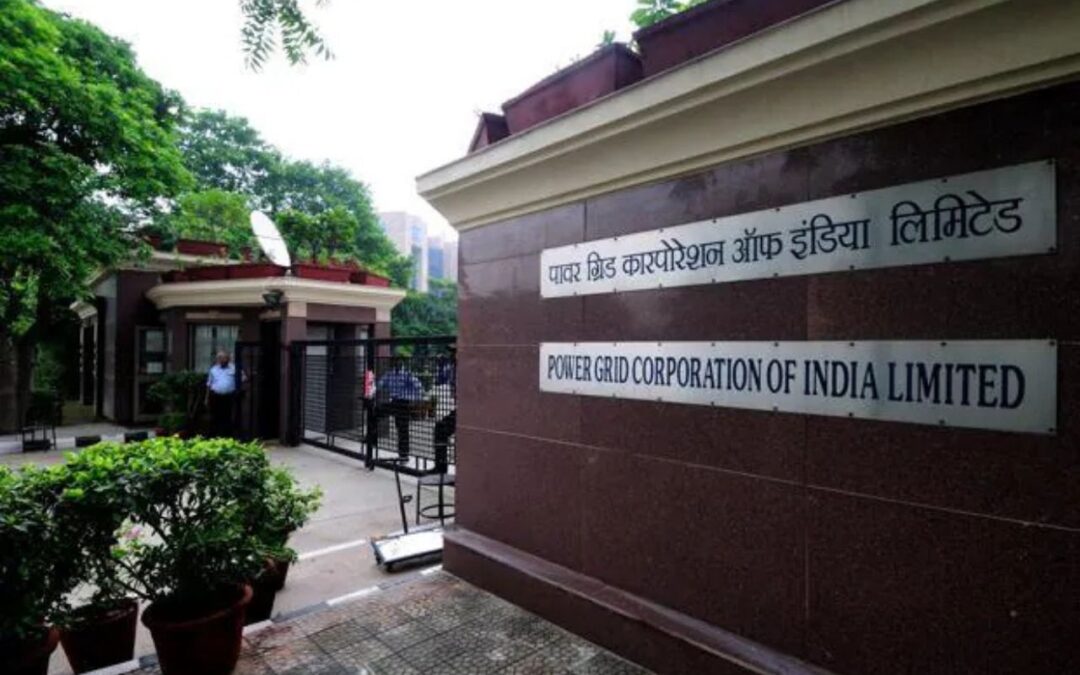
Synopsis: Power Grid Corporation’s board approved raising its FY27 borrowing limit to Rs. 35,000 crore and sanctioned a fresh Rs. 35,000 crore borrowing plan for FY28, backing an accelerating transmission capex cycle tied to India’s 500 GW renewable energy integration target.
India’s target of integrating 500 gigawatts of non-fossil power capacity by 2030 requires an unprecedented build-out of high-voltage transmission infrastructure to connect remote renewable energy parks with demand centres. As the country’s dominant inter-state transmission utility, Power Grid is positioning itself at the centre of a capex cycle that management has flagged could exceed Rs. 9 lakh crore through 2032.

Shares of Power Grid Corporation of India traded at Rs. 289.65 on the NSE, largely flat with a gain of 0.12 percent, against a 52-week range of Rs. 250.00 to Rs. 324.95 and a total market capitalisation of Rs. 2,69,531.50 crore. The stock trades at a trailing P/E of around 16.75 times and carries a dividend yield of roughly 3.1 percent.
What’s the News?
The Board of Directors of Power Grid Corporation approved enhancing the company’s FY27 borrowing limit from Rs. 30,000 crore to Rs. 35,000 crore, along with a fresh proposal to raise up to Rs. 35,000 crore during FY28, at a board meeting held on July 22, 2026.

Both borrowing plans will be funded through domestic bonds, including secured or unsecured, non-convertible, cumulative or non-cumulative, taxable or tax-free debentures issued on a private placement basis, and remain subject to shareholder approval at the company’s upcoming Annual General Meeting.
The board also approved appointing R.M. Bansal and Company and Chandra Wadhwa and Company as joint cost auditors for FY27, both firms carrying decades of experience auditing power sector public sector enterprises including NTPC, NHPC and Coal India.

This domestic bond programme follows Power Grid’s recent move to diversify its funding base internationally, having signed an 80 billion yen green loan agreement with Japan Bank for International Cooperation on June 17, 2026, specifically to finance the Khavda-Nagpur HVDC transmission project that will evacuate renewable power from Gujarat’s Khavda energy park to demand centres.
Financial and Business Analysis
The combined Rs. 70,000 crore borrowing approval for FY27 and FY28 will mainly help Power Grid fund its expanding transmission projects as India continues to invest heavily in its power network. The company has steadily increased its capital expenditure (capex) plans, reflecting a growing pipeline of new projects.
In FY26, Power Grid initially planned to spend Rs. 28,000 crore, later raised the target to Rs. 35,000 crore, and eventually invested around Rs. 40,000 crore. It capitalised Rs. 28,206 crore worth of assets during the year, above its original guidance of Rs. 25,000 crore. Management now expects capex of around Rs. 37,000 crore in FY27 and Rs. 40,000 – 45,000 crore in FY28.

Unlike many infrastructure businesses, Power Grid earns a regulated return of around 15.5 percent on its transmission assets under India’s tariff framework. This means that once new projects become operational, they generate predictable revenue through regulated tariffs, making future earnings more stable and helping the company comfortably service its debt.
The company’s financial performance also remains strong. In FY26, consolidated total income rose to Rs. 47,684 crore from Rs. 47,459 crore a year earlier, while consolidated net profit increased about 3 percent to Rs. 15,928 crore. Operating cash flow stood at Rs. 40,931 crore, net worth crossed Rs. 1 lakh crore, and return on net worth remained healthy at 15.85 percent.
Power Grid also continues to reward shareholders through regular dividends. It declared a total FY26 dividend of Rs. 9 per share, offering a dividend yield of around 3.1 percent. The company also improved its balance sheet by reducing outstanding receivables from Rs. 4,795 crore in FY24 to Rs. 2,905 crore in FY26, strengthening cash collections.
With a debt-to-equity ratio of around 1.47, the company still has room to raise additional funds without putting significant pressure on its balance sheet. Its regulated business model, strong cash flows and tariff protections provide confidence that the planned borrowings can support future growth while maintaining financial stability.
Industry and Strategic Analysis
Power Grid’s dominant position stems from its control of India’s Inter-State Transmission System, carrying over 80 percent of the country’s regional power capacity, alongside a total asset base that surpassed Rs. 3,20,334 crore in gross fixed assets as of March 2026, spanning 1.84 lakh circuit kilometres of transmission lines and 624 GVA of transformation capacity.
The company’s work-in-hand stood at Rs. 1.7 lakh crore as of its most recent investor update, with Tariff Based Competitive Bidding projects accounting for roughly 81 percent of that pipeline, alongside a further Rs. 1.1 lakh crore of projects under bidding or planned to be floated, including large corridors such as the Rajasthan Barmer Complex Phase 4 and the Vizag Green Hydrogen corridor.
Beyond core transmission, Power Grid is expanding into adjacent growth areas including Battery Energy Storage Systems, having won its first BESS project in Andhra Pradesh, and international markets, with a roughly $300 million transmission PPP project in Kenya through a joint venture with Africa50, alongside pipeline discussions in Uganda, Zimbabwe and Mozambique.
Key operating risks remain centred on Right of Way clearances, which management has repeatedly flagged as a structural challenge given that “every tower is a project in itself,” alongside equipment supply constraints, with transformer and reactor demand of over 400 GVA annually outstripping domestic manufacturing capacity of around 300 GVA, prompting the company to extend project timelines from 18 months to 26-30 months to ease pressure on original equipment manufacturers.
Overall, the company’s near-monopolistic hold over India’s inter-state transmission network provides a strong moat against market volatility. While short-term project completion times may face pressure from supply chain lead times for transformers and reactors, the long-term growth story remains firmly tied to India’s multi-decade energy transition.
Company Overview
Power Grid Corporation of India Limited is a Maharatna Central Public Sector Enterprise operating under the Ministry of Power and is India’s premier electric power transmission utility. The company plans, implements, operates and maintains the country’s Inter-State Transmission System, carrying over 80 percent of India’s regional power capacity, while also running telecom and consultancy businesses spanning domestic and international markets across 25 countries.
Disclaimer: The views and investment tips expressed by investment experts/broking houses/rating agencies on tradebrains.in are their own, and not that of the website or its management. Investing in equities poses a risk of financial losses. Investors must therefore exercise due caution while investing or trading in stocks. Trade Brains Technologies Private Limited or the author are not liable for any losses caused as a result of the decision based on this article. Please consult your investment advisor before investing.