
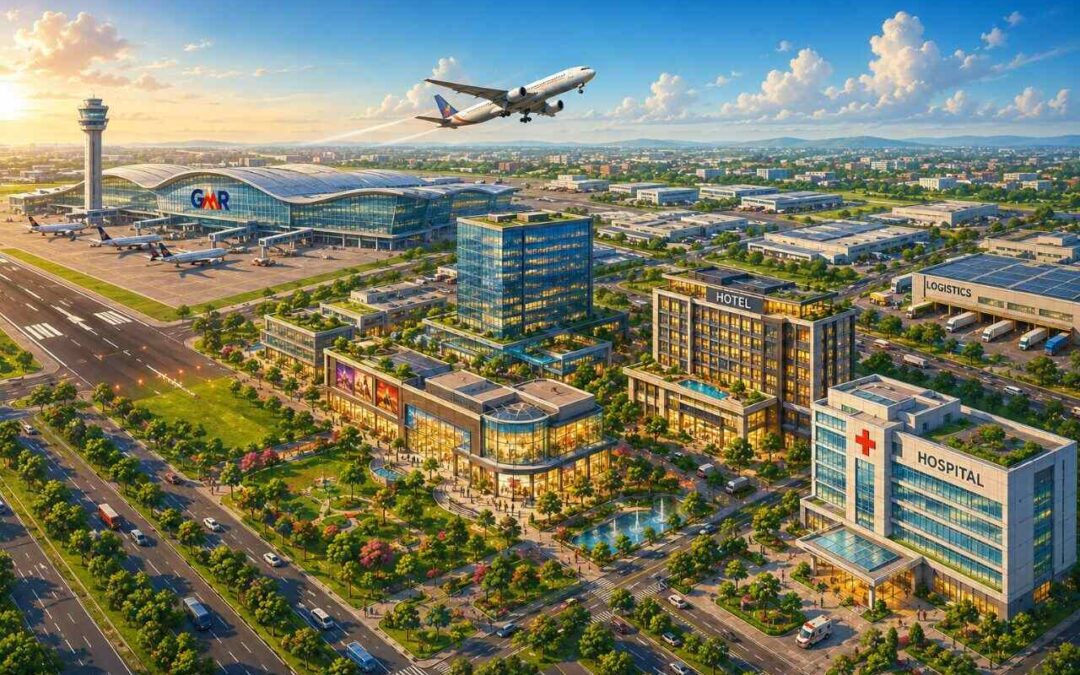
Synopsis: GMR Airports is no longer looking at airports only as transport infrastructure. It wants to develop offices, hotels, retail centres, healthcare facilities and industrial parks on land around its airports. With roughly 2,510 acres available, could airport-linked real estate become the company’s third major growth engine?
Airports are becoming more than places where passengers board flights. Land surrounding a busy airport can support offices, hotels, hospitals, shopping centres, warehouses and logistics facilities. Businesses pay for connectivity, while developers benefit from passenger traffic that already exists instead of having to create footfall from scratch.

This is the market GMR Airports is trying to scale. Its portfolio has roughly 2,510 acres with development potential, including around 1,500 acres at Hyderabad, 294 acres at Bhogapuram, 247 acres at Nagpur, 232 acres at Goa, 230 acres at Delhi and about 10 acres in Greece.
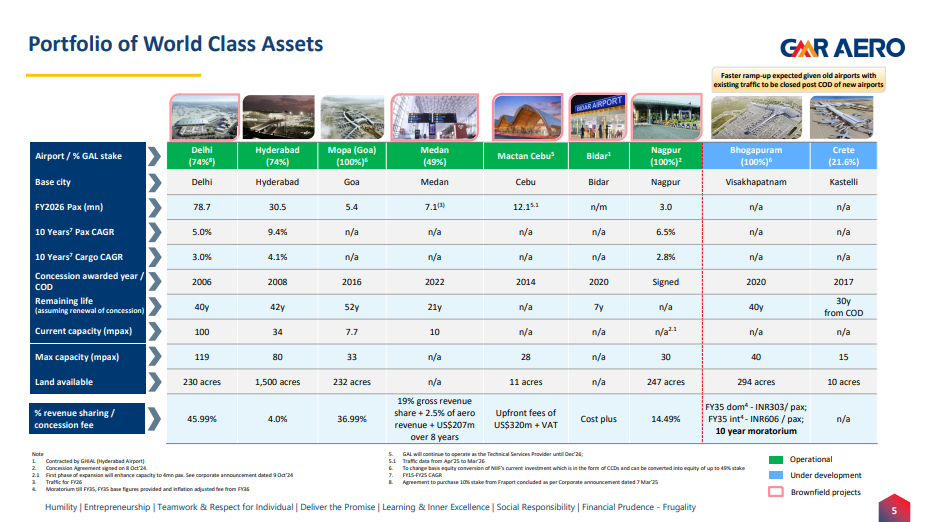
Source: GMR Airports Q4FY26 Investor Presentation
However, GMR is not entering ordinary residential real estate. It plans to build commercial districts around airports and earn through rentals, leases, development agreements and eventual asset monetisation.

What Exactly Is GMR Airports Planning?
GMR already earns from commercial property development, particularly at Delhi Aerocity. Therefore, real estate is not a completely new business. What is changing is the company’s approach.
In the past, large land parcels were mainly given to third-party developers, who constructed offices, hotels and retail projects. During the Q2FY26 conference call, management explained that around 12 million square feet of third-party projects at Delhi included older transactions such as the Bharti development. The developers invested the capital, while Delhi Airport earned lease income and other agreed payments.

GMR now wants to retain more of the future upside by developing selected projects itself. It describes this as building a third business platform after the regulated airport business and the consumer-facing non-aero platform. The strategy includes self-development, build-to-suit projects for identified tenants and thematic monetisation for hotels, healthcare, retail, logistics and industrial facilities.
The company may later monetise completed assets once rental income becomes stable. Management said in Q3FY26 that it was not looking to monetise the self-developed projects immediately. Better valuations may be available after occupancy and rents stabilise, which could take around 18 to 24 months.
Why Is Land Around An Airport So Valuable?
The biggest advantage is captive demand. GMR’s airports handled a record 121.6 million passengers in FY26. Its June update showed that the portfolio handled 30.2 million passengers in Q1FY27, with Delhi accounting for around 67 percent. This traffic creates an ecosystem of airlines, corporate travellers, employees, logistics companies, retailers and hospitality operators.

The airports also have long remaining concession periods. Assuming renewals, Delhi has around 40 years remaining, Hyderabad 42 years, Goa 52 years and Bhogapuram 40 years. This gives GMR time to develop districts gradually rather than trying to monetise the land bank at once.
Airport linked land can serve several users within the same location. A corporate tenant may need an office near international connections. A hotel benefits from passengers and airline crews. A hospital can attract medical travellers, while warehouses and cargo businesses benefit from nearby transport infrastructure.
However, the entire 2,510 acres should not be treated as ready-to-sell property. The land is linked to airport concessions, approvals and permitted uses. Its value depends on how much can actually be developed, construction costs, lease demand and the revenue-sharing structure of each airport.
Delhi Aerocity Is Becoming The First Test
Delhi is the most advanced example of GMR’s strategy. Delhi Airport reported commercial property development rentals of Rs. 949.4 crore in FY26. The number was slightly lower than FY25, while Q4 rentals fell sharply year-on-year. Management had earlier explained in Q1FY26 that these revenues can be uneven because lease-accounting entries and transaction timing may create a high base in certain quarters.
The bigger development is the move towards self-development. GMR is constructing Aerocity One, a commercial office building with around 1 million square feet of built-up area. Pre-leasing discussions are underway with large clients, and the company expects handover in Q3FY27.
It is also developing a terminal hotel near Terminal 3 with roughly 380 keys and around 0.6 million square feet of built-up area. Management said the hotel has been pre-leased to Chalet Hotels and should be ready for handover during FY27. A third project is a healthcare facility for AIG Hospitals with more than 500 beds and close to 1 million square feet of built-up area.
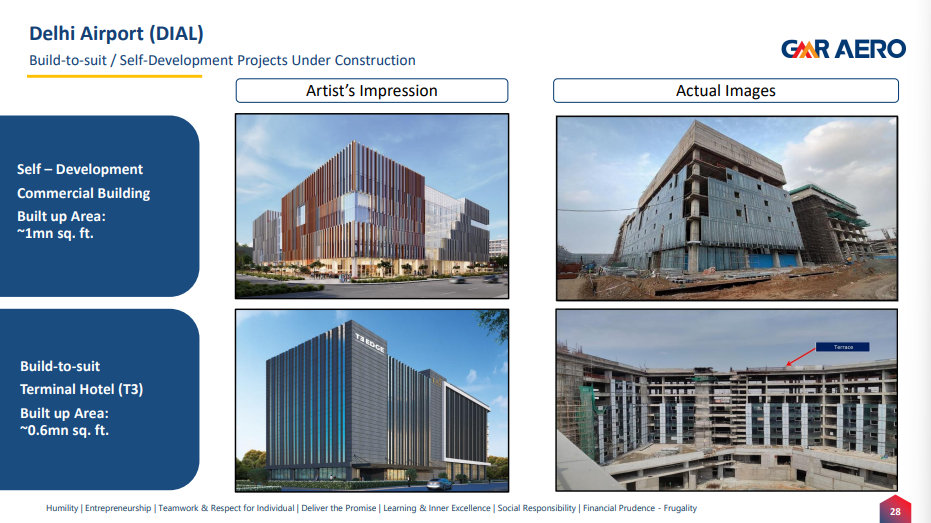
Source: GMR Airports Q4FY26 Investor Presentation
These projects show why GMR’s strategy is different from speculative construction. Build-to-suit and pre-leased assets begin with an identified customer, reducing the risk of completing a building and struggling to find tenants. The office project carries greater leasing risk but also gives GMR more exposure to rental growth if Aerocity demand remains strong.
Hyderabad And Other Airports Could Make It Scalable
Hyderabad is the largest part of the opportunity because it has around 1,500 acres available. GMR is constructing GMR Interchange, its first self-developed retail project, with about 0.77 million square feet of built-up area and around 0.58 million square feet of leasable space.
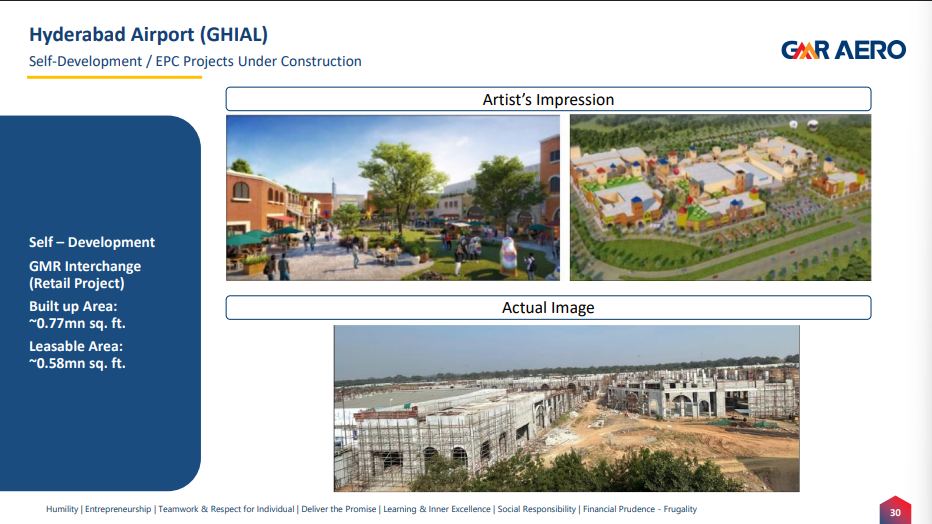
Source: GMR Airports Q4FY26 Investor Presentation
The company is also building industrial facilities inside Hyderabad Airport’s special economic zone. It has signed a lease agreement with TechnipFMC for the second phase of a build-to-suit facility and is developing another facility for Firan Technology Group. A roughly half-million-square-foot maintenance facility for Safran has already been completed.
Hyderabad Airport had also acquired the remaining 70 percent stake in ESR GMR Logistics Park for Rs. 41.3 crore, making it a wholly owned subsidiary. Management expects returns in the high teens and said the transaction strengthens its warehousing and industrial portfolio.
The model is being extended elsewhere. At Goa, four third-party hotel projects with more than 900 rooms and around 0.62 million square feet of built-up area are under construction or approval. At Bhogapuram, Indian Hotels Company has been selected to operate a 165-key Vivanta hotel. Bhogapuram and Nagpur also bring another 541 acres combined, creating a longer pipeline once airport operations mature.
How Large Could The Financial Opportunity Become?
Real estate is still smaller than GMR’s main airport and non-aero businesses, but it is already meaningful. In FY26, GMR reported gross income of Rs. 15,200.8 crore, EBITDA of Rs. 6,150.2 crore and profit after tax of Rs. 472.4 crore, its first positive annual profit in more than a decade. Delhi’s commercial property rentals alone were close to Rs. 950 crore.
The larger value may lie in the land and future rental assets. ICICI Securities’ May 2026 valuation assigned a gross value of Rs. 17,500 crore to unused land at Delhi, another Rs. 17,500 crore to unused land at Hyderabad and Rs. 4,200 crore to unused land at Goa. Together, this implied a gross value of Rs. 39,200 crore and a stake-adjusted value of about Rs. 30,100 crore for GMR.
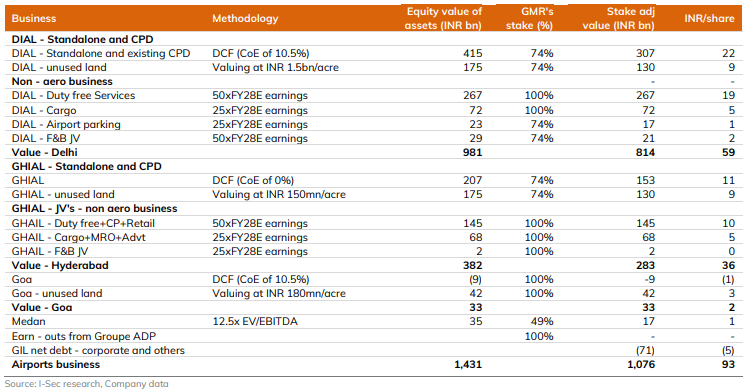
Source: ICICI Securities
For the current FY27 real estate projects, spending is expected to be around Rs. 450 crore. Management said the projects are being funded through construction finance and separate project entities, limiting the immediate pressure on the parent company’s cash flows.
What Could Stop The Real Estate Story?
The first challenge is time. Approvals, construction, leasing and rent stabilisation can take years. GMR does not expect quick monetisation of the new assets. Delays in Aerocity One, the terminal hotel, GMR Interchange or other projects would push income further into the future.
The second challenge is leverage. GMR ended FY26 with net debt of around Rs. 34,000 crore and net debt-to-EBITDA of 5.5 times. Management wants to bring this below 4 times over the next 18 to 24 months. Construction finance reduces the immediate cash burden, but project debt must still be serviced through rentals and completed assets.
Finally, airport land is valuable only when the company finds the right use and tenant. A hotel, hospital or warehouse built for a committed operator is relatively safer. Large offices and retail developments depend more heavily on occupancy, consumer spending and local demand.
GMR Airports is not suddenly turning into a conventional property developer. It is trying to convert airport connectivity, passenger traffic and long concession periods into an urban commercial platform. The 2,510-acre figure is eye-catching, but the real test is how much land GMR can develop profitably and how quickly completed projects generate stable cash flows. If the first few projects work, real estate could genuinely become its third major business.
Disclaimer: The views and investment tips expressed by investment experts/broking houses/rating agencies on tradebrains.in are their own, and not that of the website or its management. Investing in equities poses a risk of financial losses. Investors must therefore exercise due caution while investing or trading in stocks. Trade Brains Technologies Private Limited or the author are not liable for any losses caused as a result of the decision based on this article. Please consult your investment advisor before investing.