
Synopsis: Adani Enterprises has spent years building new businesses inside the parent company, and management now believes some are ready for the next stage. However, the timing, structure and order of these possible demergers remain unclear. Which business could be the first to eventually step out and get listed separately?
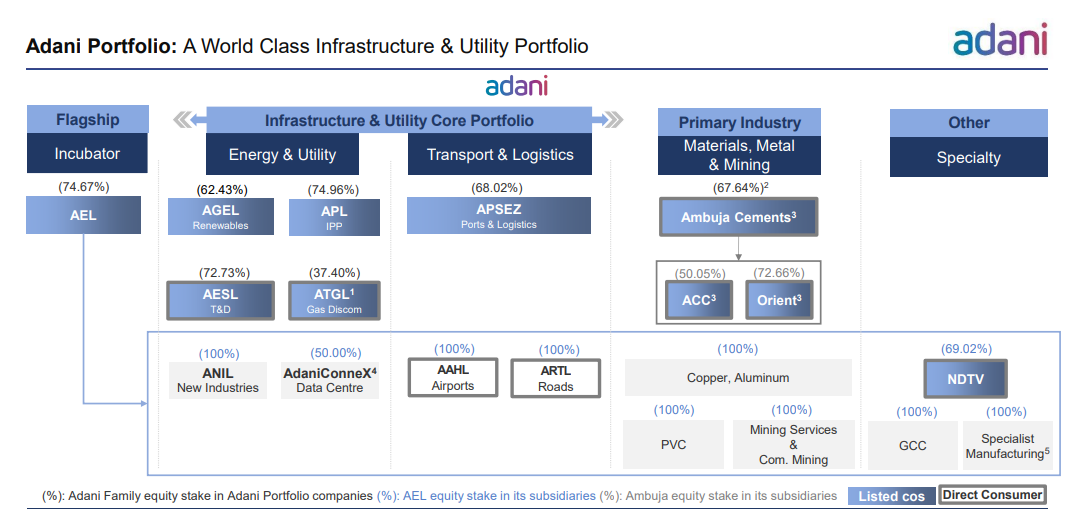
Large conglomerates often build businesses inside the parent before separating them once they achieve sufficient scale, cash flow and management independence. Adani Enterprises follows this incubation model and has previously developed businesses that later became separate listed companies. Its next potential value-unlocking candidates include airports, roads, new energy, data centres and primary industries.

This has become important because 80 percent of AEL’s EBITDA now comes from infrastructure and long-term contracted businesses, compared with 50 percent three years ago. In simple terms, more of its businesses are now fully operational, earning steady profits and becoming ready to operate as separate listed companies.
Source: Adani Enterprises Q4FY26 Investor Presentation
What Has Management Said About The Demergers?
The clearest statement came during the Q4 FY26 earnings call. Management said AEL was preparing for value unlocking through demergers and specifically named Airports, Roads, the Adani New Industries and long-term contracted Mine Developer and Operator services. It described these as independent, large infrastructure platforms moving towards the value-creation stage.

Management explained AEL’s process as four steps: build, stabilise, scale and unlock. It said the relevant businesses had largely crossed the first three stages. However, investors should not treat this as a confirmed demerger announcement.
In Q1, management said the airport business could meet its technical demerger criteria by 2027, subject to board approval, and existing AEL shareholders would receive shares under the demerger. It described Airports as the near-term opportunity over the following 18 months to two years, while other businesses were expected later.

Therefore, four businesses appear to be serious candidates, but they are unlikely to be separated together. Airports appears first, with Roads, Mining Services and ANIL following after their earnings and structures become clearer.
Why Does Adani Airports Appear Closest To A Separate Listing?
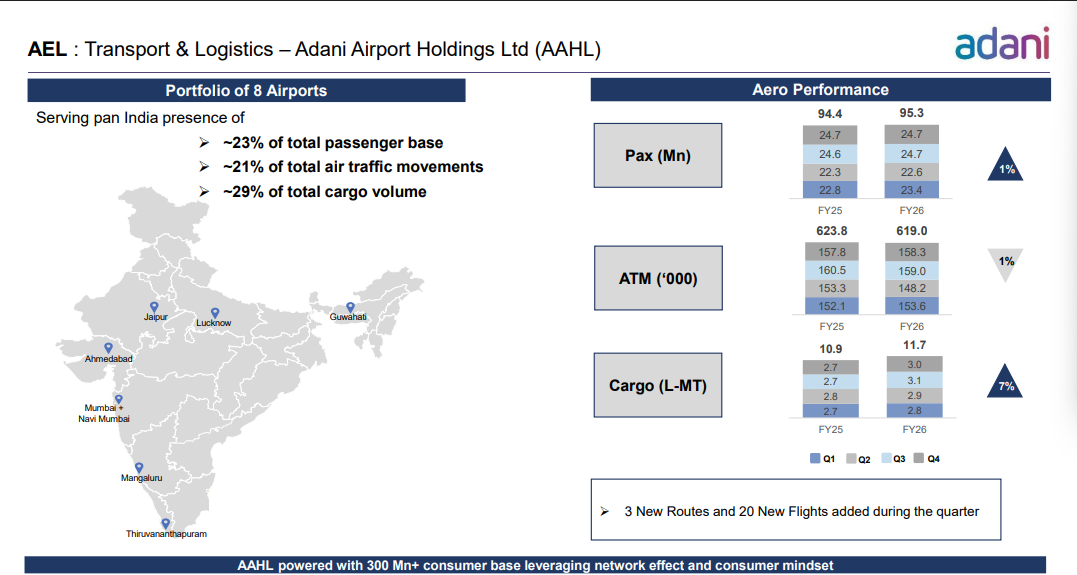
Adani Airports is already large enough to resemble an independent listed infrastructure company. It operates eight airports and accounts for around 23 percent of India’s passenger traffic and 29 percent of air cargo. During FY26, it handled 95.3 million passengers, while income increased 28 percent to Rs. 13,081 crore and EBITDA rose 55 percent to Rs. 5,394 crore. Aeronautical and non-aeronautical revenues increased 26 percent and 31 percent, respectively.
Source: Adani Enterprises Q4FY26 Investor Presentation
In Q2, management introduced Airports as a standalone vertical for the first time and brought its management team into the earnings discussion. The platform was already generating more than Rs. 1,000 crore of quarterly EBITDA. Separate reporting and dedicated management are important steps before a demerger.

Navi Mumbai International Airport strengthens the case. It commenced operations on December 25, 2025 and added a major regulatory asset to the portfolio. Management said such assets generally offer returns in the range of 12-14 percent. The group has also added airport ground handling and advertising capabilities, expanding income beyond landing charges and passenger fees.
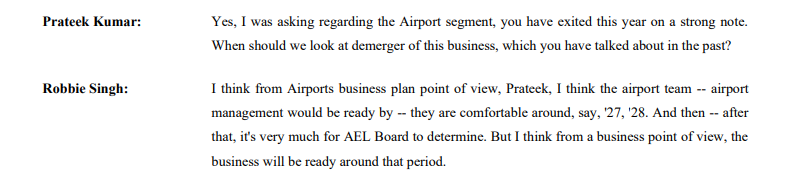
During the Q4 call, management said the airport team expected the business to be ready around FY27-FY28, after which the AEL board would decide. This is the only business for which management has provided a reasonably specific readiness period. Airports is therefore the strongest candidate to become the next separately listed Adani company.
Source: Adani Enterprises Q4FY26 Earnings Call Transcript
Could The Proposed Airline Complicate The Airport Demerger?
In a recent development, the Adani Group is reportedly considering launching an airline or buying a stake in an existing carrier, although no final decision has been taken. The attraction is understandable because the group already owns airports, ground-handling operations, advertising assets and airport-linked commercial developments.
However, the plan also faces an important regulatory hurdle. According to the additional data, Adani has approached the government seeking to relax a clause that restricts certain airport operators from holding stakes in scheduled airlines. This means the group may first require a change or clarification in the existing rules before it can directly own an airline.
The restriction is meant to address possible conflicts of interest. Since competing airlines use Adani-operated airports, they could question whether an Adani-owned carrier would receive better access to slots, gates, ground handling or other airport facilities. Any airline investment may therefore require strong safeguards to ensure equal treatment for all carriers.
Airports and airlines also have very different financial profiles. Airports are long-term assets that earn from multiple carriers, while airlines face fuel costs, aircraft rentals, foreign-exchange movements, fare competition and thin margins. The current airport demerger story is based on regulated income, growing non-aeronautical revenue and visible long-term cash flows. Combining this with an airline could make earnings more volatile and raise concerns over capital allocation.
The final impact would depend on how the airline is structured and whether the government changes the relevant restriction. For AEL shareholders, a pure airport platform would remain the cleaner demerger outcome.
Are Roads And Mining Services The Next Candidates?
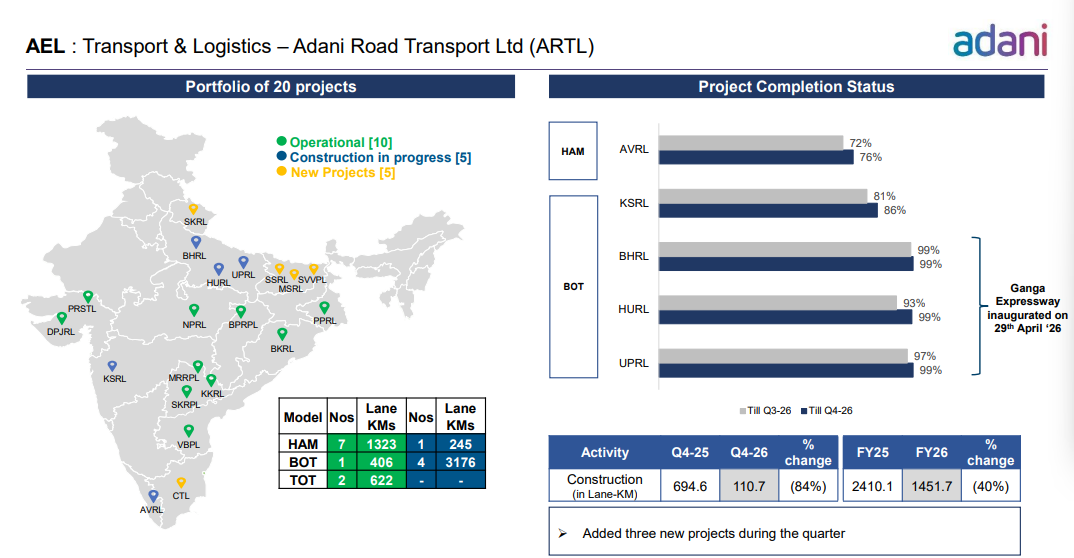
Adani Road Transport appears to be the second platform approaching readiness. Its portfolio reached 20 projects during Q4 after adding two Toll-Operate-Transfer projects and one Hybrid Annuity Model project. The biggest change was the completion of the Ganga Expressway, a traffic-risk asset with a 27-year concession period.
In Q3, management said the expressway was an approximately Rs. 18,000 crore asset and could roughly double the road business’s EBITDA from its earlier run rate of around Rs. 1,500 crore. Its completion changes the business from mainly constructing roads to operating a larger portfolio of toll and annuity assets.
Source: Adani Enterprises Q4FY26 Investor Presentation
FY26 Roads income fell 32 percent to Rs. 6,852 crore and EBITDA declined 23 percent to Rs. 1,362 crore as construction activity reduced before new assets contributed fully. Management expects accounting to become more standard and plans a detailed briefing after Ganga Expressway has operated for five months. Roads therefore looks close, but AEL may first want to establish a cleaner operating baseline.
Mining Services is another serious candidate because the MDO model is based on long-term contracts rather than simply betting on commodity prices. By FY26, the portfolio had 18 agreements with peak capacity of around 145 MMTPA. Dispatch increased 14 percent to 49.4 MMT, revenue rose 20 percent to Rs. 4,536 crore and EBITDA increased 18 percent to Rs. 1,986 crore.
Mining Services already has separately reported financials and is shown as a distinct, wholly owned business under AEL. However, the portfolio chart groups it with Commercial Mining and does not identify a dedicated holding platform similar to Adani Airports Holdings or Adani Road Transport. AEL may therefore need to clarify how the business would be separated before any demerger.
Is ANIL Ready Or Does The Green Hydrogen Story Need More Time?
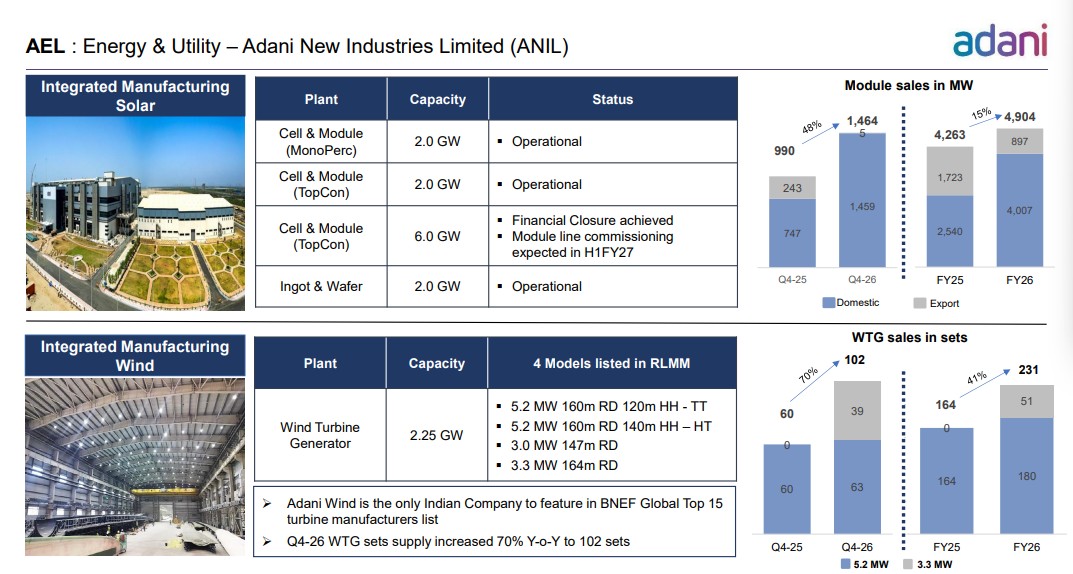
Adani New Industries is already one of AEL’s largest operating businesses. FY26 income increased 9 percent to Rs. 15,563 crore, although EBITDA declined 5 percent to Rs. 4,532 crore. Module sales rose 15 percent to 4,904 MW, while wind-turbine supplies increased 41 percent to 231 sets.
The solar platform has 4 GW of cell and module capacity, 2 GW of ingot and wafer capacity and 2.25 GW of wind-turbine manufacturing capacity. Another 6 GW TopCon project has achieved financial closure, with its module line expected in the first half of FY27. This would take total cell and module capacity towards 10 GW.
Source: Adani Enterprises Q4FY26 Investor Presentation
ANIL is large, cash-generating and explicitly named as a demerger candidate. Yet its final identity is still developing. Management says the larger objective is a green-hydrogen ecosystem rather than only solar and wind manufacturing. Electrolyser testing is underway, but final investment decisions for green power and hydrogen derivatives have not been made. The domestic shift in solar sales has also caused short-term margin pressure.
AEL may therefore prefer to complete the manufacturing expansion and provide greater clarity on hydrogen before separating ANIL. It is a strong candidate, but it does not appear as close as Airports.
Which Businesses Are Likely To Remain Inside AEL For Longer?
AdaniConneX has an attractive pipeline but remains earlier in its operating journey. It has more than 560 MW of tied-up capacity, including a 358 MW hyperscale order in Hyderabad, but only over 55 MW was operational across four data centres at FY26 end. The Hyderabad order is expected to take roughly 40 months, while the platform targets 2 GW by 2030. It may eventually become a standalone business, but committed capacity is far ahead of operating scale.
Kutch Copper is also moving from construction to operations. Its 500 KTPA facility has been commissioned and is ramping up, but FY27 is expected to provide its first meaningful contribution. Copper, Navi Mumbai Airport and Ganga Expressway are together expected to add more than Rs. 3,000 crore of EBITDA after stabilisation. Copper needs a clean operating record before becoming a realistic demerger candidate.
Based on management commentary, the likely order is Airports first, followed by Roads and Mining Services, with ANIL after further expansion. Data centres and Copper represent the next generation, while PVC, Defence and other ventures are longer-term possibilities.
The important distinction is that management has identified a direction, not announced a final timetable. Adani Airports is the only platform with a stated readiness window and therefore looks closest to getting listed. The next stage will depend on whether Roads establishes predictable post-Ganga Expressway earnings, Mining Services receives a cleaner corporate structure and ANIL completes the next phase of its new-energy ecosystem.
Disclaimer: The views and investment tips expressed by investment experts/broking houses/rating agencies on tradebrains.in are their own, and not that of the website or its management. Investing in equities poses a risk of financial losses. Investors must therefore exercise due caution while investing or trading in stocks. Trade Brains Technologies Private Limited or the author are not liable for any losses caused as a result of the decision based on this article. Please consult your investment advisor before investing.