
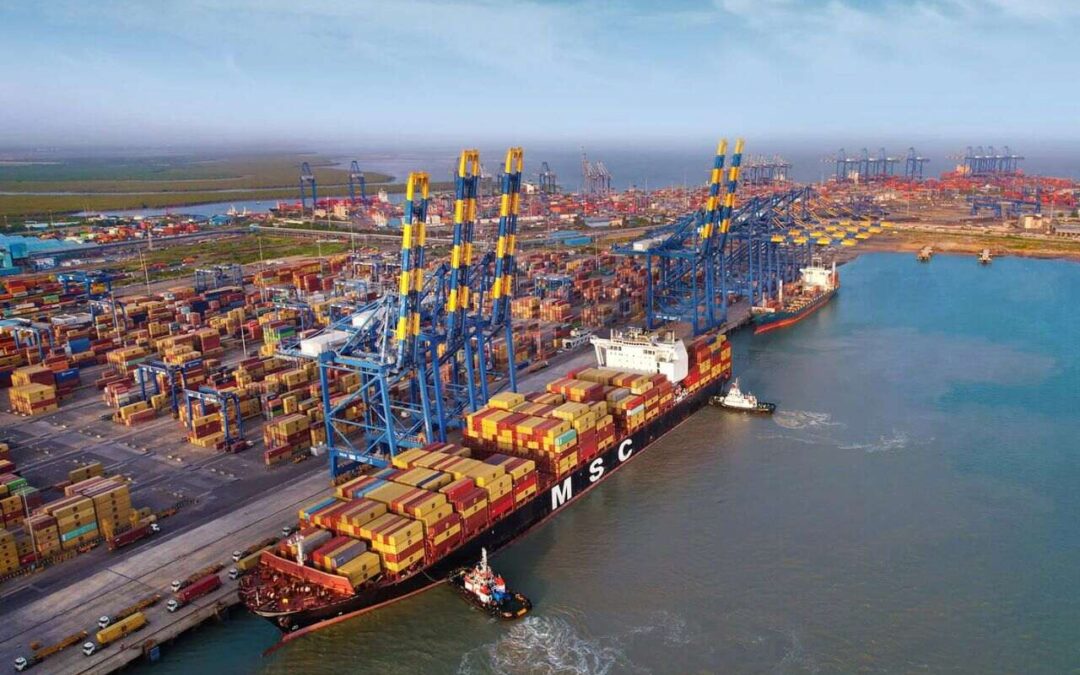
Synopsis: Jefferies has maintained a Buy on Adani Ports and Special Economic Zone Ltd, raising its target to ₹2,160, implying ~17% upside. It cites capacity constraints boosting pricing power, strong EBITDA upgrades, 15% CAGR outlook, demand-supply gaps in key states, Vizhinjam port benefits, and strong cash flows supporting expansion and deleveraging.
The shares of one of India’s largest private port operators and an integrated transport utility specialising in port management, development, and logistics, handling roughly 27% of India’s total port volumes, are in focus following the brokerage firm Jefferies target, which sees 17 percent upside potential.

With a market capitalization of Rs. 4,17,776.90 crores in the day’s trade, the shares of Adani Ports & Special Economic Zone Ltd rose by 1.7 percent, reaching a high of Rs. 1,817.70 per share compared to its previous closing price of Rs. 1,787.30 per share.
What Happened
Adani Ports & Special Economic Zone, engaged in port development, operations, and management, along with logistics and special economic zone (SEZ) activities, is in the spotlight as Global brokerage firm Jefferies maintains a Buy and hikes the target price to Rs. 2,160, from Rs. 2,100, implying about 17 percent upside from the previous close price of Rs. 1,787.30.

Capacity constraints are driving pricing power and growth
Jefferies expects India’s major container ports to face rising capacity constraints over the next few years. As demand for cargo handling grows faster than infrastructure expansion, ports like Adani Ports benefit from higher utilization, better pricing power, and increased throughput, which directly supports revenue and margin expansion in the coming cycle.
Strong upward revision in EBITDA estimates
The brokerage has raised FY28–FY29 EBITDA estimates by 3–5%, reflecting stronger-than-expected operational performance and higher volume assumptions. This revision signals confidence in sustained earnings momentum, driven by port throughput growth, efficiency improvements, and better realization per container, which strengthens the long-term valuation outlook.

Healthy long-term EBITDA growth outlook
Jefferies projects a 15% EBITDA CAGR for FY26–FY31, indicating strong compounding earnings visibility over the medium to long term. This growth is expected to be driven by capacity expansion, increased hinterland connectivity, and diversification into logistics and port-led services, reinforcing Adani Ports’ position as a structural growth infrastructure play.
Demand-supply mismatch in key states
Ports in Gujarat and Maharashtra are expected to face a widening demand-supply gap in container handling capacity. This structural shortage benefits Adani Ports, which already has a strong presence in these regions, allowing it to capture incremental cargo volumes and strengthen its market share against slower-expanding competitors.
Vizhinjam port as a strategic upside driver
The Vizhinjam port is expected to provide additional upside due to its strategic location near international shipping routes. It reduces vessel turnaround time and transit costs, making it attractive for transshipment cargo. Jefferies sees this as a key long-term growth lever that could significantly enhance Adani Ports’ container handling volumes.

Strong cash flows enabling capex
The company’s robust cash generation is expected to comfortably support both aggressive capital expenditure and gradual deleveraging. This dual strength improves financial stability while still allowing expansion into new capacity. It reduces balance sheet risk and supports sustained investor confidence in long-term earnings compounding.
Financials & Others
The company’s revenue rose by 26.50 percent from Rs. 8,488 crores in March 2025 to Rs. 10,738 crores in March 2026. Meanwhile, Net profit rose from Rs. 3,023 crores to Rs. 3,308 crores in the same period.
Adani Ports and Special Economic Zone continues to maintain healthy financial efficiency with a Return on Capital Employed (ROCE) of 14.1% and Return on Equity (ROE) of 16.4%, reflecting strong operational performance and effective capital utilisation. The company’s debt-to-equity ratio of 0.66 also indicates a manageable leverage position for a capital-intensive infrastructure business.
The company has delivered a robust profit growth CAGR of 21% over the last five years, supported by steady expansion across ports, logistics, and marine operations. Its median sales growth of 20.3% over the past decade highlights consistent long-term business growth and strong demand visibility.
APSEZ, part of the globally diversified Adani Group, is a leading Integrated Transport Utility across cargo origination (International Freight Network) through port handling, rail transport, multi-modal logistics parks, warehousing, and final delivery via road transport to customer gates.
The company operates a comprehensive ecosystem of 15 strategically located ports and terminals across India’s west, south, and east coasts, combined with a diversified marine fleet of 129 vessels, integrated logistics capabilities including 12 multi-modal logistics parks, 3.1 million sq. ft. of warehouses, and 25,000+ trucks operating on its proprietary platform, thus providing capabilities to handle vast amounts of cargo from both coastal areas and the hinterland.
APSEZ also operates 4 international ports across Australia, Colombo, Israel, and Tanzania. With a current cargo handling capacity of 653 million tonnes per annum, APSEZ commands approximately 27% of India’s total port volumes, targeting 1 billion tonnes throughput by 2030.
Conclusion
Jefferies believes Adani Ports is well-positioned to deliver a 15% EBITDA CAGR through FY31, supported by rising capacity constraints at India’s major container ports, which are expected to boost utilization, pricing power, and cargo volumes.
The growth outlook is further reinforced by Adani Ports’ strong presence in capacity-constrained regions such as Gujarat and Maharashtra, the strategic growth potential of the Vizhinjam port, and robust cash flows that can fund expansion while supporting deleveraging. Together, these factors provide visibility for sustained earnings growth and strengthen the case for a 15% EBITDA CAGR till FY31.
Disclaimer: The views and investment tips expressed by investment experts/broking houses/rating agencies on tradebrains.in are their own, and not that of the website or its management. Investing in equities poses a risk of financial losses. Investors must therefore exercise due caution while investing or trading in stocks. Trade Brains Technologies Private Limited or the author are not liable for any losses caused as a result of the decision based on this article. Please consult your investment advisor before investing.