
As organizations accelerate software delivery through Agile and DevOps practices, web testing has become increasingly important for ensuring software quality. Modern applications must function seamlessly across browsers, devices, and operating systems while delivering exceptional user experiences.
To meet these demands, teams rely on test automation frameworks that help execute tests faster, improve test coverage, and support continuous delivery. However, with numerous automation tools available today, selecting the right framework can be challenging.
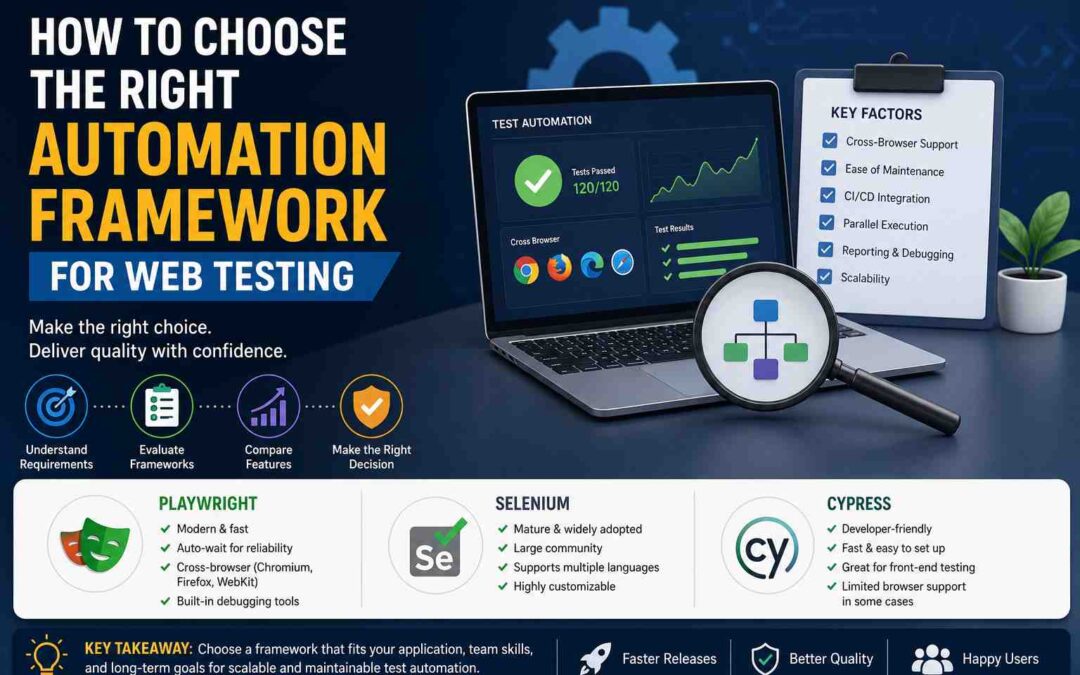
From Selenium and Cypress to Playwright testing and other modern solutions, each framework offers unique strengths and capabilities. The right choice depends on your application requirements, team expertise, scalability needs, and testing objectives.
This guide explores the key factors organizations should consider when choosing an automation framework for web testing.
Why Choosing the Right Automation Framework Matters
An automation framework serves as the foundation of your testing strategy. The framework you select influences:
- Test execution speed
- Maintenance efforts
- Test reliability
- CI/CD integration
- Cross-browser compatibility
- Long-term scalability
Choosing the wrong framework can result in increased maintenance costs, slower releases, and reduced confidence in test results.
A well-suited framework, on the other hand, enables teams to deliver high-quality applications more efficiently.
Understanding Your Testing Requirements
Before evaluating automation tools, organizations should first identify their testing goals.
Key questions include:
- What type of application are you testing?
- Which browsers need support?
- How frequently are releases deployed?
- What level of automation maturity does the team have?
- Are mobile, desktop, or web applications involved?
Answers to these questions help narrow the list of suitable frameworks.
Consider the Types of Software Testing You Need
One of the most important factors in framework selection is understanding the types of software testing your team performs.
1. Unit Testing
Unit testing validates individual functions, methods, or components in isolation. While automation frameworks for web testing typically focus on UI validation, they should integrate smoothly with existing unit testing processes.
2. Integration Testing
Integration testing verifies interactions between multiple modules, APIs, and services.
A strong automation framework should support API validation alongside UI testing workflows.
3. Functional Testing
Functional testing ensures that application features behave according to business requirements.
Most web automation frameworks excel in this area.
4. Regression Testing
Regression testing verifies that new changes do not negatively impact existing functionality.
Automation frameworks play a critical role in executing large regression suites efficiently.
5. End-to-End Testing
End-to-end testing validates complete user journeys across the application.
Frameworks that provide stable browser automation and realistic user interaction capabilities are particularly valuable for these scenarios.
Understanding the types of software testing required helps determine which framework best aligns with your testing strategy.
Key Features to Evaluate
1. Cross-Browser Support
Users access applications through different browsers, making compatibility testing essential.
An ideal framework should support:
- Google Chrome
- Firefox
- Safari
- Microsoft Edge
Comprehensive browser coverage improves confidence in release quality.
2. Ease of Maintenance
Automation frameworks should reduce—not increase—maintenance effort.
Look for solutions that offer:
- Stable locators
- Reusable components
- Clear reporting
- Scalable architecture
Frameworks with lower maintenance requirements deliver better long-term value.
3. CI/CD Integration
Modern development teams rely heavily on continuous integration and continuous deployment.
Your automation framework should integrate seamlessly with:
- Jenkins
- GitHub Actions
- GitLab CI/CD
- Azure DevOps
Efficient pipeline integration accelerates feedback and release cycles.
4. Parallel Execution
As test suites grow, execution speed becomes increasingly important.
Parallel testing capabilities allow teams to run multiple tests simultaneously, significantly reducing execution time.
5. Reporting and Debugging
Detailed reports help teams quickly identify failures and resolve issues.
Look for frameworks that provide:
- Screenshots
- Video recordings
- Execution logs
- Traceability information
Strong debugging capabilities improve overall testing efficiency.
Why Playwright Testing Is Gaining Popularity
In recent years, Playwright testing has emerged as one of the most popular automation solutions for modern web applications.
Developed specifically for modern browser automation, Playwright offers several advantages:
1. Fast Execution
Playwright supports parallel execution and efficient browser management, enabling faster test runs.
2. Auto-Wait Functionality
Traditional automation scripts often require explicit waits.
Playwright automatically waits for elements to become available, reducing flaky tests and improving reliability.
3. Cross-Browser Testing
Playwright supports:
- Chromium
- Firefox
- WebKit
This allows teams to validate application behavior across multiple browser engines using a single framework.
4. Modern Architecture
Unlike older frameworks that evolved over time, Playwright was designed for modern web technologies from the beginning.
This makes it particularly effective for testing dynamic, JavaScript-heavy applications.
5. Built-In Developer-Friendly Features
Playwright includes:
- Network interception
- Trace viewer
- Screenshot capture
- Video recording
- API testing support
These capabilities simplify test creation, maintenance, and debugging.
Comparing Popular Automation Frameworks
Selenium
Best for:
- Large enterprise environments
- Extensive browser support
- Highly customizable frameworks
Strengths:
- Mature ecosystem
- Large community
- Flexible architecture
Challenges:
- Higher maintenance effort
- Additional setup requirements
Playwright
Best for:
- Modern web applications
- Fast-moving Agile teams
- End-to-end automation
Strengths:
- Speed
- Reliability
- Auto-waiting
- Powerful debugging tools
Challenges:
- Smaller ecosystem compared to Selenium
Cypress
Best for:
- Front-end testing
- Developer-focused workflows
Strengths:
- Simple setup
- Fast execution
Challenges:
- Browser support limitations in certain scenarios
The ideal framework depends on your team’s goals, application architecture, and testing requirements.
Questions to Ask Before Making a Decision
Before adopting an automation framework, consider:
- Does it support the types of software testing we perform?
- Can it scale with our application growth?
- Does it integrate with our CI/CD pipeline?
- Is it easy for the team to learn and maintain?
- Does it support our target browsers and environments?
- Will it reduce long-term maintenance costs?
These questions help ensure a successful implementation.
Best Practices for Framework Selection
To maximize success:
- Start with a proof of concept.
- Evaluate real-world application scenarios.
- Measure execution speed and stability.
- Assess reporting capabilities.
- Consider long-term maintenance requirements.
- Gather feedback from developers and QA engineers.
Selecting a framework should be viewed as a strategic investment rather than a short-term technical decision.
Conclusion
Choosing the right automation framework is one of the most important decisions for any QA organization. The framework you select directly impacts test reliability, maintenance effort, execution speed, and overall software quality.
By understanding your application requirements, evaluating the types of software testing your organization performs, and carefully assessing framework capabilities, teams can make informed decisions that support long-term success.
For organizations building modern web applications, Playwright testing has emerged as a powerful option thanks to its speed, reliability, cross-browser support, and developer-friendly features. However, the best framework is ultimately the one that aligns with your team’s goals, workflows, and scalability requirements.
A thoughtful framework selection process lays the foundation for efficient automation, faster releases, and consistently high-quality user experiences.
