
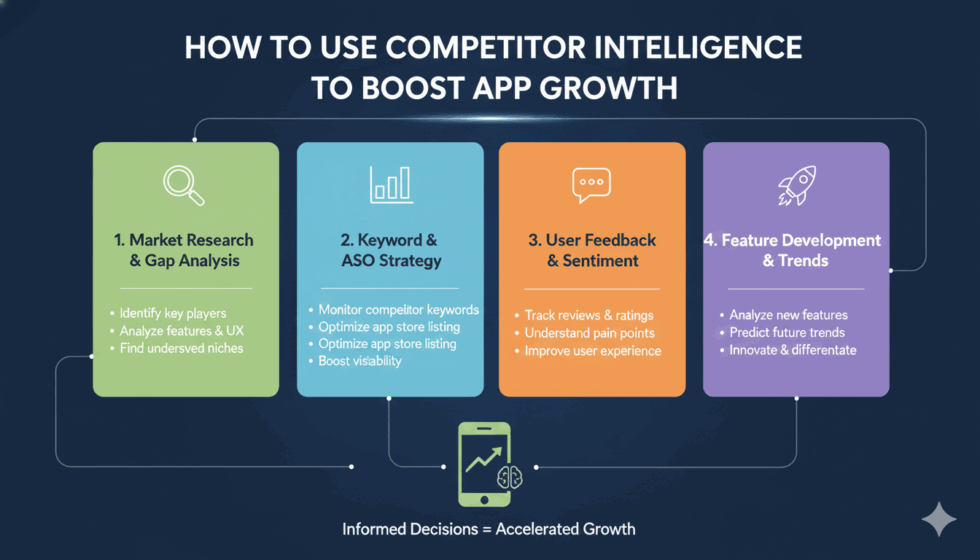
It does not come naturally that an app will grow. Behind all of the success with the breakouts, there are investigative tactics for finding out the market, studying its competitors, and leveraging an opportunity when others fail. The competitor intelligence turns this strategic approach into a practice that can provide growth teams with the insights that they need so as to be faster and smarter in comparison to their competition.
The Growth Intelligence Framework
Growth of apps begins with being able to understand where you are in the market environment. Performance tracking in mobile apps can show not only your own measurements but also the comparisons of the measurements with the category leaders and even the direct competitors. This relative situation transforms raw figures into operational intelligence.
Competitive intelligence growth teams have a huge advantage to work with. When others take the necessary risks in an unthoughtful way, these teams use data-driven insights to determine what strategies have worked before, what strategies are costly to try, and which opportunities might arise before competition ensues.
This difference is reflected in the performance: Apps that run based on competitor intelligence fetishes frequently affect a user acquisition at a 40%-60% reduced cost, compared to blindly flying applications.
Determine High-Impact Growth Opportunities
The unspoiled success with the highest speed is usually the opportunities that have been neglected or underused by competitors. App competitor analysis tools make these gaps visible through systematic market research and competitive positioning analysis. So unlike engaging in direct combat in congested areas with the established players, smart teams seek solutions in the most immediate areas with the least resistance.
Begin with a review of the rankings of category-based positions in various app stores and various geographical locations. A free app analytics tool can reveal geographic performance metrics that expose markets where competition remains thin despite strong demand. Maybe your competitor is strong in the US but weak in the Southeast Asian market, or competent in iOS but does not pay attention to Android users.
Successful Growth Tactics Reverse Engineering
The most successful apps provide hints on all sides regarding the reasons behind their success. Monitoring of competitor apps allows teams to unravel such strategies and implement their effective strategies in their setting. It is not a matter of copying but of learning how to do what has worked and using those values to work smarter.
Which search words are the drivers of organic installs among the competitors? This can be found with the ranking analysis of keywords. Whenever you find one of your rivals highly rated in particular queries, you have found proven demand. The competitor-based keyword optimization strategy in app store optimization saves months that would have been used in the traditional trial-and-error approach to identifying effective keywords.
Monitoring downloads data indicates when competitors are having peaks of growth. Compare such events with competitor updates, marketing campaigns, or exogenous aspects to know how they were caused. Was the spike precipitated by the feature launch? A partnership announcement? A viral moment? These lessons shaped your own development agenda.
Optimize User Acquisition Channels
Sustainable growth and saving cash burners are differentiated by efficient user acquisition. Competitive intelligence also offers the basis and understanding that all acquisition channels can be optimized at the beginning. Competitors’ user acquisition cost data sets up real expectations and assists in channel investment prioritization.
The analysis of competitor advertisement spending shows the location of effective apps spending marketing budgets. When competitors spend a lot on search advertising but little on social media, then such a trend is an indicator of channel efficiency in your category. Creative asset analysis is more in-depth and reveals what type of ad format, angle of message, and visual strategies will result in the most response.
The organic versus paid growth balance is fluctuating drastically by category. Competitor benchmarking demonstrates whether the leaders in your field are developing, based on the exposure of their apps to the app stores and organic download tracking, or depending on the paid campaign adoption index. This wisdom will determine whether you focus on ASO or use paid acquisition—a strategic move that will reflect on the overall growth path.
Boost Retention with Competitive Insights
Without retention, there is nothing like acquisition. Useful competitor intelligence, most of the time, will be associated with retaining the users in the long term. The metrics of retention rate and user engagement of the successful apps determine the goals you should reach and the trends that would promote long-term engagement.
Competitor-based behavioral analytics allows seeing how the leadership apps are organized in user onboarding. Just what is the look of the first session? What characteristics do they present at the very beginning and later? What is their way of making users appreciate fast? Competitor-based user journey mapping assists in developing a design of onboarding design that transforms trials into attentive users.
The rate of feature adoption within the competitor apps will show which ones are really appreciated and which ones, though appearing great on paper, are rarely used. This intelligence avoids the temptation of adding features that will only continue to bloat your app but fail to enhance retention. Invest in areas of focus that are high-adoption features that competitors have confirmed by real user behavior.
Monetization Strategy Refinement
To grow revenue, there is a need to monetize based on the expectations and market guidelines of the user. The competitor analysis will provide the cost analysis of what will be paid by users in your category, and which models will be brought to the table to provide the planned revenue.
Competitive tracking of in-app purchases and subscription sliders reveals pricing levels, the rate of free-to-paid conversion, and the dollar-per-user prototypes. A free app analytics tool showing competitor monetization patterns helps teams price confidently rather than guessing.
The trend of monetization over time is also provided by the revenue estimation tools. Is this the case of successful competitors actually shifting away from ads to subscriptions? New higher premium levels? Adjusting pricing? These movements are indicators of the market evolution and can bring you in touch with the changes in user preferences.
Develop a Continuous Intelligence System
Competitor analysis is a snap-on that is obtained in time, but sustained expansion demands sustained intelligence. The market is dynamic, and it is changing all the time. Newer competitors are rising, user preferences are changing, and growth strategies are growing. Monitoring of competitor activity in real-time gives competitors analytics reporting, and teams remain active.
Effective intelligence systems track multiple dimensions simultaneously:
- Performance measurements: the number of daily active users, the number of monthly active users, and the length of the sessions of the major rivals.
- Product: Product evolution, competitor feature roadmap analysis, and feature update analysis.
- Market positioning: Competitor messaging changes, profiling of the target audience, and differentiation.
- Growth strategies: Competitor advertisement spending changes, keyword strategies, and partnership announcements.
- User feeling: Renowned trends, user usage feeling, and customer intercourse cycles that convey an indication of a content change.
Automated monitoring will remove the manual effort of monitoring these pieces of data. Establish notifications of any major changes in a competitor—extensive updates, ranking, price changes, etc.—so that your team can counteract in the market immediately.
Conclusion: Grow Your Business with Appark.ai
Competitor intelligence needs to be turned into fast growth, which will only be possible on the appropriate platform. Appark.ai provides full mobile app intelligence that would be useful to growth teams who do not want to work in the dark.
The site allows teams to explore the top charts in the free, paid, and grossing categories of apps to discover new opportunities to enter the market by analyzing apps through advanced search capacities by category and region, viewing multiple apps together to identify performance gap opportunities and benefits, and establishing monitoring means to automatically track competitor actions.
Appark.ai offers the intelligence infrastructure of data-driven growth, whether in companies wishing to acquire users faster than competitors, growth teams managing conversion funnels, or market researchers establishing the competitive terrain. Get over it and start developing growth strategies based on viable competitive know-how.
