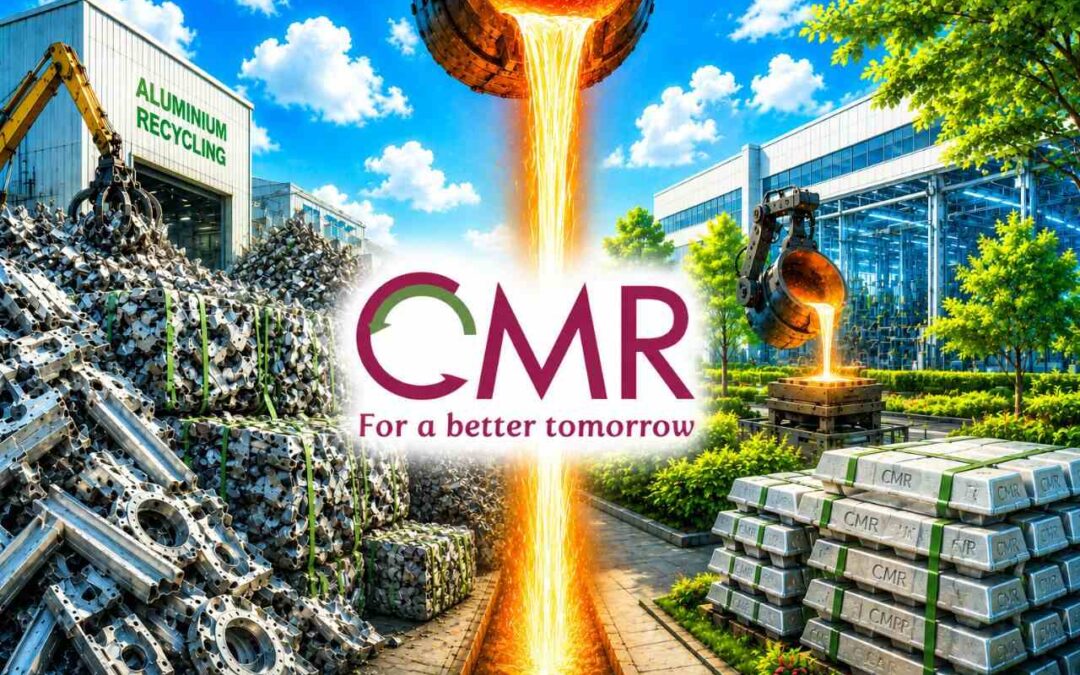
Synopsis: CMR Green Technologies made a strong market debut and also attracted buying from Goldman Sachs. But behind the listing excitement lies a deeper business story linked to aluminium recycling, electric vehicles, molten aluminium, customer concentration, commodity risks and India’s shift towards circular manufacturing.
The metal recycling industry is no longer just about scrap yards and informal trading. As companies, governments and manufacturers look for cleaner materials, recycled metals are becoming an important part of the manufacturing supply chain. Aluminium is especially important because it is lightweight, recyclable and widely used in automobiles, electric vehicles, construction, packaging and industrial products.

This is where CMR Green Technologies has entered the public markets. The company listed at a premium of around 43 percent over its issue price of Rs. 192, after its Rs. 630.88 crore IPO was subscribed 127.07 times overall. The demand was led by institutional investors, with the QIB portion subscribed 270.46 times, while the NII and retail portions were subscribed 172.35 times and 27.08 times, respectively.
The listing also saw institutional interest from Goldman Sachs India Equity Portfolio, which bought 19.41 lakh shares at an average price of Rs. 256.64 per share through a bulk deal. The transaction was valued at around Rs. 49.82 crore. This has raised a natural question for investors: what exactly has Goldman Sachs seen in this newly listed recycling company?

What Does CMR Green Technologies Do?
CMR Green Technologies is a metal recycling company with a major focus on aluminium recycling. In simple terms, the company sources scrap metal, processes it, melts it, refines it and converts it into reusable metal products. Its products include liquid aluminium alloys, aluminium alloy ingots, zinc alloys, dross and segregated furnace-ready scrap of metals such as stainless steel, copper, brass, zinc, lead and magnesium.
The company mainly serves customers in the automotive industry, including OEMs and Tier-1 suppliers. This is important because automobiles use aluminium in engine components, structural parts, wheels, transmission parts and, increasingly, electric vehicle components. As vehicles become lighter and more fuel efficient, aluminium usage rises.

CMR Green is not a consumer-facing brand. It does not make cars, EVs or batteries. Instead, it sits deeper in the manufacturing chain by supplying recycled aluminium and other recycled metals to companies that manufacture components and vehicles. This makes the business less glamorous, but strategically important.
The Biggest Strength: Scale And Market Leadership
The biggest strength of CMR Green is its scale. According to the company’s prospectus, it is the leading non-ferrous metal recycler in India in terms of installed capacity as of March 31, 2025. It also had the highest market share in the Indian secondary aluminium market in terms of FY25 revenue from operations among peer companies.
CMR Green also had an installed capacity of around four times that of its nearest domestic competitor in the recycled aluminium space. This is not a small advantage. In recycling, scale matters because the company needs strong sourcing, processing capability, customer approvals and consistent quality.

The company has 13 plants and aims to cover major automotive OEM clusters across India. This is important because recycled aluminium is not just about producing metal, it is also about delivering the right alloy at the right time and at the right cost to customers who operate tightly managed manufacturing lines.
In the automotive cast alloy segment, CMR Green had an estimated market share of around 42-45 percent by volume in FY25. It also had a market share of around 10-12 percent in India’s recycled aluminium industry in terms of volume sold. This gives the company a strong position in a growing industry, especially when large customers increasingly prefer organised and reliable suppliers over smaller informal recyclers.
The Hidden Moat: Molten Aluminium
One of the most interesting parts of CMR Green’s business is molten aluminium. The market may look at the company as a simple scrap recycler, but molten aluminium changes the story.
Normally, aluminium scrap is melted, cast into solid ingots, transported to customers and then melted again by the customer before use. This process consumes additional energy, time and cost. Molten aluminium removes some of these steps. Instead of supplying solid ingots, the company can supply liquid aluminium directly to the customer, which can then be used in the manufacturing process.
This is valuable because molten aluminium eliminates the need to reheat ingots to around 660 degrees Celsius. It can reduce energy use and remove costs linked to solidification, storage, remelting and handling. Industry reports also highlight that molten aluminium can support lower emissions and cleaner manufacturing.
However, this is not an easy business. Molten aluminium cannot be stored like solid ingots. It has to be transported in specialised insulated containers and is usually viable only within a 20-25 kilometer radius and a travel time of 45-60 minutes. This means suppliers need plants close to customer locations, strong operational precision and reliable delivery systems.
This creates a moat for CMR Green. The company started supplying aluminium through facilities adjacent to customer premises in September 2008 and through road transport in November 2013. In India, liquid aluminium supply is limited to a select group of players because it requires technical expertise, infrastructure and operational discipline.
For customers, this can create dependence. If a manufacturer builds part of its process around just-in-time molten aluminium supply, switching suppliers is not simple. This is where CMR Green moves from being just a commodity supplier to becoming a manufacturing partner.
Why The Future Opportunity Looks Big
The future opportunity is linked to three major trends: recycled aluminium growth, electric vehicles and circular manufacturing.
The industry report from ICRA Analytics expects India’s recycled aluminium market to reach a value of USD 9.20 billion and volume of 3,715 thousand tonnes by FY30, growing at a CAGR of 13.2 percent in value and 11.2 percent in volume during FY26-FY30. Installed recycled aluminium capacity in India is also expected to rise from 2,646 thousand tonnes in FY25 to 4,509 thousand tonnes by FY30.
Automotive is the most important demand driver. In FY25, India’s recycled aluminium market by end-user industry had 907 thousand tonnes of demand from automotive, 463 thousand tonnes from building and construction, 242 thousand tonnes from packaging and 552 thousand tonnes from other applications. By FY30, automotive demand is expected to reach 1,590 thousand tonnes.
Electric vehicles add another layer to this story. The industry report states that EVs require 50-60 percent more aluminium than internal combustion engine vehicles because of lightweight castings and battery housings. EV penetration is expected to rise to 10-15 percent in four-wheelers and 45-55 percent in two-wheelers by 2028. This can increase demand for secondary aluminium, especially automotive grade alloys.
The company is also entering newer areas. Over the last six years, CMR Green set up seven new plants, including a low-carbon green extrusion billets plant at Tirupati, a used beverage can recycling plant for Hindalco at Odisha and a liquid aluminium plant for a leading passenger vehicle manufacturer in Gujarat. Its entry into wrought alloy segments can help it access non-automotive markets such as building, construction and packaging, along with automotive extrusion opportunities linked to higher EV penetration.
Numbers, IPO And Financial Picture
CMR Green’s FY25 revenue from operations stood at Rs. 6,666 crore. Its EBITDA was Rs. 304 crore and PAT stood at Rs. 155 crore. Net debt-to-equity was 0.58 times. Compared with several recycling peers, the company is large, but the margins are not very high.
This is important for investors to understand. CMR Green is a high-volume, low-margin industrial business. It is not a software company or a consumer brand. Its profitability depends on sourcing efficiency, scrap prices, commodity cycles, energy costs, customer contracts and operating discipline.
The IPO structure is also important. The entire Rs. 630.88 crore IPO was an offer-for-sale by existing shareholders. This means the company did not receive fresh capital from the IPO for expansion or debt reduction. This does not make the business weak, but it does mean the listing was largely an exit or partial exit route for selling shareholders.
Brokerages had highlighted the company’s leadership, capacity advantage and long-term growth opportunity. Arihant Capital pointed to its large aluminium recycling capacity and 42-45 percent market share in automotive cast alloys. SBI Securities cited its installed capacity and recycled metals opportunity, while Deven Choksey Research highlighted themes such as EV adoption, aluminium usage, decarbonisation and circular economy.
Risks Investors Should Not Ignore
The biggest risk is the low-margin nature of the business. CMR Green works in a commodity-linked industry where raw material costs are very high. In FY25, cost of materials consumed, including purchases of traded goods and changes in inventory, formed around 90.69 percent of total expenses. This leaves limited room for error.
The second risk is raw material volatility. The company sources metal scrap from global suppliers and scrap prices vary across markets. It had around 198 global suppliers from 73 countries in FY25 including, USA, UK, New Zealand, Australia, Europe, Africa, South Africa, Thailand and the UAE, among others for Fiscal 2025, but that also exposes the company to global trade flows, currency movements, import dependence and geopolitical changes.
The third risk is customer concentration. In the nine months ended December 31, 2025, the top three customers contributed 20.93 percent of revenue, top five customers contributed 32.53 percent and top ten customers contributed 50.02 percent. In FY25, the top ten customers contributed 52.78 percent of revenue. This means a slowdown or loss of orders from a few large customers can affect performance.
The fourth risk is automotive dependence. While auto is the big opportunity, it is also cyclical. If vehicle production slows or OEM demand weakens, CMR Green’s growth can be affected. Also, purchase orders are usually based on monthly or quarterly pricing and customer delivery schedules, which can limit pricing power.
The fifth risk is valuation after listing gains. A strong debut and Goldman Sachs buying may attract attention, but investors still need to separate business quality from market excitement. A good company bought at an overheated price can still deliver weak returns.
Conclusion
CMR Green is a serious business in a growing industry. It has scale, market leadership, strong customer relationships, molten aluminium capability and exposure to long-term trends such as EVs, lightweighting and circular manufacturing. But it is still a low-margin, commodity-linked business with customer concentration and raw material risks.
In short, CMR Green is not a hype-driven green story. It is a real industrial recycling company benefiting from India’s shift towards recycled aluminium. Goldman Sachs’ investment adds curiosity, but the core question remains whether CMR can protect margins, manage scrap volatility and use its scale to capture the growing demand for recycled and molten aluminium. If it can, the company could become an important backbone of India’s aluminium recycling ecosystem. If it cannot, the stock may struggle once the listing excitement fades.
Disclaimer: The views and investment tips expressed by investment experts/broking houses/rating agencies on tradebrains.in are their own, and not that of the website or its management. Investing in equities poses a risk of financial losses. Investors must therefore exercise due caution while investing or trading in stocks. Trade Brains Technologies Private Limited or the author are not liable for any losses caused as a result of the decision based on this article. Please consult your investment advisor before investing.