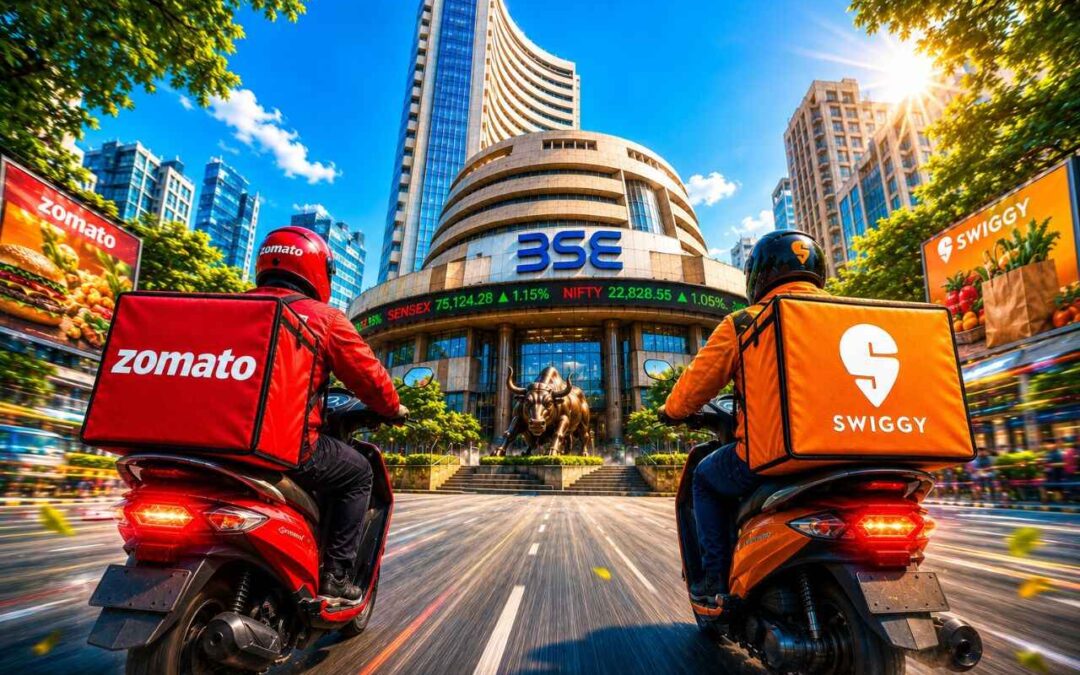
Synopsis: Eternal has profitability and Blinkit’s scale, but its valuation is extremely high. Swiggy has crashed sharply and remains loss-making, but brokerages still see big upside. Between Eternal’s premium growth story and Swiggy’s risky recovery bet, which stock really looks like the better opportunity?
India’s food delivery and quick commerce market has become one of the most closely watched spaces in the stock market. The opportunity is big because urban consumers are ordering food, groceries and daily-use items more often than before. But the business is also expensive to build because companies have to spend on delivery partners, discounts, dark stores, technology, marketing and customer retention.

This is why Eternal and Swiggy are being judged very differently by the market. Eternal is trading around Rs. 260-280 levels with a price-to-earnings ratio of nearly 728 times. Swiggy, on the other hand, is trading around Rs. 235-250 levels, far below its December 2024 high of Rs. 617, which means the stock has corrected almost 60 percent from its peak. So the simple question is this. Should investors look at the already profitable but very expensive Eternal, or the cheaper-looking but loss-making Swiggy?
What Eternal Has Got Right
Eternal’s biggest advantage is that its business is already showing profitability at the consolidated level. In Q4FY26, Eternal reported B2C NOV of Rs. 26,880 crore, adjusted revenue of Rs. 17,680 crore and adjusted EBITDA of Rs. 429 crore. Its closing cash balance stood at Rs. 17,972 crore.

This matters because Eternal is no longer only a “growth story”. It is now trying to show that growth and profit can move together. The company has two large engines. The first is food delivery under Zomato. The second is quick commerce under Blinkit. Both are now meaningful businesses, but Blinkit has become the bigger excitement for the market.
In Q4FY26, Eternal’s food delivery NOV stood at Rs. 9,757 crore, growing 19 percent year-on-year. Adjusted EBITDA from food delivery was Rs. 532 crore, with a margin of 5.5 percent of NOV. This shows that the food delivery business is already profitable and stable enough to support the larger company.

The more important part is Blinkit. Eternal’s quick commerce NOV stood at Rs. 14,386 crore in Q4FY26, growing 95 percent year-on-year. Adjusted EBITDA was Rs. 37 crore, or 0.3 percent of NOV. This is important because quick commerce is usually seen as a high-growth but cash-burning business. Blinkit is showing that a quick commerce business can grow fast and still move into positive adjusted EBITDA.
Why Eternal Still Looks Expensive
The problem with Eternal is not the business quality. The problem is the price at which the market is valuing that quality. A stock trading at around 728 times earnings needs almost everything to go right. It needs strong growth, rising margins, continued leadership and no major disappointment.
Eternal’s own guidance and analyst commentary show why the market is willing to pay such a high valuation. Management has guided for quick commerce NOV to grow at around 60 percent CAGR over the next three years, driven by assortment expansion, geographical expansion and better demand density. Motilal Oswal also noted that Eternal’s quick commerce growth story depends on assortment, coverage and densification, while management reiterated the goal of reaching USD 1 billion adjusted EBITDA by FY29.

This is a very strong long-term story. But a high valuation reduces the margin of safety. If Blinkit’s growth slows, if competition becomes aggressive again, if margins do not expand as expected, or if investors start demanding cheaper valuations, the stock can correct even if the company continues to grow. So Eternal looks like the stronger business today, but it does not look like an easy bargain. The market is already pricing in a lot of future success.
What Swiggy Is Trying To Fix
Swiggy’s case is very different. The stock has already fallen sharply, so the market has clearly lost confidence in its near-term story. But the business is not weak everywhere. In fact, Swiggy’s food delivery business continues to perform well.
In Q4FY26, Swiggy’s food delivery GOV grew 22.6 percent year-on-year to Rs. 9,005 crore. This was its highest growth in 15 quarters. Food delivery adjusted EBITDA improved to Rs. 297 crore, with adjusted EBITDA margin rising to 3.3 percent of GOV.
This is a healthy sign. Swiggy’s core food business is profitable and still growing. The company also said the growth was driven more by order and user volumes rather than only higher average order values, which makes the demand quality look better.
The problem is Instamart. Swiggy’s quick commerce GOV grew 68.8 percent year-on-year to Rs. 7,881 crore in Q4FY26, but the business is still loss-making. Contribution margin improved to negative 1.8 percent, and further improved to negative 1.1 percent in March 2026. However, adjusted EBITDA losses were still Rs. 858 crore (Reduced by Rs. 50 crore QoQ).
This is the main reason the market is worried. Swiggy has a good food delivery business, but Instamart is consuming a lot of money. Until the quick commerce business shows a clearer path to profitability, investors may continue to value Swiggy cautiously.
Why Swiggy Can Still Be Interesting
Swiggy’s opportunity comes from the fact that the bad news is already visible in the stock price. A nearly 60 percent correction from its high means the market has already punished the company for losses, competition and slower confidence in Instamart.
But the data show that Swiggy is not blindly chasing growth. The company said quick commerce remains highly competitive, but it is focusing on staying power, better unit economics and differentiation. It also said the focus on profitability caused a temporary slowdown in order volumes, but should help the business move towards faster and more profitable growth later.
This is important because Swiggy is trying to improve the quality of growth. In quick commerce, low-value orders can create headline growth but damage margins. Swiggy has been moving away from some low-AOV demand and focusing more on profitable growth. HDFC Securities also noted that Instamart’s NOV growth trailed Blinkit because Swiggy rolled back the no-fee campaign and moved away from low-AOV users, while contribution margin improved.
The key trigger for Swiggy will be contribution margin breakeven in Instamart. ICICI Securities noted that Instamart’s contribution margin improved to negative 1.8 percent of GOV and management expects breakeven by Q1FY27. If that happens, the market may start looking at Swiggy differently.
But Swiggy still has to prove that contribution breakeven can eventually become EBITDA breakeven. That is the harder part. Management has earlier said that moving from contribution loss to zero should unlock around Rs. 200 crore from the contribution line itself, but it has not given a specific EBITDA breakeven timeline.
Eternal Vs Swiggy: The Real Difference
The difference between the two stocks is simple. Eternal has already proved more. Swiggy has more to prove. Eternal has a profitable food delivery business, a much larger and faster quick commerce business, positive adjusted EBITDA in Blinkit, and strong cash. Its growth story is cleaner. It also has a stronger market narrative because Blinkit is already seen as the leader in quick commerce.
Swiggy has a profitable food delivery business too, but Instamart is still behind Blinkit in scale and profitability. Swiggy’s quick commerce growth is strong, but the gap with Blinkit is visible. Eternal’s Blinkit NOV was Rs. 14,386 crore in Q4FY26, while Swiggy’s quick commerce GOV was Rs. 7,881 crore and NOV was Rs. 5,675 crore.
This means Eternal is the better business today. But the stock is also priced like a better business. Swiggy is the weaker business today, but the stock has already corrected heavily.
Which Stock Looks Like The Better Opportunity?
The market is currently valuing the two companies very differently. Eternal is trading around Rs. 260-280, while Swiggy is trading around Rs. 235-250 after correcting nearly 60 percent from its post-listing high.
Despite Eternal’s premium valuation of around 728 times earnings, brokerages continue to remain constructive on the stock because they believe Blinkit’s leadership in quick commerce, improving profitability and the company’s long-term growth runway can support earnings growth over the coming years.
Motilal Oswal has reiterated a BUY rating with a target price of Rs. 340, while ICICI Securities has maintained a BUY rating with a target price of Rs. 360. Based on the current trading range, these targets imply an upside of roughly 21-31 percent and 29-38 percent, respectively.
Swiggy’s investment case is different. Rather than focusing on current profitability, brokerages are watching whether Instamart can continue improving its unit economics while narrowing losses. The company’s food delivery business has already become profitable, but the quick commerce business remains the key driver that could determine whether earnings improve meaningfully over the next few years.
ICICI Securities has a target price of Rs. 520, while HDFC Bank has a target price of Rs. 460. Based on Swiggy’s current trading range, these targets imply an upside of roughly 108-121 percent and 84-96 percent, respectively.
Disclaimer: The views and investment tips expressed by investment experts/broking houses/rating agencies on tradebrains.in are their own, and not that of the website or its management. Investing in equities poses a risk of financial losses. Investors must therefore exercise due caution while investing or trading in stocks. Trade Brains Technologies Private Limited or the author are not liable for any losses caused as a result of the decision based on this article. Please consult your investment advisor before investing.