Synopsis: Gravita India enters Q1 FY27 after a sharp share-price recovery, supported by capacity expansion and its move into new metals. However, margins, logistics costs, working capital and execution remain important. Can the company deliver enough growth in Q1 to keep investor confidence alive?
India’s recycling industry is moving from informal operators towards larger organised companies. Tighter rules are improving the collection and tracking of used batteries, metals, plastics and tyres. This can increase scrap availability, but growth still depends on procurement, utilisation, product mix and margins.

Gravita India is one of the listed beneficiaries of this shift. The stock is trading in the range of Rs. 1,795-1,825 with a market capitalisation of around Rs. 13,400 crore. It has recovered about 43 percent from its 52-week low of Rs. 1,267. This sharp recovery means Q1 FY27 results will be closely watched.
Why Has Gravita India Attracted Investor Attention?
The company ended FY26 with revenue of Rs. 4,265 crore, adjusted EBITDA of Rs. 452.48 crore and profit after tax of Rs. 378.80 crore. Revenue grew 10 percent, EBITDA increased 12 percent and profit rose 21 percent year-on-year. Its EBITDA margin was 10.6 percent, while the PAT margin stood at 8.88 percent. Volumes grew only 5 percent, showing that better sourcing, operational efficiency and product mix supported profit growth.

The bigger attraction is its expansion. Installed recycling capacity increased to around 4.57 lakh metric tonnes per annum by FY26-end, and management is targeting more than 8 lakh metric tonnes by FY29. Gravita is also moving beyond lead into copper, rubber and lithium-ion batteries. Vision 2030 targets include 20-25 percent volume growth, 30-35 percent profit growth and a higher contribution from non-lead businesses.
However, lead remains the core business. Motilal Oswal estimates it contributed around 88 percent of FY26 revenue and nearly 94 percent of EBITDA. Therefore, Q1 will still depend heavily on lead volumes and margins.

What Is The Base For Q1 FY27?
Gravita reported a strong Q1 FY26, creating a demanding base. Revenue increased 15 percent year-on-year to Rs. 1,040 crore. Adjusted EBITDA rose 22 percent to Rs. 111.70 crore, while profit after tax jumped 39 percent to Rs. 93.26 crore. The EBITDA margin was 10.74 percent and the PAT margin was 8.97 percent. Value-added products contributed 47 percent of revenue, while volumes grew 12 percent.
The Q4 FY26 comparison is also important. Revenue reached Rs. 1,172.76 crore, but adjusted EBITDA was Rs. 112.91 crore and the margin fell to 9.63 percent. Profit after tax was Rs. 91.88 crore with a margin of 7.83 percent. Profitability weakened because disruption in West Asia increased logistics costs and reduced sales of higher-margin value-added products.
Q1 FY27 may therefore show strong revenue growth because RMIL will be included for the full quarter. But the market may focus more on organic volumes and margins. A jump in sales mainly caused by the acquired copper business will not automatically mean that Gravita’s existing operations have accelerated.

Where Could Q1 Growth Come From?
The first driver is new lead capacity at Mundra. Gravita added 80,300 tonnes per annum in February 2026, taking the facility’s total lead capacity to 1,45,100 tonnes. Its port location should help with imported scrap and exports. Since the expansion came late in FY26, Q1 should receive a larger contribution.
The second trigger is the 45,000-tonne lead expansion at Phagi near Jaipur. Management said equipment had been installed and government approvals were expected during Q1. A delay could push utilisation into later quarters.
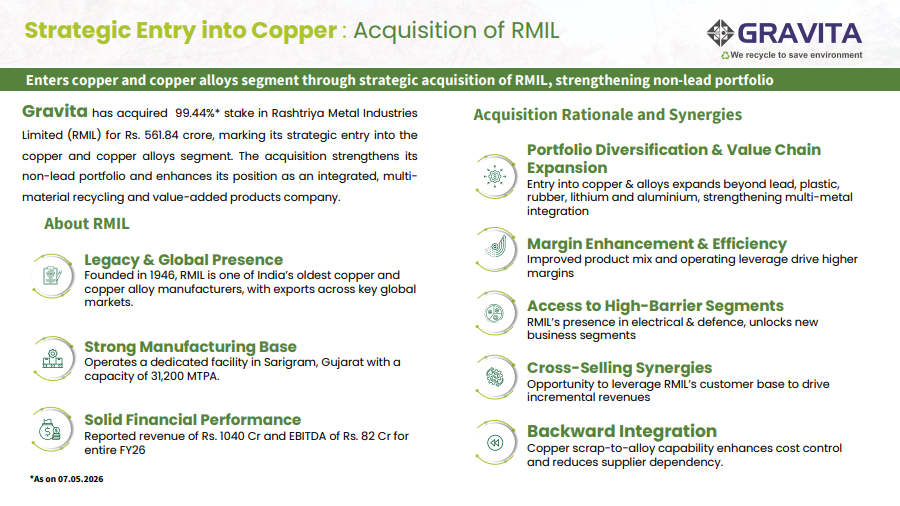
The third and biggest reported revenue driver could be Rashtriya Metal Industries Limited. Gravita acquired a 99.44 percent stake in RMIL for around Rs. 562 crore. The company manufactures value-added copper and brass products and has capacity of 31,200 metric tonnes per annum. It reported FY26 revenue of around Rs. 1,040 crore and EBITDA of Rs. 82 crore. Q1 FY27 will be the first quarter carrying its full contribution.
Source: Gravita India Q4FY26 Investor Presentation
Management expects copper volumes to grow around 40-50 percent in FY27 and wants to raise RMIL’s utilisation from roughly 50 percent to 60-65 percent. Gravita is also building a 29,400-tonne copper recycling plant for backward integration, although it should not materially support the immediate Q1 result.
Motilal Oswal expects FY27 revenue to rise 53.9 percent to Rs. 6,563 crore, adjusted EBITDA to grow 39 percent to Rs. 631 crore and PAT to increase 23 percent to Rs. 465 crore. However, it expects Gravita’s adjusted EBITDA margin to decline from 10.6 percent in FY26 to 9.6 percent in FY27, before recovering to 10.4 percent in FY28.
While RMIL currently operates at a lower percentage margin than Gravita’s consolidated business, the brokerage believes backward integration, better utilisation and a higher share of value-added copper products can improve margins over time.
Is Lithium-Ion Battery Recycling Driving Profits Yet?
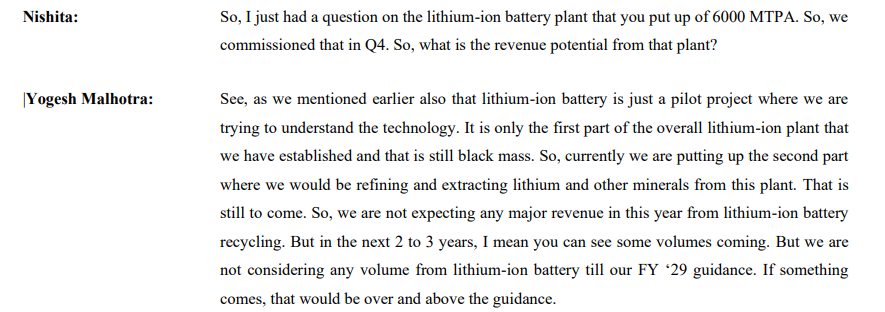
No. Gravita commissioned a 6,000-tonne pilot lithium-ion battery recycling facility at Mundra in January 2026 after investing Rs. 14 crore. This supports the future battery recycling story, but management expects no major FY27 revenue.
Source: Gravita India Q4FY26 Earnings Call Transcript
The facility currently handles the first stage of recycling and produces black mass. The second stage, which will extract lithium and other minerals, is still being developed. Management believes meaningful used lithium-ion battery availability may take another two to three years. It has not included lithium-ion volumes even in FY29 guidance, meaning any contribution would be additional.
Therefore, the battery recycling boom supporting Gravita today is mainly about lead-acid battery recycling, not a sudden rise in electric-vehicle battery profits. Stricter Battery Waste Management Rules and Extended Producer Responsibility requirements are improving traceability and bringing more domestic scrap towards organised recyclers.
The lithium-ion plant remains a long-term opportunity. It allows Gravita to test technology and build sourcing relationships before large volumes of electric-vehicle batteries reach the end of their lives. Investors should separate this opportunity from businesses currently generating cash.
What Could Weigh On The Q1 Result?
The biggest near-term risk is disruption in West Asia. Management said around 10-12 percent of sales go to the Middle East, including many higher-margin products. The disruption affected outward sales and inward raw-material movement, while logistics costs increased. Management indicated that Q1 lead EBITDA per tonne could remain near the lower end of its sustainable range of Rs. 19,000-Rs. 20,000.
The full consolidation of RMIL may also increase revenue faster than margins. Gravita’s tax rate was around 15 percent in FY26, but management expects a blended rate of 17-18 percent as more profit comes from Indian copper operations. Interest cost is expected at around Rs. 4-5 crore per quarter before the larger copper recycling project requires more working-capital debt.
Working capital needs attention. Management expects the cycle to remain around 85-90 days after copper is included because the business will depend more on imported material. Aluminium remains uncertain because Gravita still lacks an effective MCX hedging mechanism.
Can Q1 Results Keep The Rally Alive?
Gravita India’s shares have recovered well from their recent lows, but the stock is still down more than 30 percent from its all-time high of around Rs. 2,700. Even after this correction, the stock is not cheap. At Rs. 1,816, Motilal Oswal values the company at 35.3 times FY26 earnings and 28.7 times estimated FY27 earnings.
This shows that investors are still expecting strong growth over the next few years. The market is already factoring in higher production from the new plants, better performance from RMIL and growth from Gravita’s expansion into new recycling businesses. Because of this, there is not much room for disappointment.
A strong Q1 result will need to show more than just higher revenue because of RMIL. Investors will also look at whether the existing business is growing, whether lead margins remain healthy, whether the Phagi expansion starts contributing on time and whether RMIL’s utilisation improves. They will also keep an eye on logistics costs, working capital and the share of value-added products.
Gravita has several growth opportunities ahead, but many of them are already reflected in the stock price. The lithium-ion business is still at an early stage and is unlikely to contribute much to profits this year. So, for the rally to continue, the company will need to show that its expansion is leading to stronger and sustainable earnings, not just higher revenue. A bigger top line alone may not be enough for a stock that still trades at a premium valuation despite being more than 30 percent below its peak.
Disclaimer: The views and investment tips expressed by investment experts/broking houses/rating agencies on tradebrains.in are their own, and not that of the website or its management. Investing in equities poses a risk of financial losses. Investors must therefore exercise due caution while investing or trading in stocks. Trade Brains Technologies Private Limited or the author are not liable for any losses caused as a result of the decision based on this article. Please consult your investment advisor before investing.